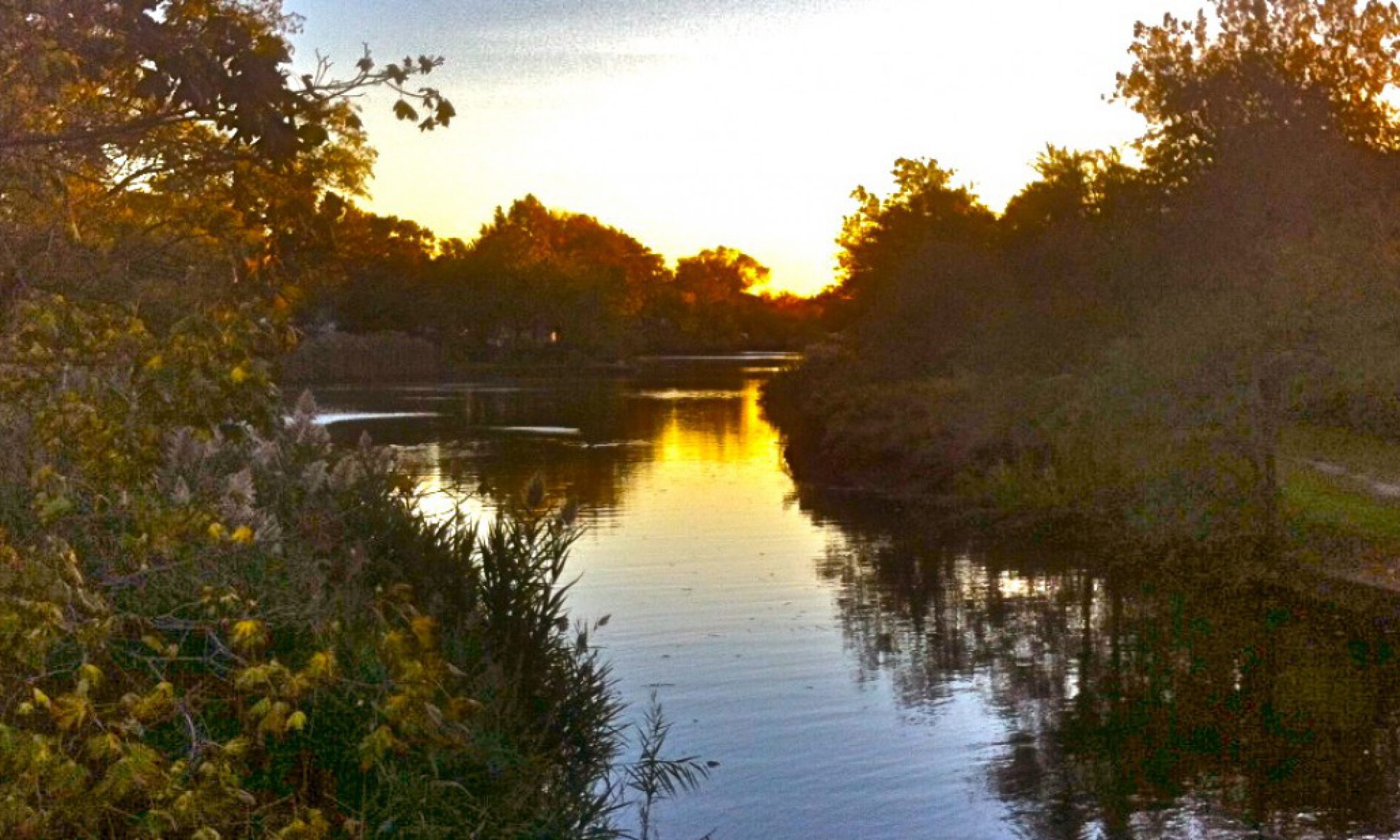
Chapter 8 of Mountain High, Valley Low or My Life as a Wishbone: Tales of Valley Stream and Copake Falls, New York: “A Good Little Hike”

The South Taconic Trail chops through miles and miles of deep woods, climbing the peaks of three mountains while rambling north and south through three towns in New York and one town in Massachusetts. Near the point at which those two states and Connecticut all stand on one foot, there’s a side trail along the Mighty South Taconic that scrambles up and down Mt. Frissell and leads to the far Mightier Appalachian Trail, which runs parallel at that point just a few miles to the east. Behind our backyard on Trisha’s Mountain is five and a half miles of unbroken wilderness to the east, stretching to the next cup of caahfee in Sheffield, Mass. This wild and pristine swath of the Earth is one of the Nature Conservancy’s designated Last Great Places, which lends to its no street cred. 

And it all smells fantastic.

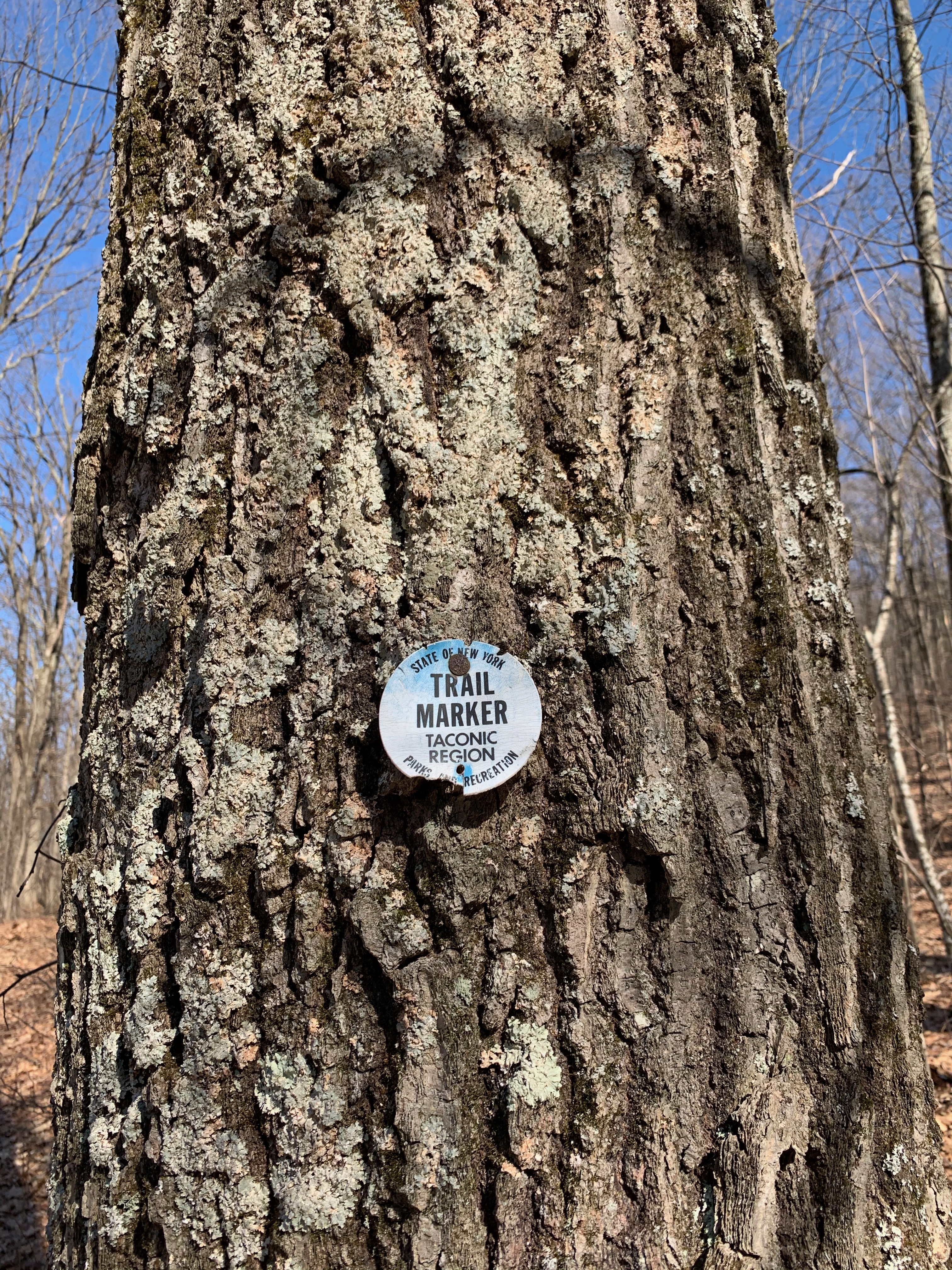
Along a ridge on Trisha’s Mountain, which is really the southern descent of Sunset Rock Mountain, is a trail that’s only about a mile long, called either the Wood Thrush Trail or the Blue Trail, depending upon whom you ask. The Wood Thrush Trail sounds more like morning in the English countryside and The Blue Trail sounds more like a Cannonball Adderly record, so for these purposes I’m going with Wood Thrush. This humble and fabulous little trail starts at Sunset Rock Road, just off the high point of North Mountain Road, then provides a fine aerobic workout up and down a few hollows before easing down at the end into the camping area of Taconic State Park.

On the official New York State Parks South Taconic Trail Map, available for $6.95 at the park office, the Wood Thrush Trail appears to be within close proximity of the point at which our lawn meets the wilderness. I was very excited at this discovery. So much so that I bought a Fiskars 29-inch machete axe on Amazon for $40 with which I planned to bushwhack my own trail through the woods and up the mountain, thus connecting to the Wood Thrush Trail, which would connect me to Sunset Rock Road, which would connect me to the Sunset Rock Trail, where I could in turn access the South Taconic Trail, along which I could travel south past Bash Bish Falls, up and over Mt. Frissell and on to the Appalachian Trail, from where I would have my choice heading north to Mt. Kahtadin in Maine or south to Springer Mountain in Georgia.

It’s a cool looking axe, as you can see. I showed it to Trisha when Amazon delivered it and she said, in her best Karl Childers from the movie “Slingblade”: “I’d like to be baptized.”  That’s why I’m in love, boys. 

But ain’t nobody gonna be walking to Georgia from our backyard. 

Not that I didn’t try. It was in February of 2020. Six weeks after we bought our house in the country and three weeks before the criminal mismanagement of a coronavirus outbreak became a worldwide pandemic that broke everything and screwed everybody. A Buddhist friend from Long Island was doing us a huge favor (kindness and generosity being two of the five pillars of Buddhism) by following Jack, Mookie, Lou the Subaru and me up Route 22 in his van carrying stuff for the house, including two new toilets, obviously the most valuable of cargo, which would later be installed by a local plumber who plays Santa Claus at the Copake Town Christmas Parade every year and plays the organ at a local church every Sunday morning. 

Details like that are what makes life worth living. 

Being familiar with the area, my Buddhist friend stopped at Brewster Pastry, located in a grand city-state shopping plaza on a shining hill just south of the official upstate line at the Red Rooster, to procure for us the most delicious danish ring I have ever experienced. Due to family obligations, which evolved in the time that took him to drive the 36 miles of Interstate 684, it turned out that instead of crashing on an air mattress on the mountain, which was the original plan, he only had a few hours before he had to turn around and go back to Long Island. 

Patience and compassion are two more pillars of Buddhism. Plus he gets credit for the fifth one, wisdom, for knowing about Brewster Pastry. 

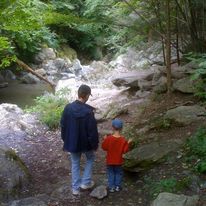
After we unloaded the toilets and other somewhat lesser valuables, and after a cup of coffee and a memorable danish, we decided to do a little reconnaissance on the Wood Thrush Trail. It was dry and cold under a powder blue winter sky, a perfect afternoon for a good little hike through the woods. 
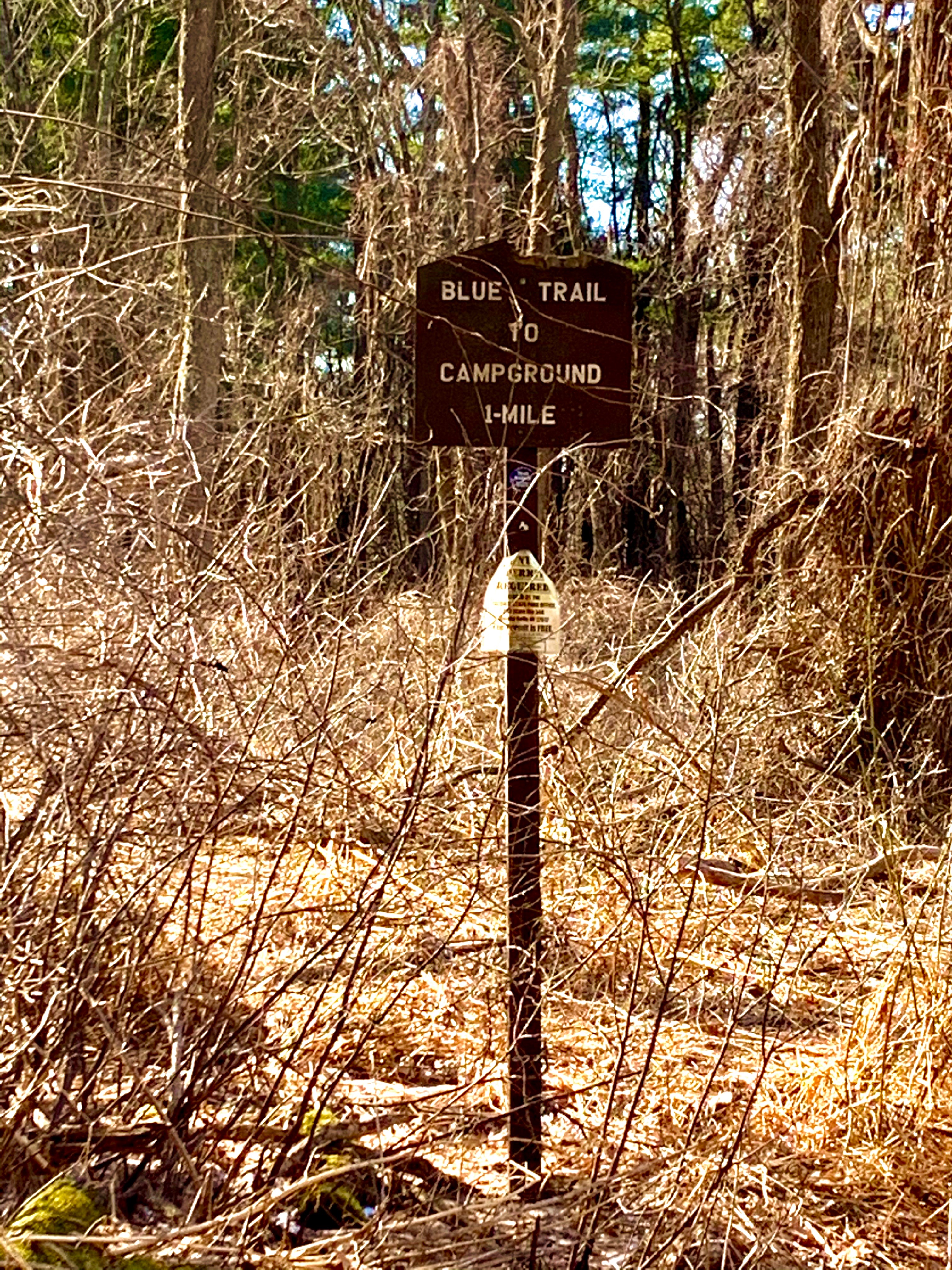
To save time, we drove the three quarters of a mile uphill to the corner of North Mountain and Sunset Rock Road, which is a narrow dirt road that twists all the way through the wilderness from Copake Falls to Mt. Washington, Mass. The parking lot for the Sunset Rock Trail, which merges with the Mighty South Taconic, is about a mile straight uphill, but there is also a sign warning that the road is not maintained from November until March and I don’t think they’re just saying that.  

Having been either cruelly deluded by the South Taconic Trail Map or too stupid to comprehend its scale, I figured that we’d eventually be able to see at least the tops of the houses along North Mountain Road, of which we’d be looking for the seventh one. It seemed promising that the trail actually started within a stone’s throw of the road. 

As trails are hiked by humans, of course, they get a little wider and a little less wild over time, until they eventually become the Cross Island Parkway. It was clear that the Wood Thrush Trail, despite its frequent blue trail markers, was not as heavily traversed as the other local trails. It also became clear that, after one big dip, we were steadily gaining elevation, to the point where we could see the sky angling through the top of the mountain to our left. This meant that the houses that were down there somewhere to our right were hidden from view because of the extreme slope, except for the chimney and the very top of the great center hall colonial colossus next door to us. It was hard to judge the distance between us and the house, and it was of course, straight downhill. I had already figured out from the $6.95 trail map that there was a 400-foot elevation gain between the yard and the trail, which didn’t seem like a lot until one looked down. 

Meanwhile, not only did my Buddhist friend have a tight schedule that winter afternoon, but I also had an appointment to have a propane tank delivered and connected to the stove sometime after 2 p.m. by the good folks at Herrington’s. It was and is my first ever propane tank, so it was obviously a special moment for me. Before we headed back to the house, we took a look at our surroundings on the Wood Thrush Trail. The plan was to take a mental snapshot of sorts of the spot on the trail that seemed to be directly in back of the yard, then walk up from the yard, back into the woods and back up to the trail, which despite the brush would be a mostly possible in February but completely impossible in April without a machete axe and a pair of loppers at the very least, and would also more than likely end in a prolonged bout of Lyme disease. 

A quick stop for more danish and coffee and we were climbing the hill behind the house and stepping into the domain of the bears and the owls. I had already ventured into the woods one other time, the day we closed on the house. According to Zillow property line maps, which are almost uniformly useless, Trisha and I own some of these woods. The rest belongs to the People of the State of New York, so technically we own that, too. I had also seen on my trail map that a small stream ran through the woods not far from the edge of the yard. Some careful stepping and a few whacks with the machete got me to this stream, which, on that day at least, was not much more than a trickle of muddy water cutting through the rocky ground, easily bridged if one were blazing a trail to Maine. 

My Buddhist friend understands that life is suffering, but the fact was he only had one pair of shoes with him and he was looking at another three-hour drive. So while I pulled myself up the hill with a big walking stick, he took his time to avoid any serious mud. 

A few pertinent facts regarding the almost 58-year-old body to which my soul is tethered:

  1. It has spent the majority of its life on the South Shore of Long Island, where there are far more escalators than hills, and no matter how much time it’s spent upstate, it has never truly gotten used to climbing. 
  2. It picked up a 24-piece case of Redpack 28 oz. Whole Tomatoes in Aisle 3 of the North Woodmere Foodtown in October of 1981 without bending its knees first, walked a mile back home looking a human jackknife, and has had a pain in its lumbar region ever since.
  3. It was sideswiped and thrown to the ground by a large golden retriever in March of 1989, in a case of tragic miscommunication, resulting in several broken ribs on its right side.
  4. It fell from a chair that flipped from under it sometime in late summer of 2013 while it was stapling bulletin board paper over a white board in Room 111 of Middle School 202, banging its left leg off a desk on the way down, resulting in a cramping pain every time it tries to accelerate or walk uphill. 
  5. It smokes. 

But in my magical thinking world, I’m just as capable of blazing a trail up a mountain through the woods as anybody. All I have to do is switch into Little Engine That Could Mode and play through the pain. 

Remind me of that when this body has 68 years on it. Maybe I’ll still have a sense of humor about it, but you may find me a grave man. (Joke credit: William Shakespeare). 

I took the four-hundred-foot incline one step and one breath at a time, stopping every so often to avoid dropping dead of a heart attack. I kept calling down to my Buddhist friend that I was pretty sure I could see the path from where I was, but this was magical thinking as well. At the point where it became impossible to move forward without grabbing hold of the nearest small tree, I got the call on my rectangle from my soon to be new friend Paul from Herrington’s, who is just about everything you’d hope for in the guy that services your furnace and makes sure you don’t blow yourself up with propane. It was time to put this adventure to rest, and I still have no idea how close I got to the Wood Thrush Trail.

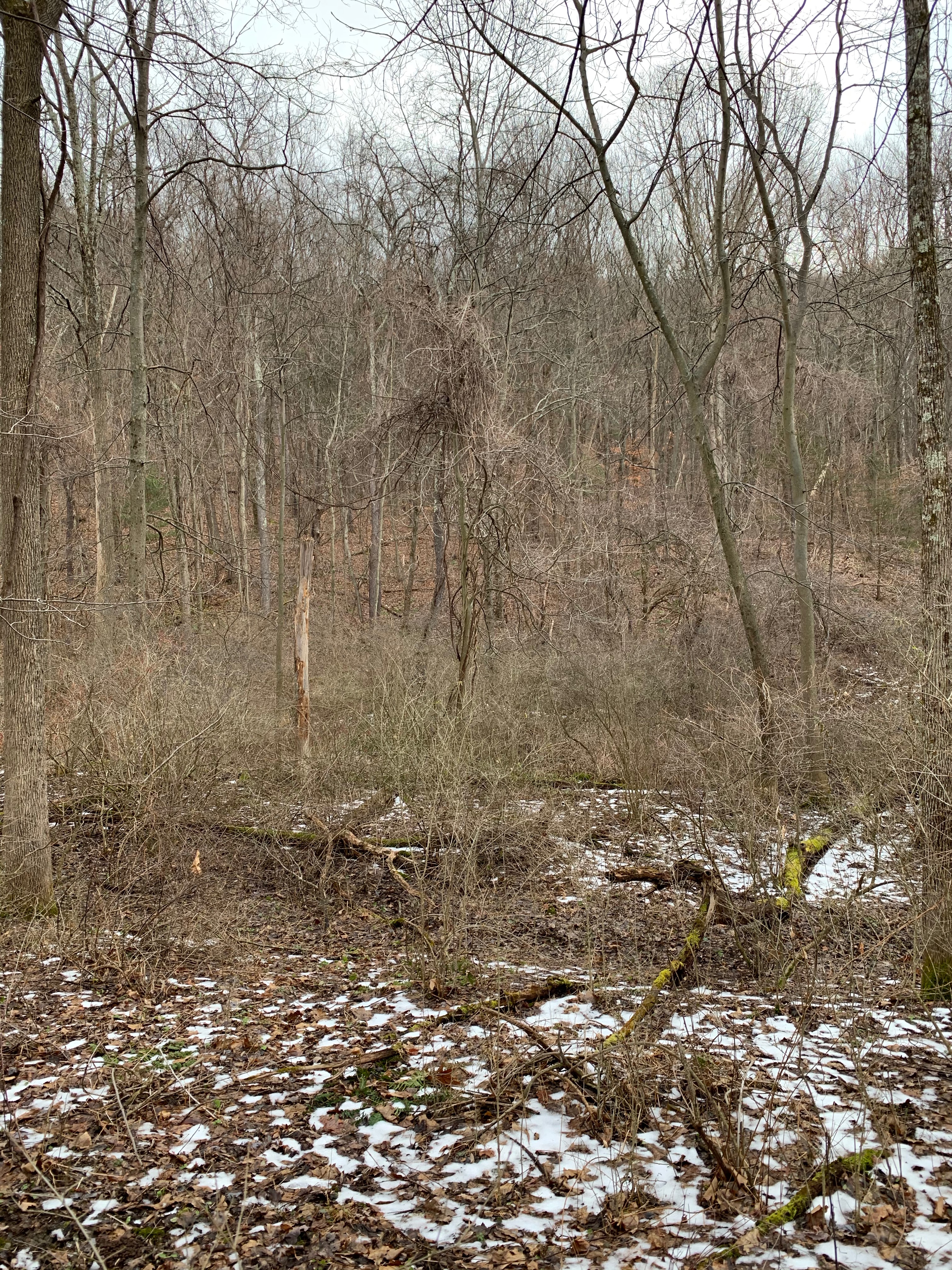
I took the Wood Thrush Trail again for a spectacularly good little hike in early May. I got past the point reached three months before with my Buddhist friend and I found a spot where a dry culvert ran straight down the mountain. Across that culvert, a mighty oak had fallen. So like the insects and fungi and other parasites that also took advantage of this tragedy, I found a great new place to sit down in the woods for a while and get some thinking done.

This accomplished, I turned around and headed back to Sunset Rock Road. While the sign marking the trailhead there clearly states “Campground 1 Mile”, and I have no idea how close I got to the campground, which I really didn’t want to get to anyway because it would mean a whole lot of uphill on the way back, it sure felt like I had walked over a mile.

One evening in August, Trisha and I were sitting in camp chairs on the front lawn, doing our Zen sunset thing, and a couple of guys came walking down the road from the direction of Sunset Rock. Figuring out that we were sitting out there just to watch the sunset, one of them asked if we do this every night. We told them every night we can. Then he told us that they were walking back to the campground after walking up the Blue Trail, believing it would be an easy mile, and that they could then walk from there up to the trail that goes to the rock, which, in the ultimate of ironies, closes at sunset. 

They didn’t make it to Sunset Rock, and they were now racing daylight to get down North Mountain and back to their campsite. But they stopped to chat from ten feet away. One of the guys said that the trail seemed a lot longer than a mile. I said that’s what I thought. 

So I checked it on Google Earth. 

It’s a mile. 

Maybe he also picked up a case of tomatoes when he was younger, or he got run over by a dog or decided to stand on a chair to staple bulletin board paper. Or maybe a mile through the woods is so full of sensory stimuli that it seems longer than it is. 

Or maybe it’s just that trail. 

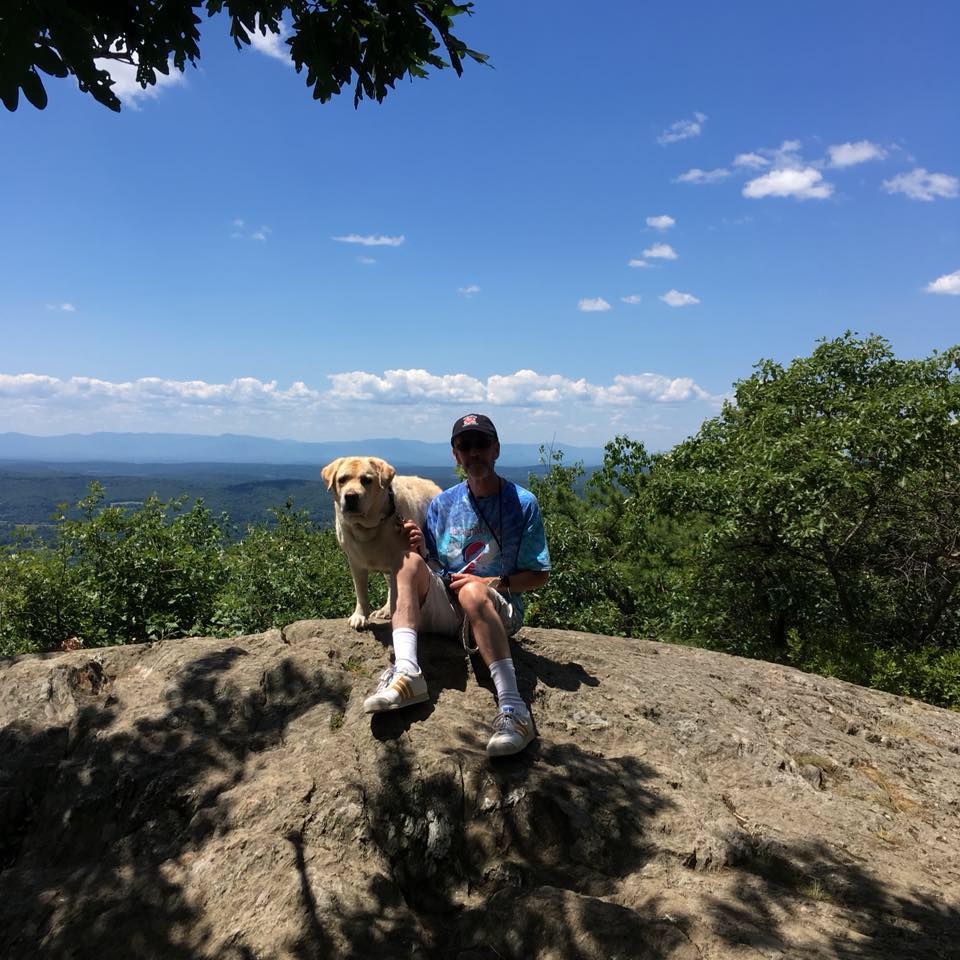
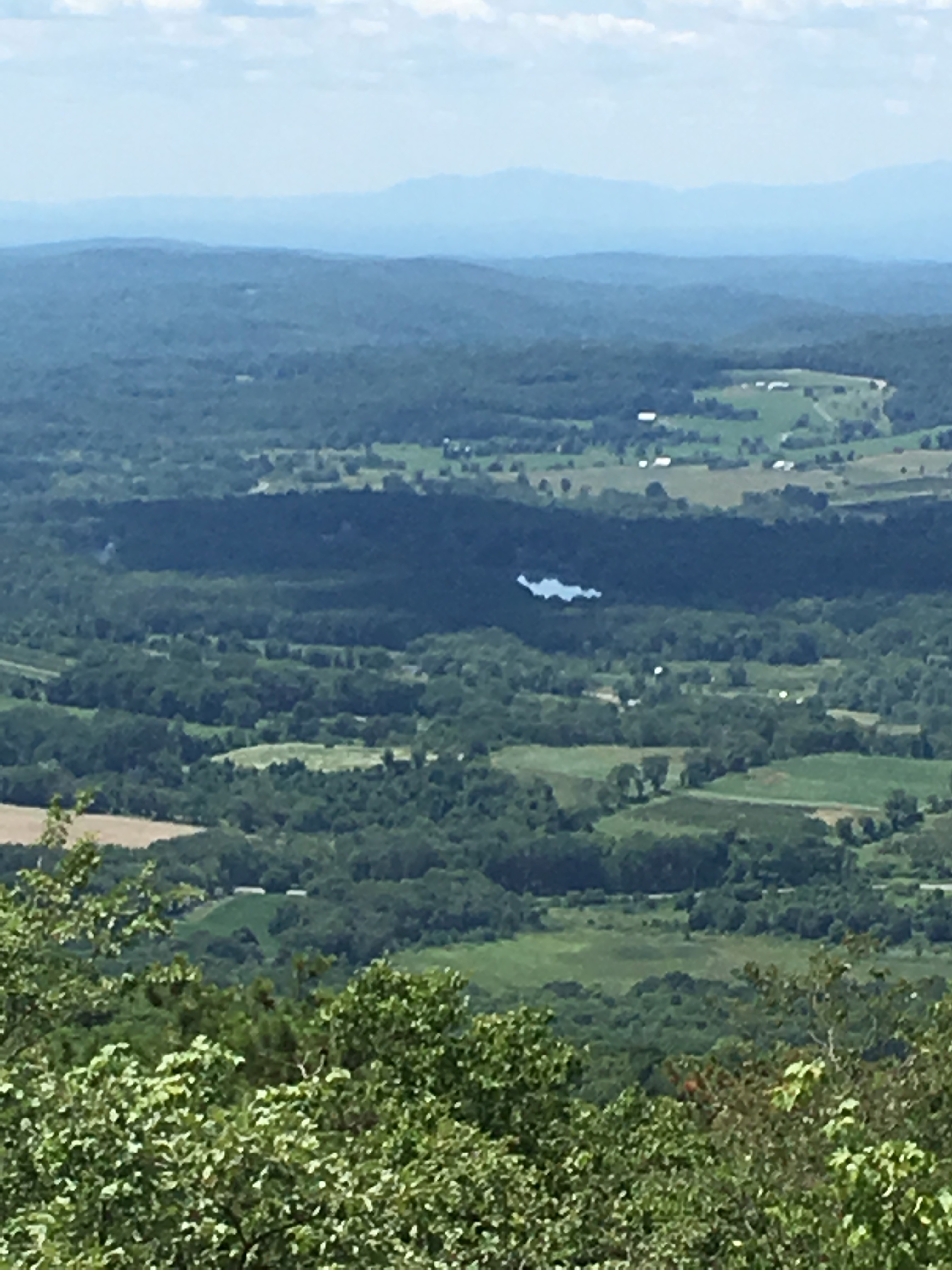
The Sunset Rock Trail, which is a little over a mile round trip, does not seem as long when you’re hiking it. It could be because it changes so drastically in such a short time, or it could be because after not much effort at all you get to sit on a rock and look down over the Peaceful Roe Jan Valley and out into the Catskills, infinity and beyond while you eat your peanut butter and jelly sandwich. 

I would have expected that a trail that leads to a rock with a million-dollar view would be a tough uphill climb, but most of the uphill is in the car on the seasonal dirt road to the parking lot. I sure enough feel the burn where my leg hit the desk on the one steep ascent, but my walking stick does most of the work. 
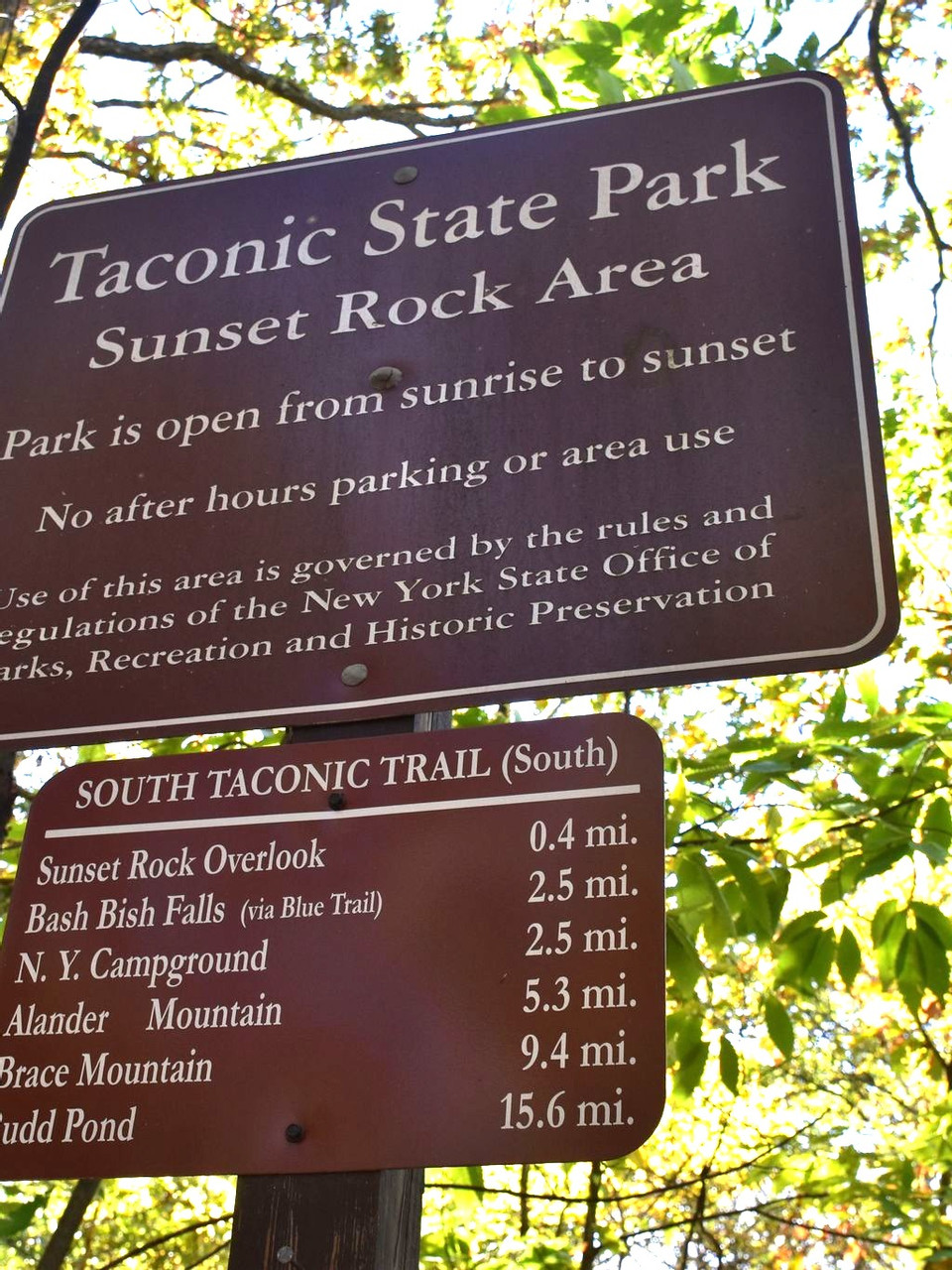
Once you level off on the Sunset Rock Trail, you’ve reached a new climate with a little dash of alpine.  Here you enter a clearing where there are smaller trees and bushes. There are big clumps of mountain laurel blooming in June and July. The air seems to improve suddenly. You’re at the turnoff where the Mighty South Taconic moves on north to its terminus at Catamount Ski Resort, and if you go that way by mistake, you’ll be back in the deep woods and you’ll miss the rock and your peanut butter and jelly sandwich. So don’t do that. Walk to the right.

If you go the right way, you pass through a wild place that looks like it was personally landscaped by God. It’s a tunnel created by high hardwoods on either side leading you through a path of ferns. One does have to be aware of mother#$%ing snakes up here, as they like to move towards the light when it starts to warm, and they like big sunny rocks as much as people do. And those particular Taconic-Berkshire mother#$%ing snakes just happen to be deadly rattlesnakes. 

I’ve never run into one, thank Jesus, but I keep them in the back of my mind, like my own impending death. But so far, I’ve evaded both. I’m told that rattlesnake encounters are relatively rare. Besides which, this one little stretch of trail seems so removed from civilization that you might just as likely run into gnomes and fairies, which, while they can enchant you, will not attack you with venomous poison. 

Still, I never let my guard down. 

The view from Sunset Rock just goes on and on and on, and under ideal conditions, it will make all your worries disappear and you will be born again. But there’s always the chance that a few of the droves have broken loose from the Bash Bish Trail and have wandered up to the rock, waiting to annoy you upon your arrival. A friend of mine who hiked the Mighty South Taconic all the way up from the campground to the rock one day ended up having to share the view with a group of people who just wouldn’t shut up, a situation he described perfectly as, “kind of a buzzkill, John Daniel.” 

Not to take anything away from the Bash Bish Trail. It is the Kingdom of the Droves and it always has been, but it’s a beautiful, beautiful place that, ultimately, people can’t ruin, although they have tried very, very hard. 

First Insider Tip on the Bash Bish Trail: Take a Monday or a Tuesday off from work. Or be prepared to share it with lots and lots of people on a Saturday or Sunday. Second Insider Tip: All Massachusetts State Parks are alcohol-free, by decree of Governor Michael Dukakis forty years ago. So if you happen to be working on a forty in a brown paper bag as you swagger along the trail, because that’s how you roll, you’re going to have to either finish it or pour it out on the state line. 

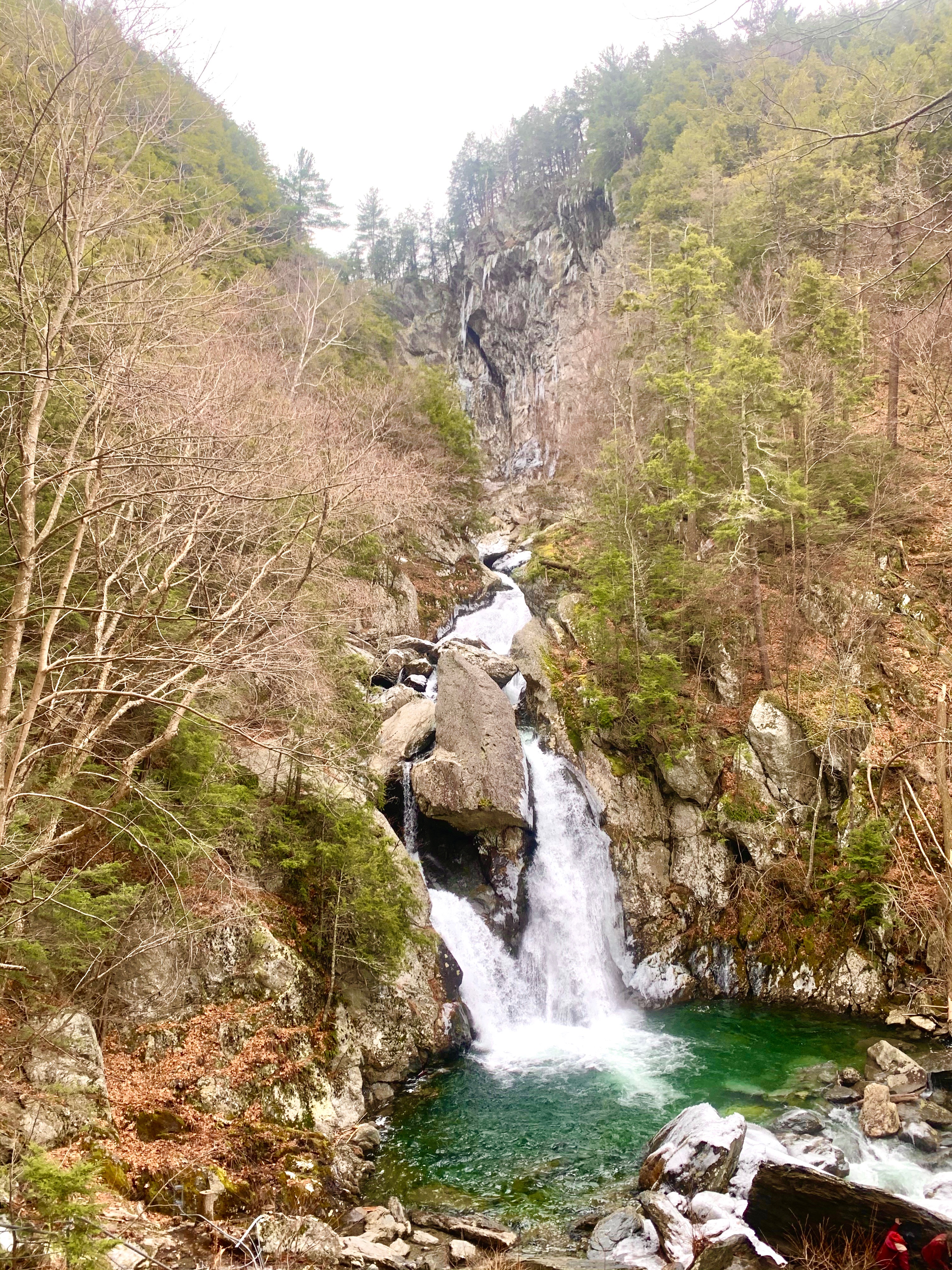
Third Insider Tip:  When you get to the falls, don’t even think about climbing up to the top and diving 200 feet down into the inviting pool of water below, because if you make it you’ll likely get arrested by the Mass Park Police, and if you’re anything like twenty-five reckless or inattentive people in the last century or the mythical Native American woman named Bash Bish with a lot of emotional baggage who didn’t make it, it will be the last thing you do.

Trisha would call this an “unchristian” thought, but it is kind of cool to live near one of the most dangerous tourist attractions in the world. More no street cred. And the thing I love about the falls most of all is, no matter where I am or what I’m doing, It’s always up there Bashin’ and Bishin’, twenty-four-seven, waiting for me to come back and stare at it. It’s Bashin’ and Bishin’ right now. People like me who have been hiking up to the falls for years feel a sense of ownership, like they’re on their way to the home of an old friend who’s always up for a visit. People who have visited once never forget it, and they usually plan to get back there someday. 

The trail from the parking lot to the falls is the epitome of a good little hike. Which is to say, that, among good little hikes, there is no better good little hike. Especially if you’re Mookie. Three-quarters of a mile through a state and a commonwealth, deep woods full of interesting scents rising to your left, the trail wide enough to ensure social distancing for people and dogs passing the other way, although Mookie doesn’t really know what those words mean. All he knows is there are people and dogs of all sizes everywhere and the freshest swimming water in two counties. It’s a festival of external stimuli. 

The instant that my nine-and-a-half-year-old labby gets out of the car at the Bash Bish parking lot, he’s a puppy again. The first stop is to check the trail kiosks for the latest pee mail. Then he knows the path slopes down gradually until the place where he goes swimming, so he takes me for a walk, and I let him lead. 

On one good little hike, when we he was around two years old, Mookie and I were playing in the Bash Bish Brook when we met some nice Massachusetts hippie girls – paisley bandana kerchiefs, nose rings and everything – who had a baby girl with them. The baby was six weeks old, but the hippie girls thought it would be cool for the baby to meet Mookie, and Mookie thinks it would be cool to meet everybody on Earth. And there I was, standing in cold water under warm summer skies, watching an animal for whom I was legally responsible and whose teeth were designed to rip through flesh and bone leaning in to sniff the face of a six-week-old baby. It was one of those moments early on when I realized I was walking around with God’s Most Perfect Dog. 

And by the way. That water? Go ahead and drink it. Fill up a bottle with it. Yeah, I know, dogs and barefoot droves. Still. It’s holy water. It cures everything. @ me. 

Everybody loves this stretch of the Bash Bish trail. On hot days, people stake out a spot on the brook and just sit there in for hours. There’s lots of big boulders in the middle of the brook to play on or take your narcissistic selfies on. Please be advised though, that if you decide to build a little balancing stone statue on one of the boulders, which seems to have been a thing for a while now, the manager of Taconic State Park, normally the most affable of gentleman, will come along at some point and angrily kick them over. God put the stones where he needed them. As much fun as stone balancing is, God know what he’s doing. Leave the damn stones alone. 
Things got out of control in the summer of 2020 during the Pandemic. Droves invaded from every direction. They parked all over Copake Falls and dragged barbecue equipment and other bad ideas into the park and down the trail to the falls. On the weekends of these Drove Invasion Days, Mookie and I went up to the Roe Jan Park that the droves don’t know about – yet- to get in our swim and our good little hikes. 

By the third week of July, there were police roadblocks at the two entrances to Copake Falls off Route 22. To go get take-out from Dad’s Diner or the Church Street Deli, I’d have to get waved on to make the left out of the hamlet, then fifteen minutes later, smile, roll down the window and say, goofily, “Hi! Just goin’ back to my house with lunch!” to armed law enforcement officers. Fact is, all my ID says I’m from Long Island, so I had to rely on their kind nature to gain entry to Route 344. 

This insanity reached its zenith when people began lining up in their cars in a staging area for hours on Saturdays and Sundays just to get the chance to get in a good little hike to Bash Bish Falls. Mookie and I stuck to the Rail Trail, the Roe Jan Park and our secret little spot under the bridge. 

You can’t blame the droves. Not all of them were unrepentant assholes from Long Island. Some of them were good, nature-respecting folks who were just trying to get out of the house. Of course, I didn’t have to clean up after the unrepentant assholes, so my sympathy comes easy. But these have been miserable times, and I’ve been using a good little hike through the woods to Bash Bish Falls for years to inject my spirit with some instant happy. Why would I, a nauseatingly lucky son of a bitch, deny that to anybody else, especially now? 

Mookie and I went back to the Bash Bish Trail on the last day of September. It was a Wednesday. To the untrained, non-park-employee eye, the area showed no signs of the human invasion it had experienced over the summer, but the friendly Mass Park Policeman on duty that day to make sure nobody jumps off the falls told me stories that would bend your bones. The air was crisp, the trees were in color, and the brook was not too cold yet. So Mookie got in his swimming, then we walked along and said hi to people in masks as we climbed the big hill past the Mass border and up into the trees, where you’re at eye level with the birds. Our old friend was waiting for us up at the end of the trail, Bashin’ and Bishin’ away, and we sat on a rock, and we stared for a while.

We were there again for the First Day Hike on New Year’s Day of 2021, when everyone was guilty of a little magical thinking, but that’s how it should be. The First Day Hike was led by the affable park manager and his beautiful Newfoundland dog Mahi Bear, whom Mookie resents because Mahi gets more attention. There were only about ten or twelve people with us on the hike, but there were lots and lots of other visitors on the trail. The weather had suddenly improved and a few hundred people had the same idea at the same time: 2020 was such catastrophe of sadness that they were damned if they weren’t going to start 2021 by heading up to Bash Bish Falls for an injection of happiness. We greeted every single one of them, and they greeted us back. A few of them told Mookie how beautiful he was, and he wagged to say he knew that, but thank you for saying it. 

Mookie and I love the Bash Bish Trail, and the Harlem Valley Rail Trail, which is great for broken down old guys from Long Island. Neither one of us needs to walk to Maine, or even the three mountains of the Mighty South Taconic Trail. But it is nice to know they’re up there. In his good dog life, he has gotten little licks of peanut butter while looking down from Sunset Rock over the Peaceful Roe Jan Valley. And if I want to go get lost in the woods for a while, my giant oak tree bench on the Wood Thrush Trail is there waiting for me. If it’s time for a little excitement and some holy water, we’re off on another good little hike to check on our old friend, always up there Bashin’ and Bishin’, and always up for a visit.  

And if it ever seems like I’m taking any of this for granted, please don’t hesitate to pick up a couple of stones from the brook and aim them at my head. 

Copyright 2021 by John Duffy

All Rights Reserved

Chapter 7 of Mountain High, Valley Low or My Life As a Wishbone: Tales of Valley Stream and Copake Falls, NY: “Christmas Zen and The Art of Mulching”

We knew we’d be going back to see The Dee’s again before Thanksgiving. We just weren’t sure if we’d be going back to see Joey or Tommy. 

We hadn’t been inside the gigantic, glass-walled store at Dee’s Nursery after the first frost since the last time we visited Santa Claus as part of our annual Christmas tree hunting and gathering tradition. The inside store is Joey’s domain, although his dad, Tom Sr., the Dee’s patriarch, still hangs out by the registers while we watch the damage we’ve done to ourselves in slow motion. Usually we won’t visit until April, when it’s time to load up Lou the Subaru with bags of tall fescue grass seed, with the topsoil and the peat moss to throw on top of it. Whether it’s Grass Seed Day, or a month later when we start loading up on annuals, veggies and compost, Trisha and I always get a hearty greeting from Joey. Long ago we maxed out on planting trees and shrubs and hybrid tea roses and perennials on our little 60 X 100 plot, so we usually don’t get out to the yard much anymore to see Joey’s older brother Tommy until the Christmas trees show up. But Tommy is always good for a hearty greeting, too. If you were Joey or Tommy, you’d be glad to see us, too. 

The Dee’s Nursery is a second-generation family business in Oceanside, Long Island, started in 1958. It was one of my mom’s favorite places to visit in the springtime. Our Christmas Tree hunting and gathering tradition when I was a kid was to go to Garden World in Franklin Square, where they had reindeer you could feed, which is horrible in retrospect, but I suppose my parents and everyone else involved meant well at the time. But Mom loved going to see The Dee’s in the springtime, and taught me to love it, too. For a local, independent business, they have a huge operation, and their selection, quality and service in all things gardening just can’t be beat. Tommy told us one year that he drives a crew up to the family’s own Christmas Tree farm in Franklin, Maine every November. He was very happy and very proud of that, as well as being proud of their annual donation of thousands of Christmas trees shipped to troops serving overseas. And we are always happy and proud to buying one of those trees from this family year after year, comin’ to us straight from Maine. 

Every business transaction should be as pleasant. 

Unfortunately, we’re in America, so while the The Dee’s are all about service, selection and quality, their prices can be beat quite easily in any season, specifically by the likes of the Home Depot, the presence of which in Rego Park, Queens convinced my late father-in-law to close down his own second-generation nursery business, McCloskey’s Florist, shortly after I joined his family. That was tough to watch. 

So we’re willing to pay The Dee’s a couple of extra bucks to support a local business and stay out of the Dante’s Inferno which is the Valley Stream Home Depot parking lot. And in addition to helping support The Dee Boys and their families, we have two other local guys:  Ray, whose dad started Alma’s Garden Center on Sunrise Highway in Lynbrook around the time I was born, and Dave, who owns Di Setta Nursery down in Woodmere. A conservative estimate of $50,000 big ones over the course of eighteen years have been split among these three businesses by two slightly touched people who consider growing flowers in the yard to be an unnegotiable necessity. 

In years when money was tight, we bought our flowers and our dirt on credit cards, which is quite stupid when considered objectively and I wouldn’t recommend it. But we had to have them. In our defense, we’ve never spent money on lavish vacations and fancy restaurants. So it goes that I may die without seeing Yosemite or the Grand Canyon, but damn you should have seen our gardens in June.  

I was away from the gardens a lot this year. More so than in any year since we began building them up from nothing in 2002. I spent about eight weeks of elapsed time in 2020 up in the Peaceful Roe Jan Valley, among the Taconic-Berkshire Mountains that nature built from nothing a couple of million years ago. There are lots of wildflowers and flowering shrubs around Trisha’s Mountain, but nothing we’ve planted, which I suppose could change in time, but as I pointed out in Chapter 5, it would take some intense negotiations with the deer and the bunnies and the groundhogs to get it off the ground. 

We never took it for granted for a second this year. It was our incredibly good fortune to have a property up in the country with lots of oxygen, especially in the midst of all the Pandemic misery this year – when just down the road there were people sitting on line in their cars for hours outside Taconic State Park waiting for a chance to just take a walk to Bash Bish Falls, and less fortunate people than those people were dying on hospital beds. We’re only a year into our second home owning adventure as I write this, so the novelty has not even come close to wearing off yet. We’re still just walking around feeling stupid lucky. Knock freaking wood.

So I wasn’t giving the gardens a lot of thought during those eight weeks when I wasn’t in them. They were being watered or rained on and the weeds would wait ‘till I got back. I suppose in my mind I was beginning to move on from them. But that’s how it happens, isn’t it. You think about something until something else comes along that requires bandwidth in your brain, and the thing you were thinking about starts getting crowded out. Sometimes when you look back, you realize that’s kind of a scary process. The more time I spent up n the country this year, getting to know our upstate home, the less I was thinking about the downstate one. Not only can you not be in two places at once, it’s hard to even think of two places at once. 

But after all these years, most of the landscaped space on Duffy’s Creek is on autopilot anyway. Most of the trial and error has been done. The losers don’t grow here anymore, and the winners come back stronger every year. 

The Big Plan is, of course, to phase out Duffy’s Creek and live full-time on Trisha’s Mountain. When that actually happens remains a question. Back in the Aughts, I noticed on a sign that Copake Town was founded in 1824, so I was thinking I could be up here full time by the time the Copake Bicentennial comes around, maybe even walk down Main Street on stilts dressed as Uncle Sam. I have big dreams. 

But that would mean only three more growing season’s on Duffy’s Creek. And that would also mean eventually selling the house, perhaps to someone who rips out all the gardens and replaces them with heavily fertilized grass, or worse, just lets them go to hell, which wouldn’t take long at all. 

Once I landed back on Long Island in mid-November of 2020, following my nineteenth trip up and down Route 22 for the year, this time to take delivery of a new industrial-grade humidifier for the basement, I decided to get off the road for a while. I’d been back and forth eight times in thirteen weeks, and the plan (in progress as I write this) was to stay on the creek for six weeks, through Thanksgiving and Christmas. Mookie in particular was exhausted from all the traveling. We needed a break. 

But unlike Mookie, I’m not good at doing nothing, no matter how hard or how often I try. I enjoy doing nothing, but after a while I have to do something. I admire people who can keep doing nothing going. I decided that not only was I going to clean up the gardens down to the last fallen leaf, but that this year, since I had the time, I was going to give them all a damn good mulching. And not only that, I was going to power wash the patio so it would already be clean in the spring. I have big dreams. 

And I love mulch. I love topsoil and compost, too: The look, the smell, the feel, everything. I suppose I could live without the weight. But still. There’s no more agreeable afternoon activity to me than getting down and dirty in the gardens. 

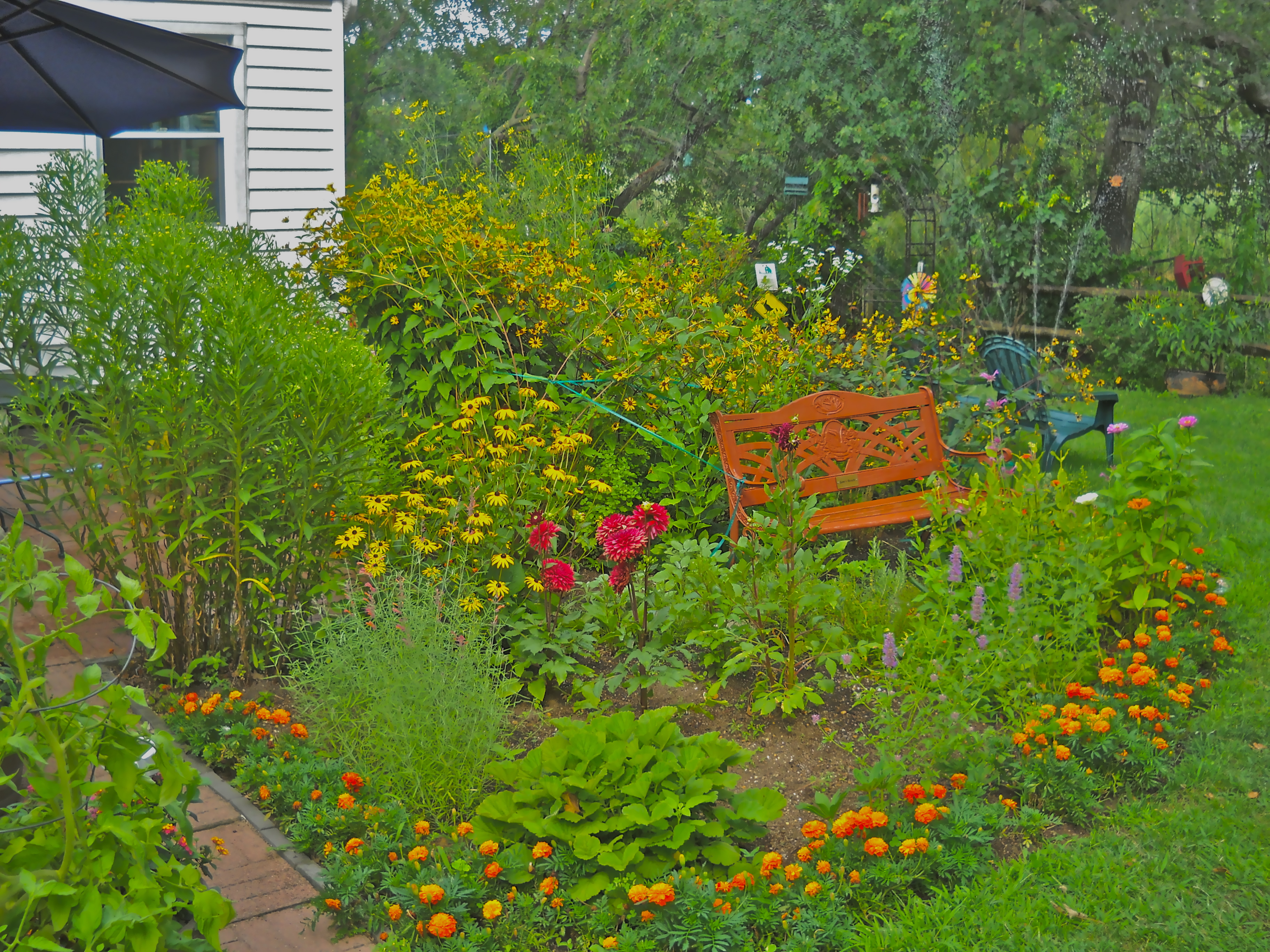
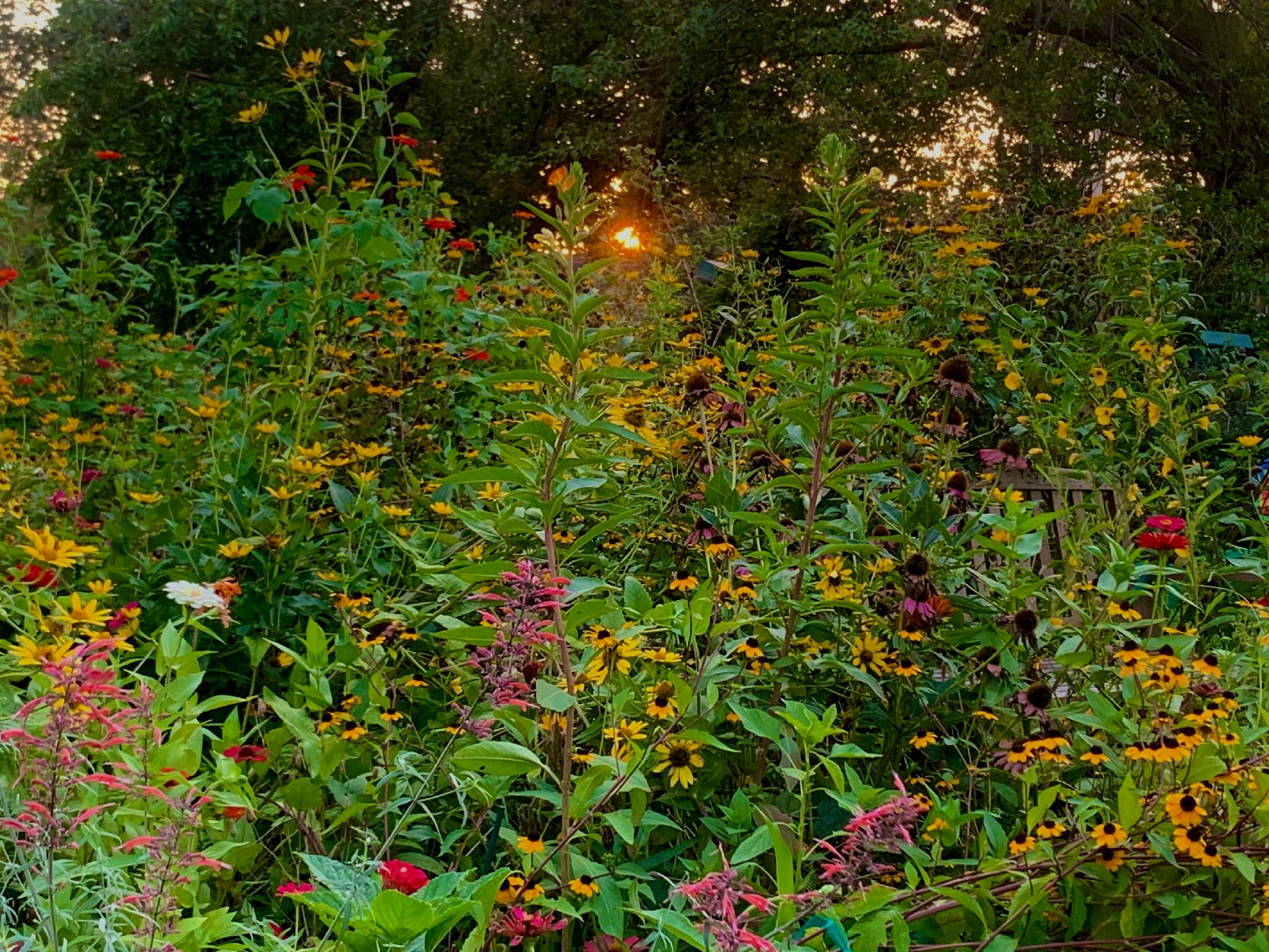
We have seven of them. They all have names. In the front are two semicircle raised beds built with river stone. One is my creation, which starts out as a well-mannered and proper bed of tulips and daffodils in the spring and devolves into an insane tangle of sunflowers and zinnias by July. I call that the Crazy Summer Garden. The opposite semicircle is Trisha’s statelier “Cottage Garden”, highlighted by a giant purple beautyberry bush, chiefly the domain of our resident mockingbird no matter how hard Lyle the Cat stares through the window at him. There’s mock orange and flowering quince around the front, coneflower and bee balm in the middle and creeping purple phlox cascading over the stones. Unlike my garden, somebody had a plan. 

On the side of the garage was the tomato and vegetable garden. This year I phased that out and threw in a couple of dahlias which I mostly neglected despite their beauty. I couldn’t keep the damn squirrels away from the tomatoes, and I didn’t want to grow lettuce and broccoli that I wasn’t home to eat or give away. But I still grew cucumbers in another little patch next to the shed this year, way more than I could use, which was good news for a neighbor on the creek who loves cucumber sandwiches. Meanwhile, my 2020 bread and butter pickles were another raging success. 

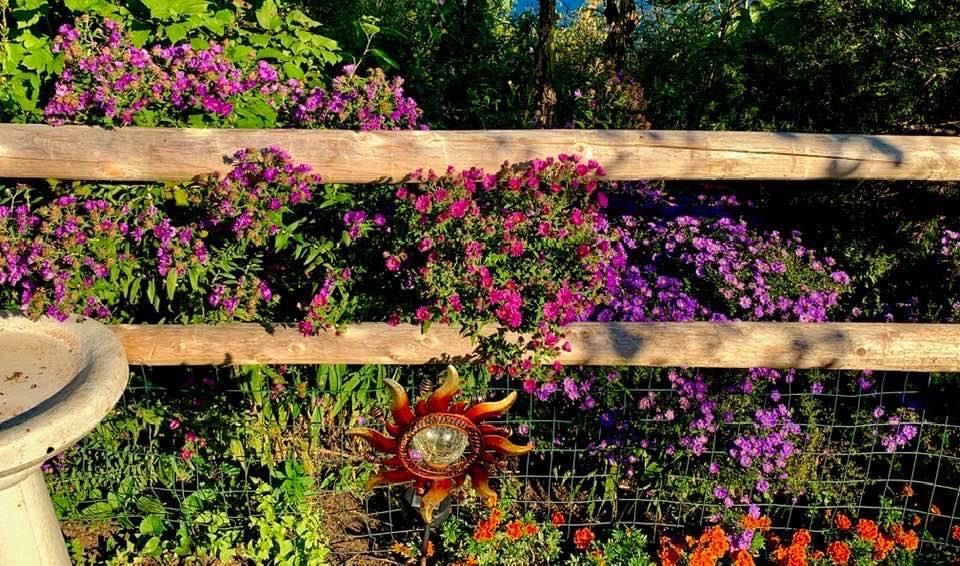
Between our backyard fence and the creek is my Wetland Garden. In one section, I’ve been naturalizing purple and pink native asters for ten years now, and let me tell you, come September, my aster is the most spectacular aster you’ve ever seen. In another section are shrubs that don’t mind drinking crappy brackish water; red twig dogwood, rosa rugosa and winterberry holly, plus a red cedar tree that my brother and I saved from being uprooted after Hurricane Sandy, which is now known as the Leaning Cedar. Most of these plants were, of course, bought from Tommy Dee, many on credit cards. The whole thing is held back from the creek with a bulkhead of logs, wire fencing and dirt that I carted in after ripping out forty years of thug brush eighteen years ago. I had the time of my life. 

Look at my aster! Look at it! It’s fabulous!

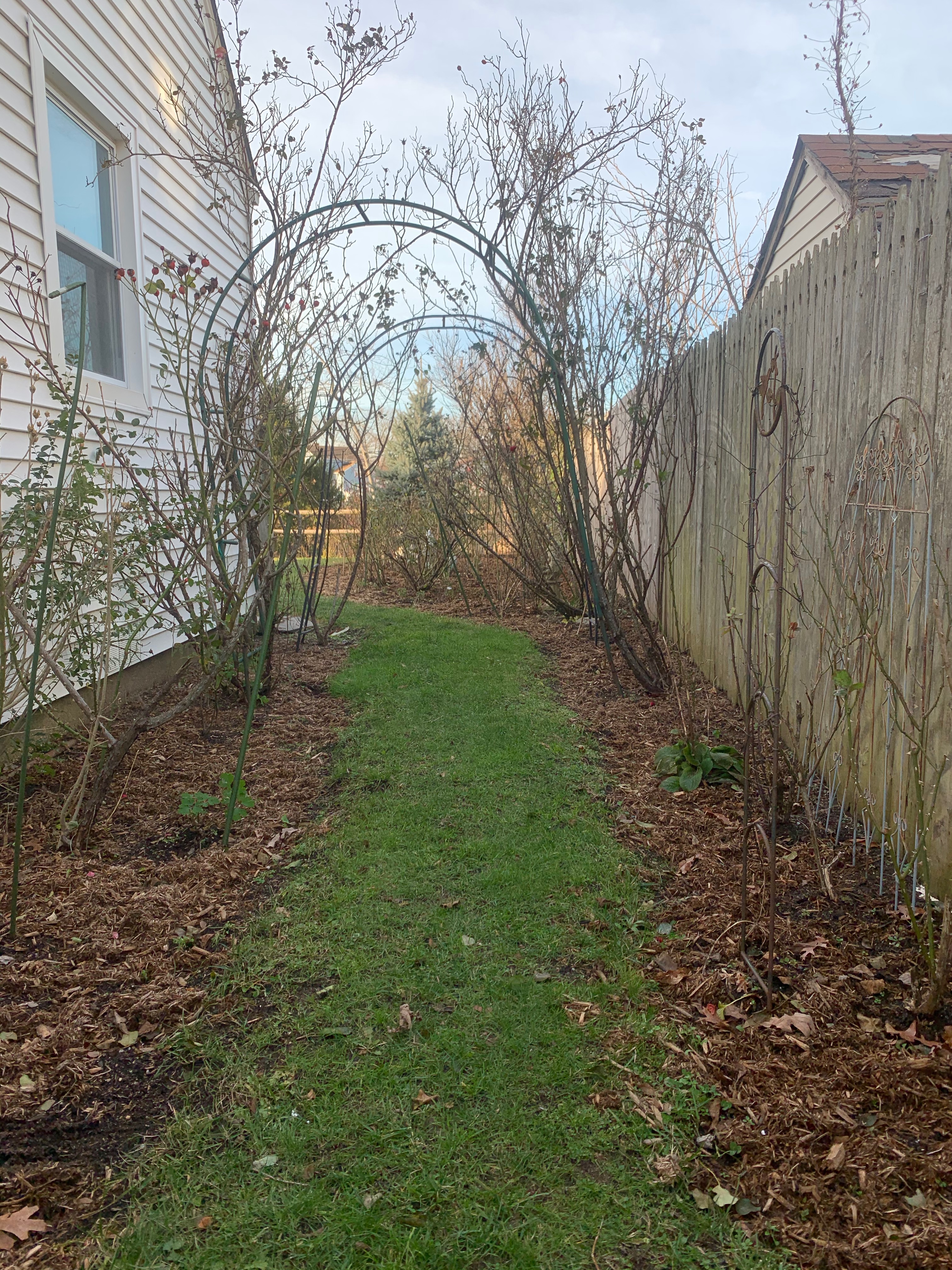
Along a wooden fence are Trisha’s hybrid tea roses. The roses also stretch into a spot between two houses that we call the Secret Garden. All the roses have cultivar names and stories which she’s told me lots of times because I asked, and she planted many of them in memory of people. Apparently, their preferred pronoun is “she”, as in, “she needs to be cut back.”  I can’t keep much of this straight, but I do try really hard. And Trisha works very hard at keeping the hybrid tea roses sprayed with the stuff that keeps them from getting eaten up by little parasites every year. You can get high off the aroma of Trisha’s rose garden in June, and often we do. But one season of neglect and they’d be nothing but angry, thorny green sticks. 

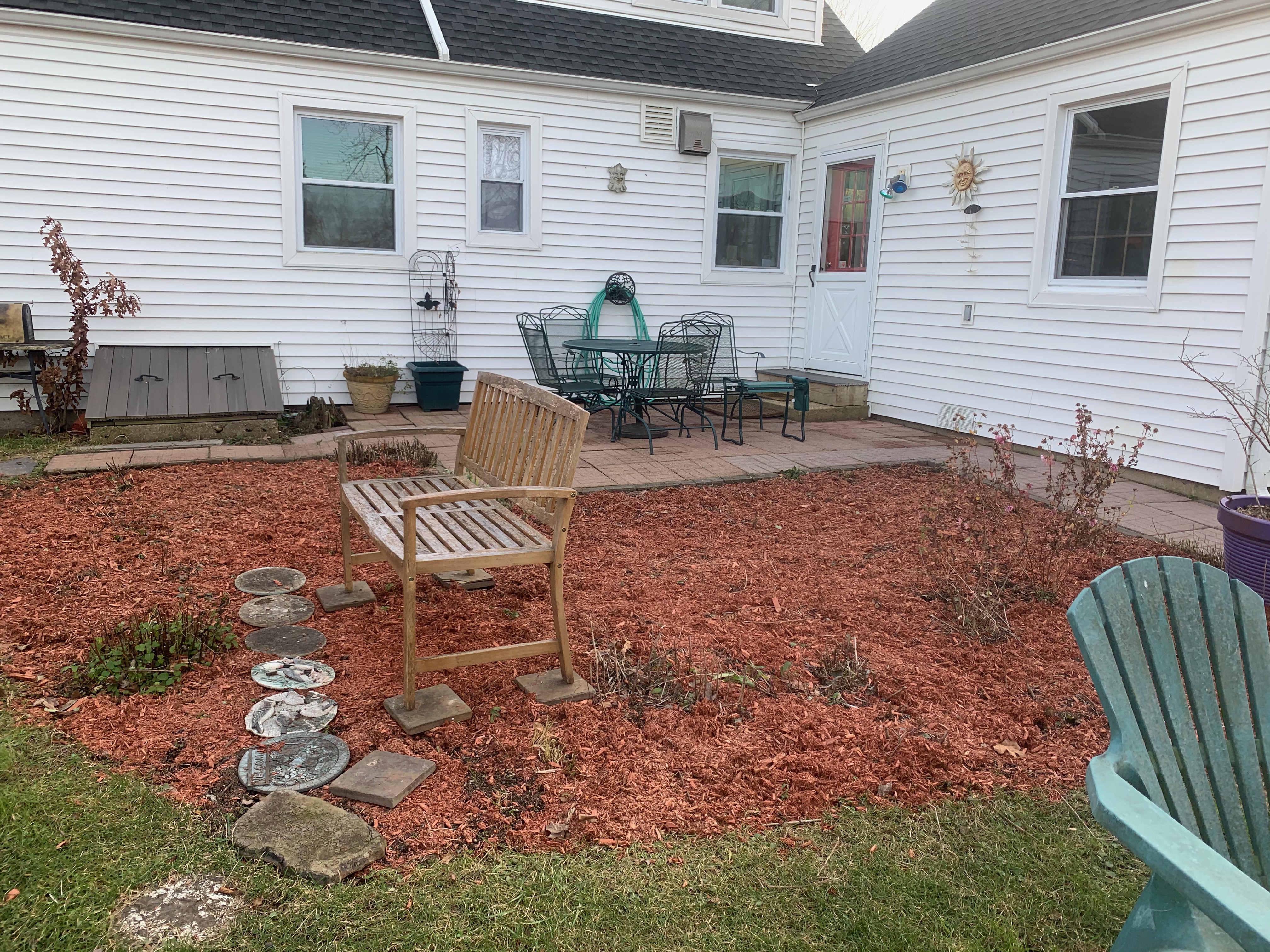
Out the back door is my Patio Garden. My parents had a deck when we bought the house. They had it built in the 1970’s, when you were required to build a deck in your suburban backyard under penalty of law. The deck had seen better days by the time we bought it, so we were already planning to rip it out and replace it with a patio when we visited the Berkshire Botanical Garden in Stockbridge, Mass. It was there that I encountered the Herb Associates, a group of volunteers that maintained an herb garden with a patio right outside a kitchen in one of the buildings on the grounds.

I have to admit, my biggest takeaway from this experience was the sheer joy of knowing that there was a group of old ladies from Stockbridge who called themselves the Herb Associates, but I also liked the idea. Eventually, the garden out the back door on Duffy’s Creek became a combination of herbs, perennials and annuals surrounding a loose-laid brick patio that looks like the mason who built it was actually an English teacher on summer vacation. 

Around the patio, I have planters where I put the same annuals every year because I know they’ll behave themselves and look great doing it: Geraniums and lantana, both in red, white mandevilla, some years white jasmine if I want to splurge, plus some basil and oregano that I didn’t get around to harvesting this year. Plus I have three highbush blueberries in planters on the patio and four more on the side of the garage, which I’ve used to make some sublime pies over the years, and which us make us very popular with robins.

Since we’ve done all the heavy planting (and transplanting), and the gardens are what they are, most of the work now is adding compost in spring and keeping everything weeded and watered. Invariably, since you only have to get dirty once, I’ll do all the weeding in one shot once every two or three weeks. I can tell which days were weeding days just by looking at my Fitbit history. Any days when I walked 25,000 steps and saw some serious cardio orange and red on my heartbeat chart, those were the days I was out playing in the dirt. 

After all these years of pulling weeds, I know every one of them personally, many by name. I can tell you, for instance, that every year I have to pull out deadly nightshade. And every year, deadly nightshade says, “Yeah, OK. Whatever, dude. I’ll be back.” Late in the season, I have to pull out white snakeroot, which can poison milk if cows eat it, and reportedly killed Abraham Lincoln’s mother. Weeding is serious business. 

The fall cleanup is actually the biggest job in the gardens now. First is deadheading all the perennials and pulling out the dried-up ghosts of hundreds of zinnias and marigolds and other annuals. Then comes raking out all the leaves and cultivating the soil, then chopping out the last of this year’s weeds. It takes hours and hours and hours. Which is great if, like me, you enjoy this sort of thing, and you happen to have hours and hours and hours. 

Any teacher who rides the rhythms of the school year knows that the fall semester is insanely busy. So for all the years I was on that ride, I’d check the Weather Channel app constantly to see what Saturdays and what Sundays would be suitably benign enough to get out and clean up the yard. And knowing how long each section took, I could plan out what I could get done in the time I had. My ultimate goal was to get a bed of cedar mulch down on every garden surface once all the leaves were raked up and the annuals were pulled out and the perennials were cut back and the deadly nightshade and the white snakeroot and all their outlaw buddies were on the brush pile. 

I very rarely got anywhere close to that goal. Some years were better than others. Some years I’d still be cleaning out last years’ dead stuff in April. But a couple of years, I got all the mulch down, and it somehow made going to work easier knowing that I did it. This year, with a stretch of freakishly warm weather and a freakish amount of time on my hands, I realized that the attaining the ultimate goal of a damn good full mulching, topped off by a power washing, would somehow make standing around inside the house and looking out the windows all winter a lot easier. I cleaned the gardens until they screamed for mercy and gave them a long overdue mulching. 

I usually go for the dyed red cedar mulch, but this year, Dave Di Setta, who keeps his mulch right at the front gate for easy access, only had fifteen bags of red left, and seeing as it takes thirty bags total (and three round trips for Lou the Subaru) I went half red and half plain brown this year. 

it’s a beautiful sight and a warm, fuzzy feeling for this OCD sufferer. Not only is it a nice warm blankie for all the plants and enrichment for the soil, it’s also much easier to track what plants are breaking the soil next spring, meaning it’s also harder for the weeds to hide. So in the words of Cosmo Kramer, you’ve got to mulch. You’ve got to. 

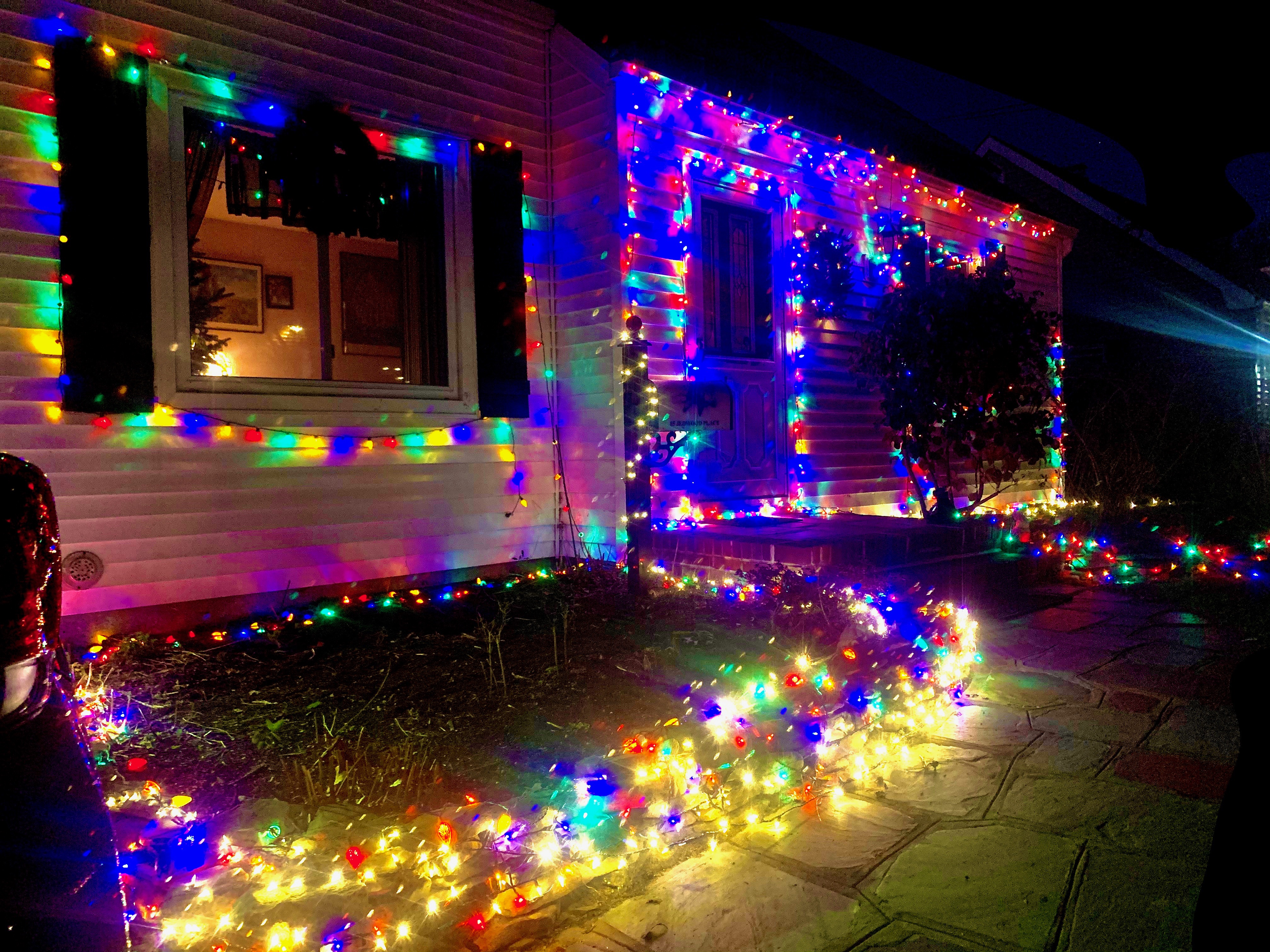
In the midst of this herculean effort, completed in three-or-four-hour blocks of time over the course of eight nice-weather days, I also put up the Christmas lights, which look delightful and which I absolutely hate doing, and which nobody will actually come to the house to see for themselves. I think I do it for my parents, most of all, and for the memories it conjures up. I have no control over whether any future owners of the property will celebrate Christmas. 

Which brings us to the tree. Last December, which was two-thousand years ago, was very exciting for us. We were closing on a house in Copake Falls, a dream we had dreamed for twenty years. The closing was set for the 20th of December, the day the boiler stopped working in the house on what was not yet Trisha’s Mountain, and the closing had to be postponed. Someone flipped the reset switch on the boiler the next day and it’s been working since (knock wood again), and the closing was finally a done deal a week later, on the 27th. We reserved one of our old cabins at Taconic State Park to stay over both times, to avoid nighttime winter driving, which can kill you. 

Fortunately, we had the World’s Most Responsible Teenager on the block to take care of the cats on both nights, but this time, she had the added pressure of watering the live Christmas tree next to the radiator in the living room. Leaving a live Christmas tree unattended, even overnight, gave us the willies. I guess I’ve seen one too many videos of blazing Christmas trees infernos. In practical terms, there was very little chance of the Christmas tree burning down the house. They don’t spontaneously combust like the drummers in Spinal Tap. As Bruce Springsteen sang in the worst song he ever wrote, you can’t start a fire without a spark. But if the tree had burned the house down, Lyle the Cat would surely have had something to do with it. 

So this year, knowing that we could get up to the Mountain between Christmas and New Year’s, we took a ride to Dee’s to see Joey’s artificial Christmas trees for ourselves inside the store. Our tradition is to put up our tree in the first weekend in December, then take it down the first weekend after New Year’s, by which time some of them over the years have grown a trifle crispy. But neither Trisha nor I, and by extension our offspring and animals, has ever experienced a Christmas without a real Christmas tree. As a kid, I felt pity for people with artificial trees, people who were happy to spend the season looking at a sad, scrawny green plastic scarecrow, usually with boring all-white lights, that looked as much like a tree as a White Castle looks like Versailles, or as a Taco Bell looks like a hacienda. I don’t care what you got for Christmas, or how much fun you had. That’s not really living. 

As with many things in my lifetime, though, artificial Christmas tree research and development has grown by leaps and bounds. The ones they make now look very much like trees. They’re pre-lit. You can find one in perfect symmetry to your available space and the initial investment pays for itself in three years of not buying a tree from Tommy’s yard. And you can leave them up as long as you like. John Prine left his up all year long, but he had a bigger house. And there would be no chance of fire by stupidity if we left the tree up on the Creek and drove up to the Mountain, despite Lyle the Cat. 

Joey Dee took us through a couple of handsome artificial trees that looked promising and told us he had plenty in stock and more coming in. Nobody was coming to our house over Christmas, so we’d be the only ones who would see it. We’d likely end up getting a fake tree when we move upstate permanently because you really couldn’t put a living tree anywhere near the fireplace, so why not just get used to having a fake tree now? There was only one overriding downside, only one good reason why we didn’t pull the trigger. 

We didn’t want to. 

I started reading about Zen Buddhism when I was in college. Alan Watts, D.T. Suzuki. Those guys.  I liked everything about it. In Zen philosophy, the past and the future are illusions. Any wisdom you’ve gained along your path is meant to applied to right now, not to some future day. What’s more, our house and gardens and creek and your house and all your stuff are events, not things, because everything is in a constant, slow-motion state of flux, and nothing is permanent. And since they’re events, not things, they should be celebrated like events, with as much enthusiasm as you work up, because they’re going to end, and we’re going to end, and since that will be the end of that, this right here and this right now are all we’ve got. 

But as hard as I’ve tried, I’ve just never been able master the art of living in the Here and Now. I don’t know what’s in anyone else’s brain beyond what they’ve told me, so maybe I’m better at it than I think I am. All I know is that even after years and years of piling up great memories, there are still stupid little moments that I wish I had handled differently rattling around in my head like loose change in a coffee can. And Lord knows I’ve scattered baskets of brain cells across my years worrying about things that theoretically might have happened but never did.  

And even when I’ve been as close as I could get to living fully and completely in the Here and Now, and there have been lots and lots of those times, I never went too long without checking my watch. It’s how I’m wired, and that’s just sad, but it’s no excuse. Very often, I enjoyed the hell out of the job I did for 25 years, but I could always tell you exactly how long I had to keep doing it until I didn’t have to. 

But if anything could get me to finally shake off all this mental illness, finding myself floating along through the days, collecting my monthly Cash For Life payments from the New York State Teacher’s Retirement System while waiting for a Pandemic to end (and a psychopath to go away) may have been the ticket. I’ve cut off a big chunk of my past and I have no more than a vague plan for the future. Whenever I check my watch, I’m right smack in the middle of the Here and Now. 

Self-awareness is one of the benefits of getting old, unless you’re hopeless. It becomes easier to catch yourself when you’re up to your same old lame tricks. Too often this year I’ve found myself sitting on my poorly constructed patio on the creek, thinking about what it would be like to leave Valley Stream and move up to Copake Falls permanently, how I’d feel about letting it all go. Then I’d be up on the Mountain thinking about what it would be like to be there with no back to go to. None of this is anything that I really had to think about at that moment, and any second I that I was, I knew I was only cheating myself out of good time.

And I’ve come to realize that the only reason I’m giving any unthinkworthy thoughts any space in my head at all, instead of enjoying the passage of time, which is of course the secret of life, is because I’m not thinking about my lesson plans for Monday morning, or what to do about that one kid. So all this extra room opens up in my brain, and something has to fill the vacuum. At times in 2020, to my credit, I happily feasted on whatever was in front of my eyes in the Here and Now. 

But sometimes I pigged out on boxes of worry cookies and bags of regret chips. 

We’re all works in progress. If you’re doing it right. 

A moment of personal enlightenment came as it often does, after cleaning. In this case, on the first Sunday of December, when the temperature on Long Island was a sickeningly sweet 70 degrees. I had finished all the mulching and power washed the patio bricks, which takes just as long as cleaning them on your hands and knees with a pencil eraser, then topped off the weekend by cleaning out the garage. The property on Duffy’s Creek looked as good as it ever had on the first Sunday in December. 

Mookie doesn’t need to read an y books about Zen Buddhism

I was sitting in the yard with my nine-year-old dog, enjoying the fruits of my labor and watching the walkers on the creek path. Looking at how beautiful and how happy he looked, my mind had to find a way to try and ruin it by wandering up an unpleasant stream, as it does too often, to the day when I’d have to let Mookie go. 

Then I remembered an excellent cartoon I came across called “Why Dogs Are Better Than People”. The artist drew a man and his dog walking. The man’s think bubble is crowded with dollar signs and buildings and cars and angry looking people and piles of paper. The dog’s think bubble is he and the man walking.  I told myself to just stop it already. We’re Here. It’s Now. Nothing matters until it does. 

And that was how the Christmas Tree Decision ultimately led us to the Fraiser Firs comin’ to ya straight from Maine via Tommy’s yard. Because we’re Here and it’s Now, and there’s no reason to get a fake tree this year just because we might get one in some distant future Christmas. We made one change in the tradition, and it I think it’ll work out just swell. Instead of waiting until the first weekend in December, we went to Dee’s on the day before Thanksgiving. There was only one other customer in the yard, and most of the trees hadn’t even been unwrapped, but we found this year’s winner within five minutes.

So we’re going to keep Christmas as well as we possible can, and we’re going to try to create a little joy in this miserable time. Then we’re going to take down that perfect Christmas tree the week after Christmas, and we’re going to head up to Copake Falls. Just for good measure when we get there, we’ll put up the little prelit tabletop Christmas tree that was in my father’s room at the nursing home when he woke up to his last Christmas. We’ll have a fire in the fireplace on New Year’s Eve and we won’t burn down either house. 

And as another New Year rolls in, I won’t have to see the pictures of people in Taconic State Park enjoying a bonfire after their First Day Hike to Bash Bish Falls and say boy that looks like fun I’d like to get in on that some year because I’ll be there, soaking it in, unconcerned about any other day, past or present.

And by that same logic, I’ll still be pulling deadly nightshade and white snakeroot out of the gardens at Duffy’s Creek until the day we hand somebody else the keys. And if that day happens to be in December, I may just treat them to a damn good mulching before I move on, and before the next event starts. 

Copyright 2020 by John Duffy

Introduction to Mountain High, Valley Low or My Life as a Wishbone: Tales of Valley Stream and Copake Falls, New York: “From The Gateway To Suburbia to The Land of Rural Charm”

Here’s where it starts: At the very end of 2019, the week between Christmas and New Year’s Day, the week when nobody does much of anything, my wife Trisha and I did something complicated, extravagant and totally unnecessary. We bought a house.

Everyone with whom we shared this news was ecstatically happy for us. Nobody called us stupid. Not to our faces.

I suppose if somebody had a problem with us buying this particular house, the problem would be that we already own a house, and the majority of people on Earth don’t own a house, and many don’t have a home, and now we have two. From that perspective, of course it’s clear that we didn’t have any damn business buying another house.

But we bought it anyway. We had our reasons. We think some of them are almost valid, but I’ll leave that to you. If you’re a capitalist, maybe you’ll say we’re smart people and we know what we’re doing and it’s not a problem at all so go ahead and enjoy it. If you’re a Marxist, you’ll likely call us out for the selfish pigs that we are. Fortunately for us, there are way more capitalists than there are Marxists, at least in our circle.

Trisha and I bought my parents’ house eighteen years ago in Valley Stream, Long Island, New York. It’s a little 1,300 square-foot cape cod-style house on a 60 x 100 plot of land. It’s cute. You’d like it. We grow a lot of flowers. The backyard overlooks a pretty little winding creek, the official name of which is actually “Valley Stream”, but people who don’t know me usually either call it Hook Creek or Mill Brook.

People who do know me call it Duffy’s Creek. Some, anyway. Because I asked them to. My parents bought the house in 1955, and I grew up there, the “baby” in a family of five kids. I never went very far, never changed my mailing address. I got married, came back, entered into a real estate transaction, had a son of my own, and began growing old right on that creek. The tide comes in and out from Jamaica Bay, and by the grace of God, I go right on living. It’s a nice story so far, isn’t it?

But here’s the thing: Three weeks after Trisha and I met on the boardwalk by the ocean in Long Beach, Long Island in 1999, we spent a perfect early-November weekend staying in a cabin in Taconic State Park at Copake Falls, in Columbia County, New York, a place we had both discovered independently, she from going to the annual Falcon Ridge Folk Festival in nearby Hillsdale, me from years when I would periodically get in my car and drive long distances because I didn’t have anybody to go to the Falcon Ridge Folk Festival with. We lit a campfire on a crackling cold and clear Friday night full of stars, and on Saturday morning we hiked to Bash Bish Falls under Indian summer skies full of crazy blue jays hopping through orange and yellow trees yelling, “Stay! Stay! Live Here!” We fell in love with each other and we fell in love with the place. And for the ensuing twenty years, we returned there every summer and a couple of falls, probably logging about six months of elapsed time. Our son Jack has never known a year that didn’t include at least one week in Copake Falls.

“It’s like our second home,” we’d say.

But that wasn’t true. It just sounded nice.

So our home away from home stayed up there on the map and up there in our minds year after year as we continued to grind it out on Long Island. The sound of the blue jays and the turns in the country roads stood behind us, tapping on our shoulders to remind us what we were missing; the ancient mountains, the cleaner air, the bigger trees, the wide open roads, the farm stores and the church barbecues, the people who wave when they drive by, the absence of malls and chain stores (except for the Stewart Shop up in Hillsdale, which is perfect and cannot be criticized). I wasted hours and hours of my precious time here on Earth scrolling though Zillow listings.

Copake Falls was an alternative reality. And as Valley Stream continued to get louder and louder year after year, summer after summer Copake Falls stayed mellow.

Valley Stream is a lot of things. Many of them are good. But “mellow” is not one of those things. A quick check for “antonyms of mellow” on Merriam Webster reveals “discordant, dissonant, grating, harsh, inharmonious, jarring, strident, unmelodious and unmusical.” I guess it would be harsh, maybe even unmelodious, to describe my hometown in these terms. But still, it sure as hell is not mellow, except in our backyard, and then only when our surrounding neighbors aren’t shooting fireworks or holding dance competitions. And if you want to see jarring and strident, live near a mall on Long Island during those seasons when people get in their cars every half hour to go buy more stuff. If grating and harsh is more what you’re after, listen to a Long Islander who has been inconvenienced.

Robert Frost came up with the line, “I had a lover’s quarrel with the world.” It was such a good line that he requested it as the epitaph on his gravestone. As you might guess, Jean-Paul Sartre doesn’t have an epitaph on his gravestone (cool issues and all), but he sure could have gone with one of his best lines: “Hell is other people.”

People are what make a place more than anything. Or break it. There are rural parts of America and suburban parts of Long Island where I’m not too arrogant to say I wouldn’t be caught dead. People who are proud of where they live, wherever they might be, like to come up with slogans to promote their hometowns as places that other people might like to see, possibly even live in, because people spend money, and that’s what keeps places alive. Valley Stream once sold itself as “The Gateway to Suburbia”. Kind of a Dante’s Inferno thing really, but I suppose it was meant as a compliment at the time. The Town of Copake sells itself to this day as “The Land of Rural Charm.” That’s a good one, huh? I hope whoever thought of that at a meeting got the praise and recognition that they earned. But I could show you lots of uncharming rural places around town if I had to. And tell you about some less than charming rural people.

So In fairness to my fellow Long Islanders (and – whether they like it or not – my now-fellow Copakeans), let’s start with the premise that the vast majority of people everywhere, in every place with a name, are really all right. I truly do believe this. But sadly, as you know, while most people are wonderful, some people just suck. So it follows that if there are more people, more people will just suck. That being established, here are what I believe are the four basic groups of problem humans:

1. The Slightly to Extremely Dangerous: Those who have had hard lives or some sort of trauma and have decided than instead of nobility or faith, they will instead make it a point to project their hurt and anger on convenient targets they find around them. While this group of people have to be treated like walking landmines, as a child of God, one can’t judge them if one is not one of them and hopes not to be. I just try to stay out of their way and not to make things any worse for them.

2. The Insufferably Annoying: Those who have been sadly brainwashed by too much TV into thinking they are the star of their own little reality show, and thereby have developed a need to create drama and tension where none should exist in order to compensate for an otherwise tedious existence. Long Island is saturated with people like this, possibly because of its wealth. If your main problems are not the procurement of food, clothing and shelter, you really have no problems, so if you want some, you have to invent them. Ideally, it would help every one of them to be slapped silly, but violence is never an option.

3. The Head-Scratchingly Frustrating: Those who, for a variety of reasons, from deeply neurological to not getting hugged enough as babies, just can’t grasp the simple rules of getting along. They’re not particularly dangerous or overly dramatic. They just flat out boggle the mind. Ask anyone who’s ever worked in retail. But, as my father would have said, you can’t make their problem your problem. You can suffer fools gladly or ungladly. You’re still going to suffer fools.

Now, If you give people in these three categories the benefit of the doubt, and assume that in their essence they really just can’t help themselves, and they probably have many good qualities as well, that leaves us to grapple with the problems perpetuated and the damage done by Group #4, The Unrepentant Assholes: Those who live to purposefully and gleefully gain negative attention from the rest of us by being as unpleasant, uncooperative and self-centered as they can possibly be.

My personal sampling of the several hundred-thousand people I’ve interacted with in 57 years suggests that groups 1, 2 and 3 represent between 7% and 10% of the overall population. Maybe as much as 15% in higher-end neighborhoods. The Unrepentant Assholes in Group 4 are actually a very, very small percentage of the human population. I asked Trisha, and she said 2%. I was thinking three, but I’ll go with her answer.

There are 284.7 square miles of land in Nassau County, New York, and approximately 1,359,700 people call it home, making for a population density of 4,787 people per square mile, with all the people noise and chaos they generate. Bear in mind that there are large swatches of Nassau County where billionaires have reserved lots of land for themselves and their horses and their golf courses, leaving the rest of us to fight over what’s left. The population density of South Valley Stream is 7,583 people per square mile.

Traveling from Nassau County to Columbia County, you’ll pass Co-Op City in the Bronx, which has a population density of 47,000 per square mile. So really, I should just shut up. I’m very much aware of this. But we’re born where we’re born, for reasons that are seemingly random and certainly not fair, and we know what we know. I would like to build a little house with a garden for every family in Co-Op City on all the land currently being used for golf courses. I have no beef with horse farms.

Meanwhile, In Columbia County, there are 635 square miles of land, which is home to 59,461 people, which is 93 people per square mile. This includes Hudson, the county seat, which is two square miles and has 6,144 people, 1238 of whom sell antiques. Extrapolate that funky little metropolis, and now we’re down to 84 people per square mile, and 2% of 84 is 1.68.

This all means that in every square mile of land in Nassau County, you will find 94 Unrepentant Assholes (150 in South Valley Stream, most of them driving). Whereas in Columbia County you might find two. Plus you can factor in the variable that being known as having manners and not being a big fat pain in the ass is much more important in Columbia County, because you don’t want everyone else to agree that you’re that one person in their square mile, whereas in Nassau County, every asshole is competing for attention against 93 other assholes within one square mile, and it’s hard to keep track of them all.

There is no cure for any of this. Not in this life, man. More people create more stress. As the Pandemic of 2020 set in, I started seeing clickbait on my rectangle about how people would start moving from the city up into the Hudson Valley “in droves”. Since it’s an issue that affects my life, I was interested to know how many a drove is and how many droves you could multiply that by, but I try not to fall for clickbait. And the proliferation of people in Groups 1, 2 and 3 will only get worse as cell phones get better. And more Group 4’s means more chances of something unpleasant happening to you or around you every time you leave the house.

So the choice for us seems to have become one of either standing in the Gateway to Suburbia as the Barbarians continue to storm through, or goin’ to the country and buildin’ us a home in The Land of Rural Charm, hoping that agricultural zoning regulations will keep the droves at bay for a while.

And that’s why at the end of the twenty-first year of complaining about the miseries that follow the overpopulation of Long Island, and of idealizing the alternative existence of Columbia County, Trisha and I bought a second home two and a half hours away from our first one, a mellow-yellow ranch house on 1.9 acres of land bordering the very state park where we had once walked around all gooey in love under the autumn sun with the blue jays and everything so many years before. Since I had named the creek in back of our house in Valley Stream after myself, because who could stop me, and since the funds that made this real estate transaction possible were bequeathed through my wife’s family, I insisted that we call our new second home, perched on a ridge 840 feet above sea level, “Trisha’s Mountain”.

We had a dream. We had the money. We jumped off the cliff. And then the whole country broke. And then I quit my job.

Not really, but sort of. I actually retired from 25 years as a middle school English teacher. It’s an important job, and somebody has to do it, but it is no longer me. However, the pension I earned is a lot less than if I had stuck around and made more money for a couple of more years, thereby assuring that eventually, if I wanted to live in the style to which I’ve become accustomed, house in the country and all that, I’d have to suck it up and find a part-time job. So, I gave myself four months to decompress, while the Covid-19 Pandemic and the complete collapse of American Society that will likely precede or follow the Presidential Election of 2020 play themselves out.

In the meantime, in between traveling up and down State Route 22, I thought I’d write a book. But I didn’t know what to write about. I had some ideas, but I don’t like it when people are angry at me, so I had to keep thinking of other ones.

The whole “we left the crowd in the city and moved to the country but we didn’t know the cows next door would smell so bad and why are there bees and snakes” thing has been done to death. That’s not what I’m after here. There isn’t a whole lot of Upstate / Downstate culture shock for me to write about because I pretended that I had a house in the country for twenty years before I actually had one. And nobody up there has to explain to us how not to be “citiots.” We get along just fine with everyone. Not much material there. Of course, In order to be considered a local in Copake, your family has to have lived there for two-hundred years, so we know we’ll always be outsiders. We try to counter that by being polite.

So ultimately I decided to write a book of stories and word pictures, twenty of which are set in Columbia County, the other twenty in Nassau County.

My only claim to originality is that I write from the perspective of one whose heart truly lives in two places at the same time, and who knows his time in the one place, the place that created him, is likely winding down.

A Little Side Note: Right now, if you’re reading this book in its competed form, and not in installments on duffyscreek.com, you’ve established that 20 plus 20 equals 40 and not 41. Very astute. Chapter 1, the longest one in the book, is mostly about New York Route 22, the road in between (and how I found it). As we’re making this several years long transition, the road from here to there and back has become sort of my third home.

Valley Stream and Copake Falls, while they are almost united by a common language, and while you can drive from one to the other in two and a half hours, and while by virtue of boundaries drawn up 400 years ago are both in New York State, could not be less alike. But this book is not about comparing and contrasting them. It’s about things that define these places for me. They are both home now. When I’m in one place, I feel the other one trying to pull me back. Neither of them seems to understand that I can’t be in two places at once.

I have become a human wishbone.

I grew up in Valley Stream (and by extension, Long Island) in days when it wasn’t quite as strident and jarring. As another one of my heroes, Mose Allison, said of Tippo, Mississippi, “I am of that place, and the stamp is upon me.” But the little hamlet of Copake Falls has been yanking at the sleeve of my soul for most of my adult life, and now our plan is to go there for good someday.

But not today.

I guess you could say we have a plan. But we don’t, really. Our right-now-16-year-old son has two more years of high school and likes it upstate just as much as we do. So he would be more or less on board if we actually had a plan. Trisha is very successful at her mommy-takes-the-train-to-the-city job, so she’s not in a hurry to leave (as we’d be broke, and she’s in charge of the money) but I know Long Island’s obnoxiousness gets to her even more than it gets to me. And as I write this in the summer of 2020, you can’t even go sit on the beach unless you want to risk getting horribly sick (or getting somebody else horribly sick), and Long Island is pretty much pointless without the beach and the ocean. It seems predetermined which way the wishbone will eventually snap, and I guess if there is a plan, that’s the plan.

Abraham Lincoln said that the best thing about the future is that it happens one day at a time. I’ve outlived him by a year, so I’m happy to be here at all.

And as people suffer all over the world, my main purpose in life in August of 2020 is waiting for people to call me to schedule delivery of some comfy furniture.

I never thought it would come to this.

Of course, If we decided to put our house in Valley Stream on the market tomorrow morning, it would take the better part of two years to shovel out of it anyway. So for the foreseeable future, part of me is watching the tide come and go on the creek and part of me is watching the light dance across the mountains. I am a stupidly lucky son of a gun and I have not a thing in this world to complain about, but if you’re nice enough to read on anyway, I’ll try not to be boring.

When a friend at work would complain to me, he’d often say, indignantly, “this is not what I signed up for!” Well, this is exactly what I signed up for that mellow December day last year in the lawyer’s office in Millerton.

I am a human wishbone. I am Gumby, damn it. With one arm and one leg stretched north, the other arm and leg stretched south.

Which would put my center somewhere around the Red Rooster.

Copyright 2020 by John Duffy

All Rights Reserved