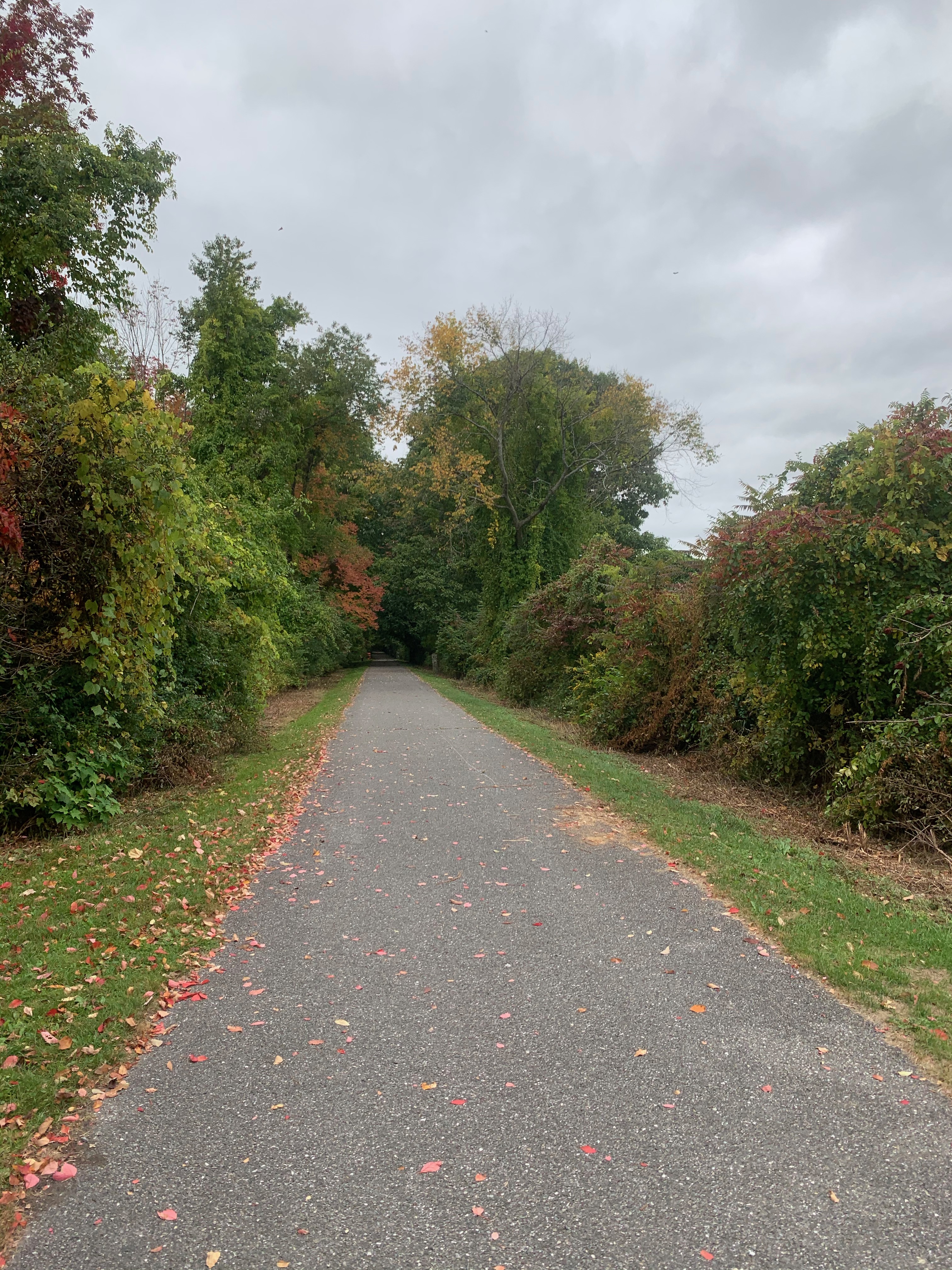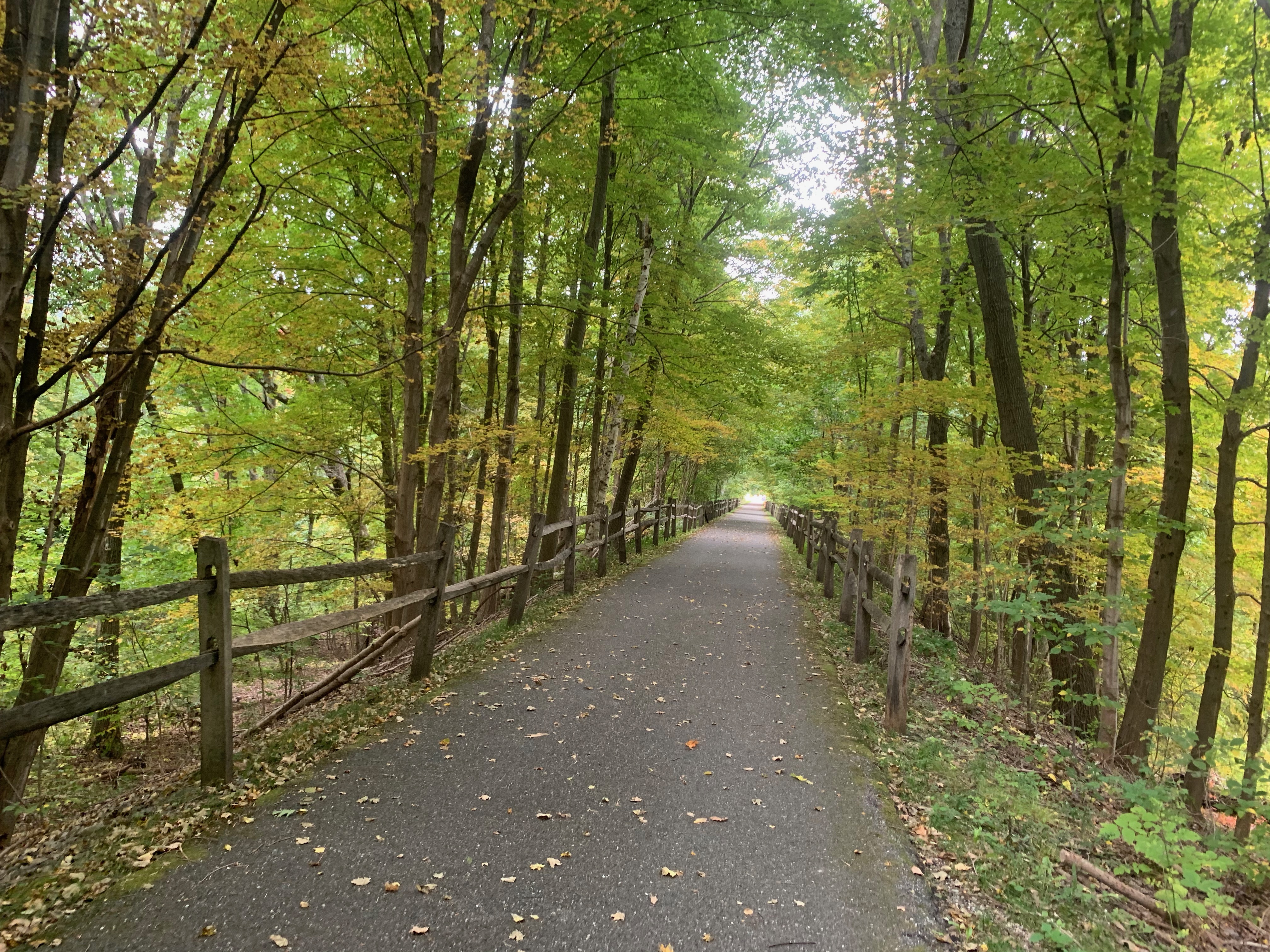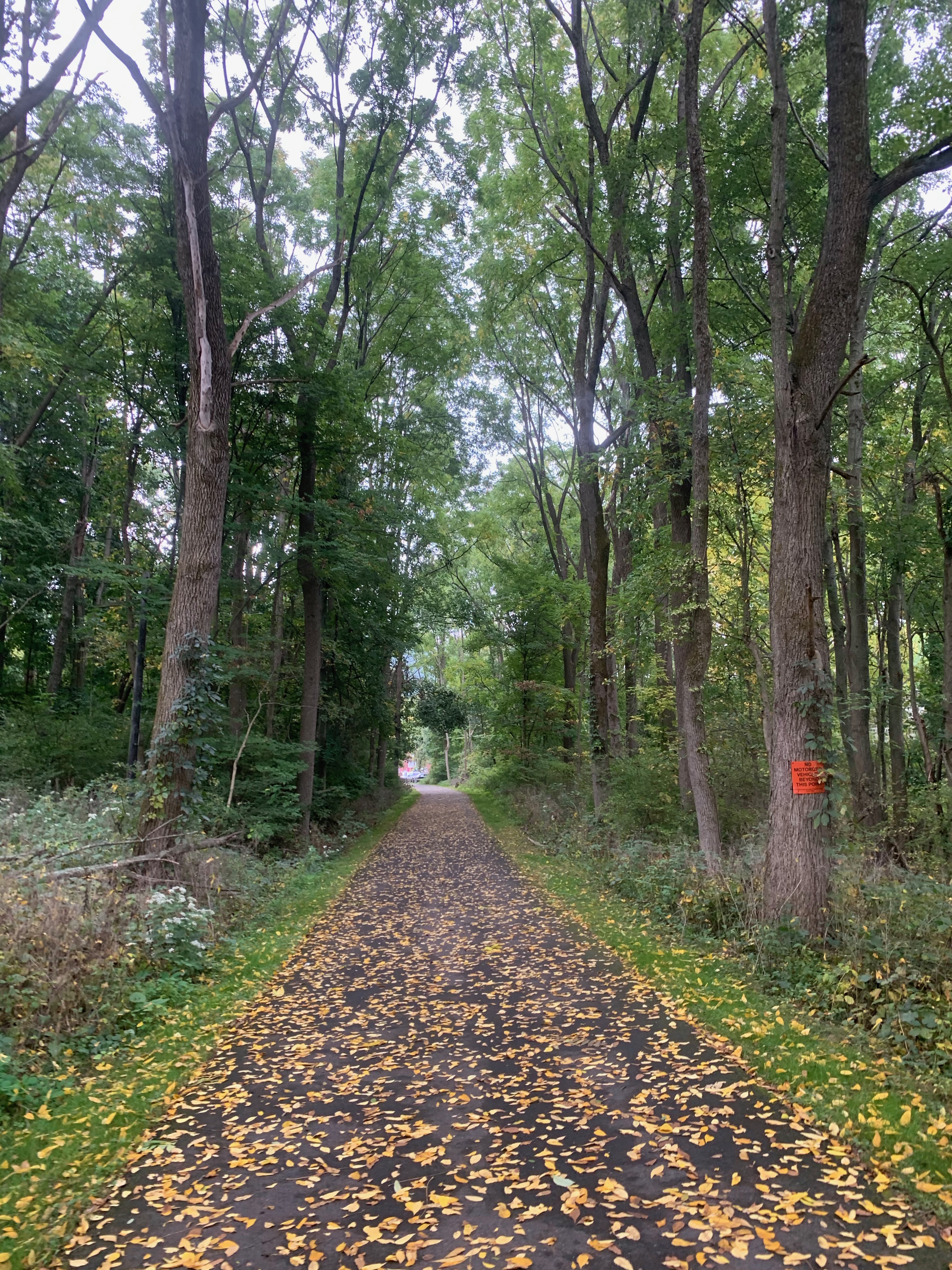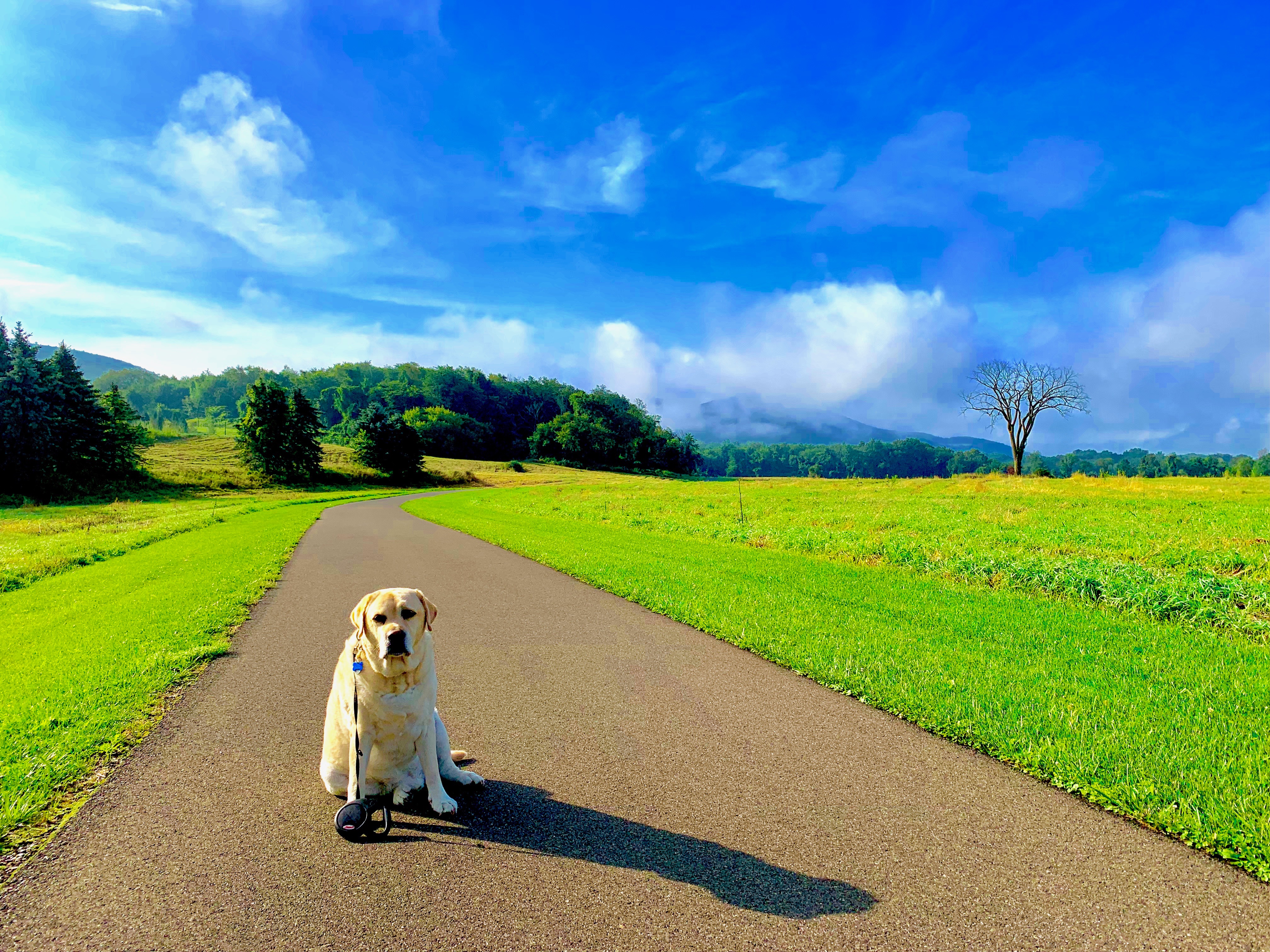
Chapter 8 of Mountain High, Valley Low or My Life as a Wishbone: Tales of Valley Stream and Copake Falls, New York: “A Good Little Hike”

The South Taconic Trail chops through miles and miles of deep woods, climbing the peaks of three mountains while rambling north and south through three towns in New York and one town in Massachusetts. Near the point at which those two states and Connecticut all stand on one foot, there’s a side trail along the Mighty South Taconic that scrambles up and down Mt. Frissell and leads to the far Mightier Appalachian Trail, which runs parallel at that point just a few miles to the east. Behind our backyard on Trisha’s Mountain is five and a half miles of unbroken wilderness to the east, stretching to the next cup of caahfee in Sheffield, Mass. This wild and pristine swath of the Earth is one of the Nature Conservancy’s designated Last Great Places, which lends to its no street cred. 

And it all smells fantastic.

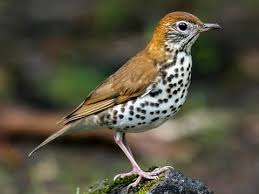
Along a ridge on Trisha’s Mountain, which is really the southern descent of Sunset Rock Mountain, is a trail that’s only about a mile long, called either the Wood Thrush Trail or the Blue Trail, depending upon whom you ask. The Wood Thrush Trail sounds more like morning in the English countryside and The Blue Trail sounds more like a Cannonball Adderly record, so for these purposes I’m going with Wood Thrush. This humble and fabulous little trail starts at Sunset Rock Road, just off the high point of North Mountain Road, then provides a fine aerobic workout up and down a few hollows before easing down at the end into the camping area of Taconic State Park.

On the official New York State Parks South Taconic Trail Map, available for $6.95 at the park office, the Wood Thrush Trail appears to be within close proximity of the point at which our lawn meets the wilderness. I was very excited at this discovery. So much so that I bought a Fiskars 29-inch machete axe on Amazon for $40 with which I planned to bushwhack my own trail through the woods and up the mountain, thus connecting to the Wood Thrush Trail, which would connect me to Sunset Rock Road, which would connect me to the Sunset Rock Trail, where I could in turn access the South Taconic Trail, along which I could travel south past Bash Bish Falls, up and over Mt. Frissell and on to the Appalachian Trail, from where I would have my choice heading north to Mt. Kahtadin in Maine or south to Springer Mountain in Georgia.

It’s a cool looking axe, as you can see. I showed it to Trisha when Amazon delivered it and she said, in her best Karl Childers from the movie “Slingblade”: “I’d like to be baptized.”  That’s why I’m in love, boys. 

But ain’t nobody gonna be walking to Georgia from our backyard. 

Not that I didn’t try. It was in February of 2020. Six weeks after we bought our house in the country and three weeks before the criminal mismanagement of a coronavirus outbreak became a worldwide pandemic that broke everything and screwed everybody. A Buddhist friend from Long Island was doing us a huge favor (kindness and generosity being two of the five pillars of Buddhism) by following Jack, Mookie, Lou the Subaru and me up Route 22 in his van carrying stuff for the house, including two new toilets, obviously the most valuable of cargo, which would later be installed by a local plumber who plays Santa Claus at the Copake Town Christmas Parade every year and plays the organ at a local church every Sunday morning. 

Details like that are what makes life worth living. 

Being familiar with the area, my Buddhist friend stopped at Brewster Pastry, located in a grand city-state shopping plaza on a shining hill just south of the official upstate line at the Red Rooster, to procure for us the most delicious danish ring I have ever experienced. Due to family obligations, which evolved in the time that took him to drive the 36 miles of Interstate 684, it turned out that instead of crashing on an air mattress on the mountain, which was the original plan, he only had a few hours before he had to turn around and go back to Long Island. 

Patience and compassion are two more pillars of Buddhism. Plus he gets credit for the fifth one, wisdom, for knowing about Brewster Pastry. 

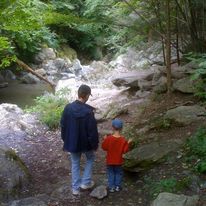
After we unloaded the toilets and other somewhat lesser valuables, and after a cup of coffee and a memorable danish, we decided to do a little reconnaissance on the Wood Thrush Trail. It was dry and cold under a powder blue winter sky, a perfect afternoon for a good little hike through the woods. 
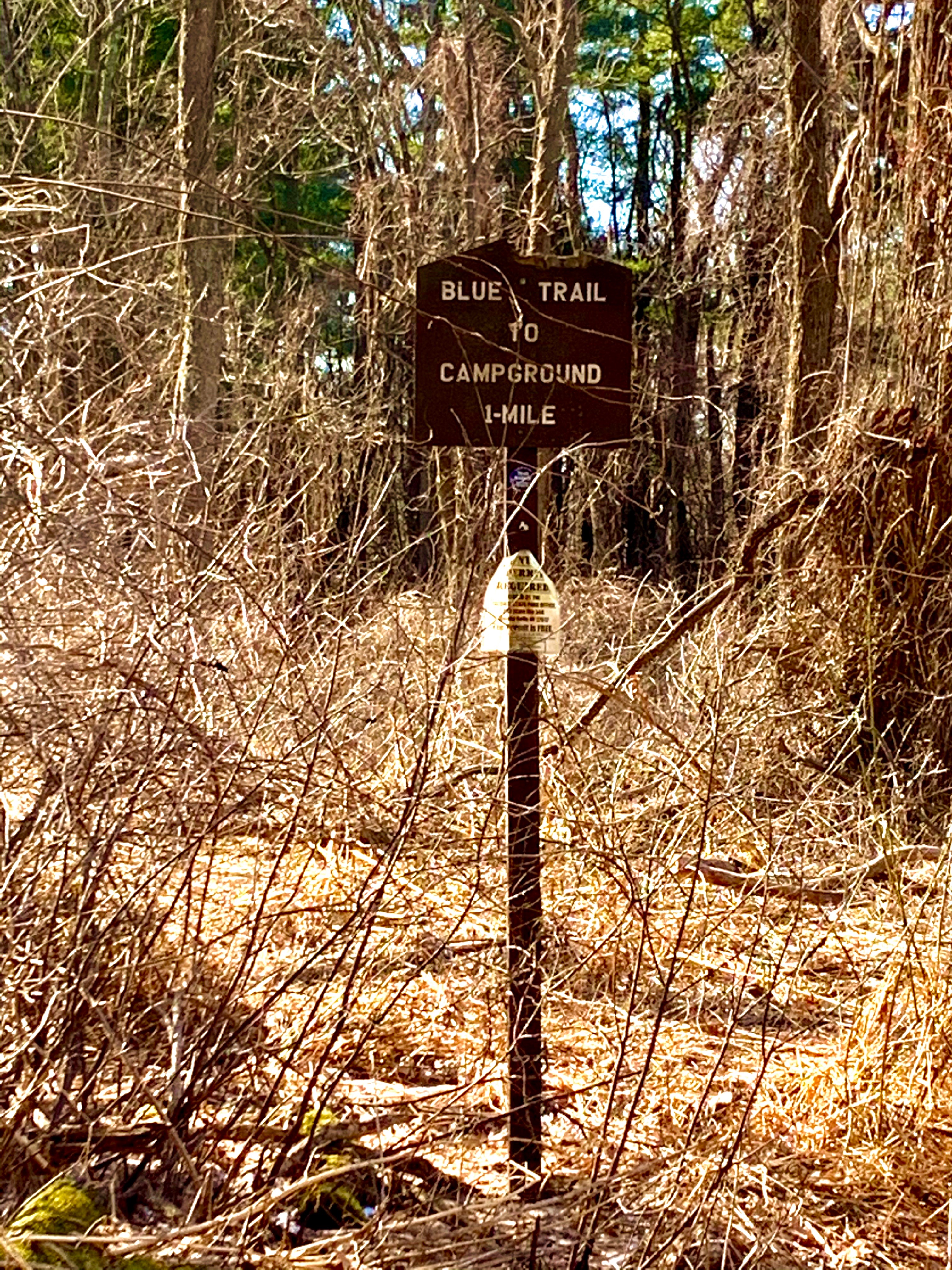
To save time, we drove the three quarters of a mile uphill to the corner of North Mountain and Sunset Rock Road, which is a narrow dirt road that twists all the way through the wilderness from Copake Falls to Mt. Washington, Mass. The parking lot for the Sunset Rock Trail, which merges with the Mighty South Taconic, is about a mile straight uphill, but there is also a sign warning that the road is not maintained from November until March and I don’t think they’re just saying that.  

Having been either cruelly deluded by the South Taconic Trail Map or too stupid to comprehend its scale, I figured that we’d eventually be able to see at least the tops of the houses along North Mountain Road, of which we’d be looking for the seventh one. It seemed promising that the trail actually started within a stone’s throw of the road. 

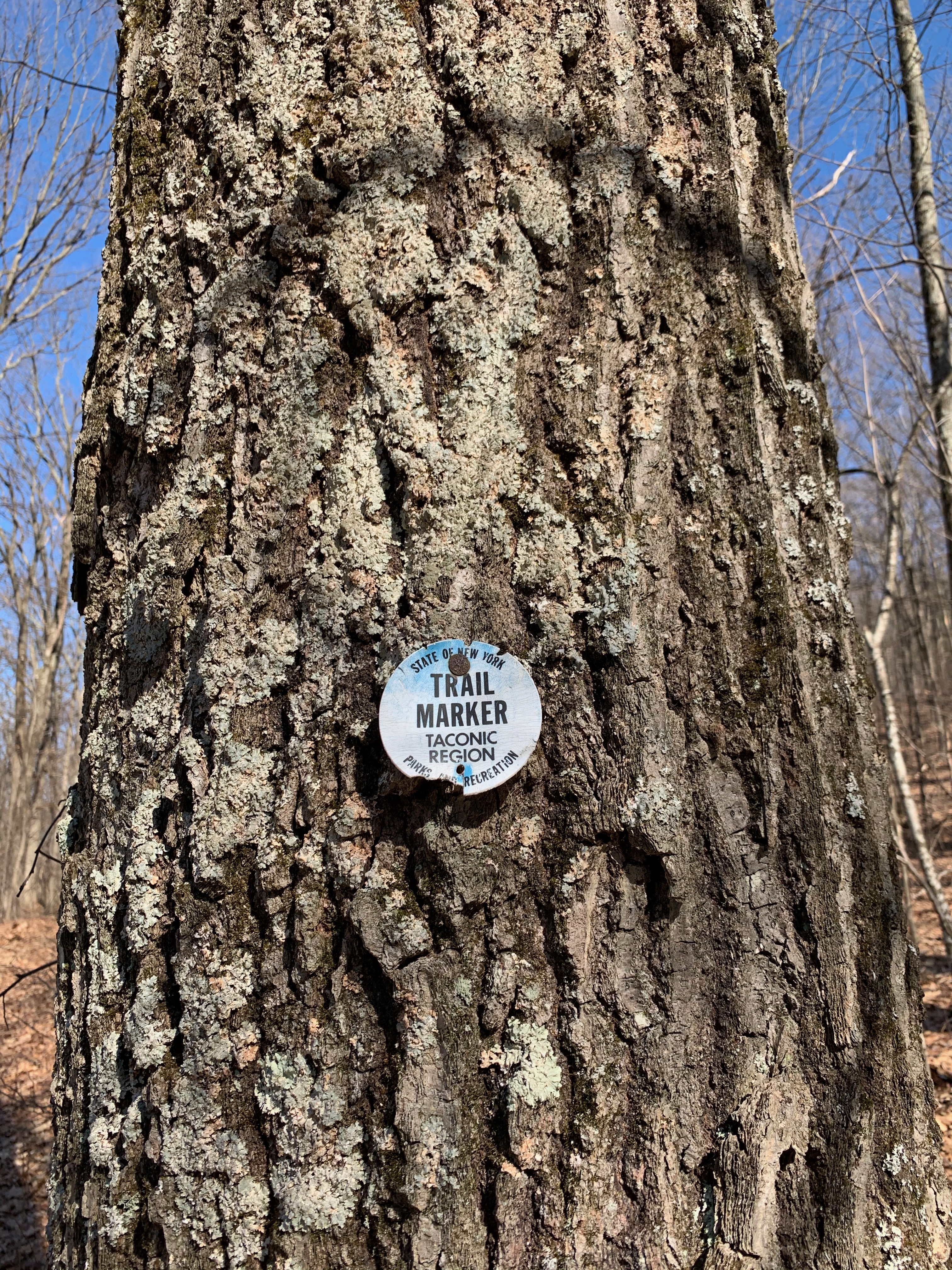
As trails are hiked by humans, of course, they get a little wider and a little less wild over time, until they eventually become the Cross Island Parkway. It was clear that the Wood Thrush Trail, despite its frequent blue trail markers, was not as heavily traversed as the other local trails. It also became clear that, after one big dip, we were steadily gaining elevation, to the point where we could see the sky angling through the top of the mountain to our left. This meant that the houses that were down there somewhere to our right were hidden from view because of the extreme slope, except for the chimney and the very top of the great center hall colonial colossus next door to us. It was hard to judge the distance between us and the house, and it was of course, straight downhill. I had already figured out from the $6.95 trail map that there was a 400-foot elevation gain between the yard and the trail, which didn’t seem like a lot until one looked down. 

Meanwhile, not only did my Buddhist friend have a tight schedule that winter afternoon, but I also had an appointment to have a propane tank delivered and connected to the stove sometime after 2 p.m. by the good folks at Herrington’s. It was and is my first ever propane tank, so it was obviously a special moment for me. Before we headed back to the house, we took a look at our surroundings on the Wood Thrush Trail. The plan was to take a mental snapshot of sorts of the spot on the trail that seemed to be directly in back of the yard, then walk up from the yard, back into the woods and back up to the trail, which despite the brush would be a mostly possible in February but completely impossible in April without a machete axe and a pair of loppers at the very least, and would also more than likely end in a prolonged bout of Lyme disease. 

A quick stop for more danish and coffee and we were climbing the hill behind the house and stepping into the domain of the bears and the owls. I had already ventured into the woods one other time, the day we closed on the house. According to Zillow property line maps, which are almost uniformly useless, Trisha and I own some of these woods. The rest belongs to the People of the State of New York, so technically we own that, too. I had also seen on my trail map that a small stream ran through the woods not far from the edge of the yard. Some careful stepping and a few whacks with the machete got me to this stream, which, on that day at least, was not much more than a trickle of muddy water cutting through the rocky ground, easily bridged if one were blazing a trail to Maine. 

My Buddhist friend understands that life is suffering, but the fact was he only had one pair of shoes with him and he was looking at another three-hour drive. So while I pulled myself up the hill with a big walking stick, he took his time to avoid any serious mud. 

A few pertinent facts regarding the almost 58-year-old body to which my soul is tethered:

  1. It has spent the majority of its life on the South Shore of Long Island, where there are far more escalators than hills, and no matter how much time it’s spent upstate, it has never truly gotten used to climbing. 
  2. It picked up a 24-piece case of Redpack 28 oz. Whole Tomatoes in Aisle 3 of the North Woodmere Foodtown in October of 1981 without bending its knees first, walked a mile back home looking a human jackknife, and has had a pain in its lumbar region ever since.
  3. It was sideswiped and thrown to the ground by a large golden retriever in March of 1989, in a case of tragic miscommunication, resulting in several broken ribs on its right side.
  4. It fell from a chair that flipped from under it sometime in late summer of 2013 while it was stapling bulletin board paper over a white board in Room 111 of Middle School 202, banging its left leg off a desk on the way down, resulting in a cramping pain every time it tries to accelerate or walk uphill. 
  5. It smokes. 

But in my magical thinking world, I’m just as capable of blazing a trail up a mountain through the woods as anybody. All I have to do is switch into Little Engine That Could Mode and play through the pain. 

Remind me of that when this body has 68 years on it. Maybe I’ll still have a sense of humor about it, but you may find me a grave man. (Joke credit: William Shakespeare). 

I took the four-hundred-foot incline one step and one breath at a time, stopping every so often to avoid dropping dead of a heart attack. I kept calling down to my Buddhist friend that I was pretty sure I could see the path from where I was, but this was magical thinking as well. At the point where it became impossible to move forward without grabbing hold of the nearest small tree, I got the call on my rectangle from my soon to be new friend Paul from Herrington’s, who is just about everything you’d hope for in the guy that services your furnace and makes sure you don’t blow yourself up with propane. It was time to put this adventure to rest, and I still have no idea how close I got to the Wood Thrush Trail.

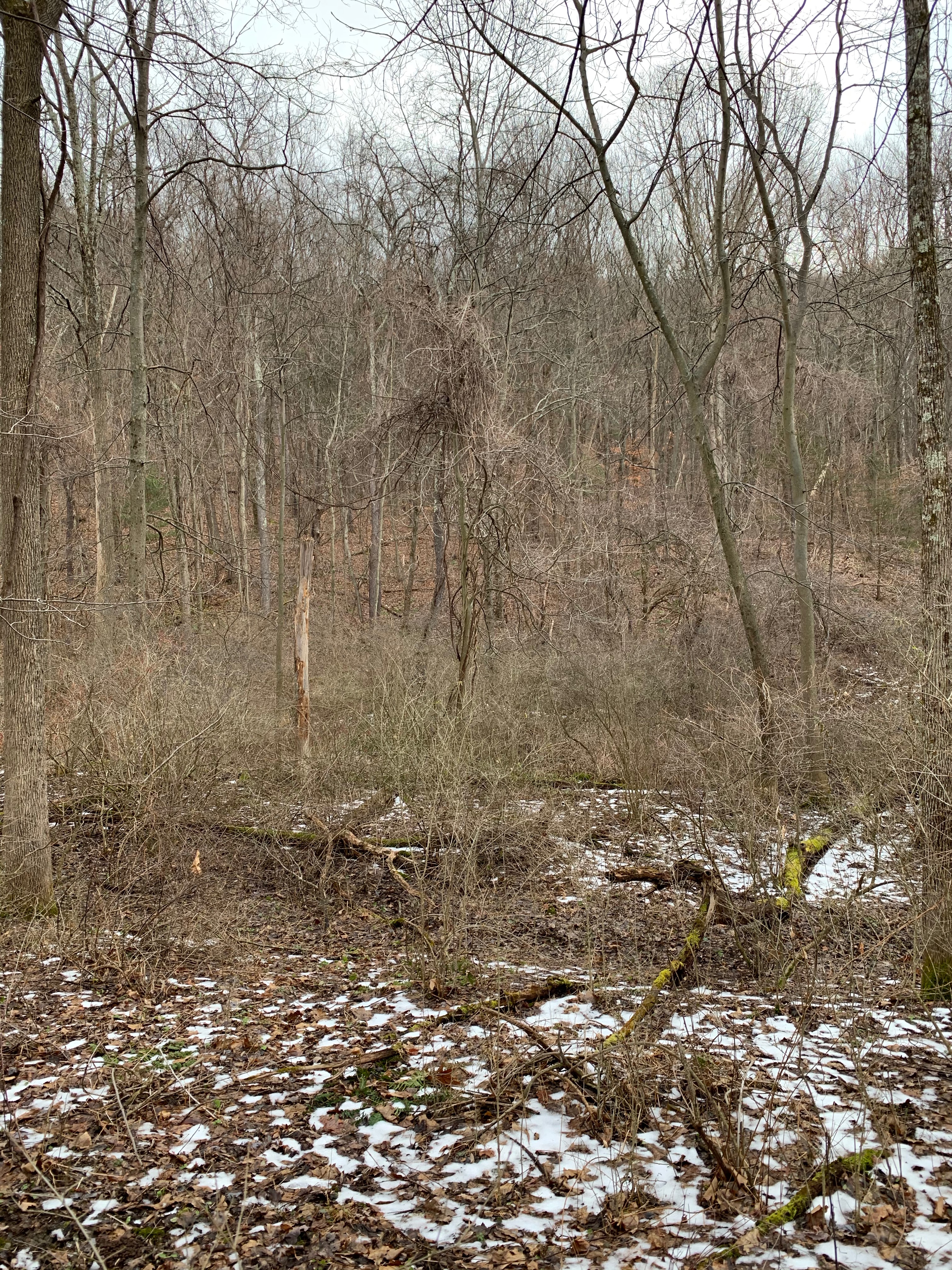
I took the Wood Thrush Trail again for a spectacularly good little hike in early May. I got past the point reached three months before with my Buddhist friend and I found a spot where a dry culvert ran straight down the mountain. Across that culvert, a mighty oak had fallen. So like the insects and fungi and other parasites that also took advantage of this tragedy, I found a great new place to sit down in the woods for a while and get some thinking done.

This accomplished, I turned around and headed back to Sunset Rock Road. While the sign marking the trailhead there clearly states “Campground 1 Mile”, and I have no idea how close I got to the campground, which I really didn’t want to get to anyway because it would mean a whole lot of uphill on the way back, it sure felt like I had walked over a mile.

One evening in August, Trisha and I were sitting in camp chairs on the front lawn, doing our Zen sunset thing, and a couple of guys came walking down the road from the direction of Sunset Rock. Figuring out that we were sitting out there just to watch the sunset, one of them asked if we do this every night. We told them every night we can. Then he told us that they were walking back to the campground after walking up the Blue Trail, believing it would be an easy mile, and that they could then walk from there up to the trail that goes to the rock, which, in the ultimate of ironies, closes at sunset. 

They didn’t make it to Sunset Rock, and they were now racing daylight to get down North Mountain and back to their campsite. But they stopped to chat from ten feet away. One of the guys said that the trail seemed a lot longer than a mile. I said that’s what I thought. 

So I checked it on Google Earth. 

It’s a mile. 

Maybe he also picked up a case of tomatoes when he was younger, or he got run over by a dog or decided to stand on a chair to staple bulletin board paper. Or maybe a mile through the woods is so full of sensory stimuli that it seems longer than it is. 

Or maybe it’s just that trail. 

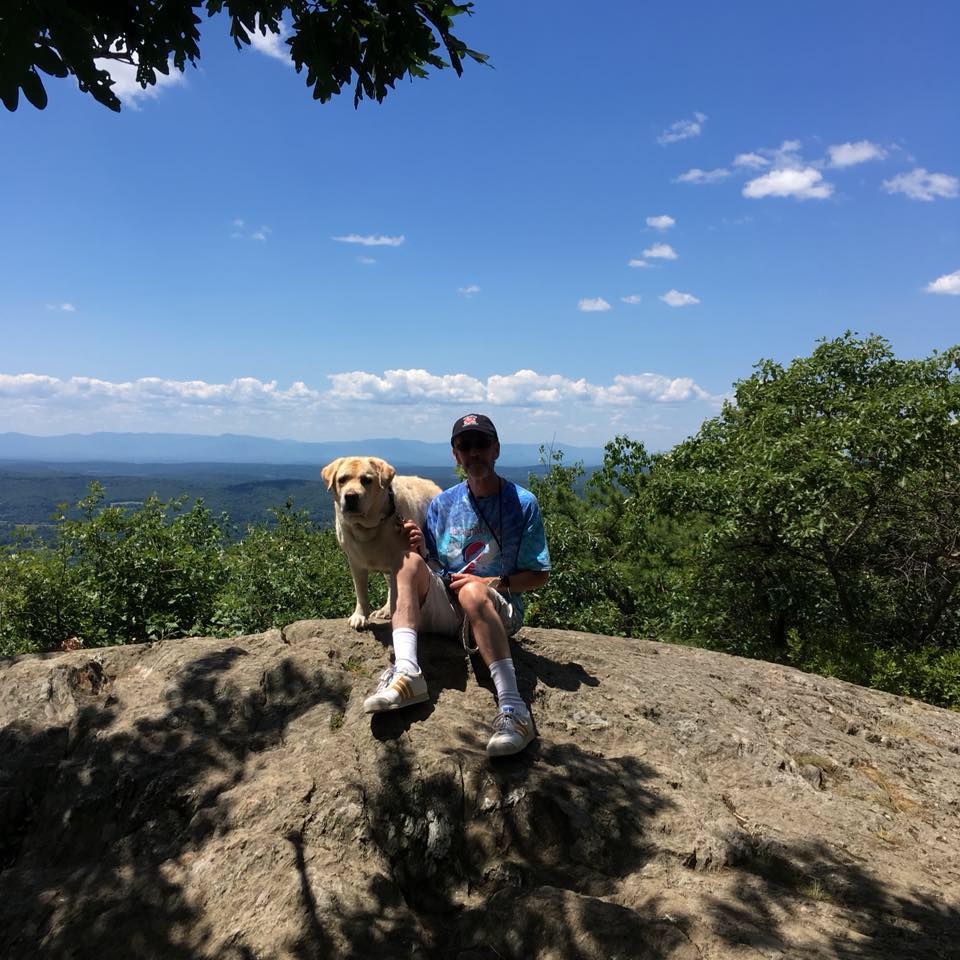
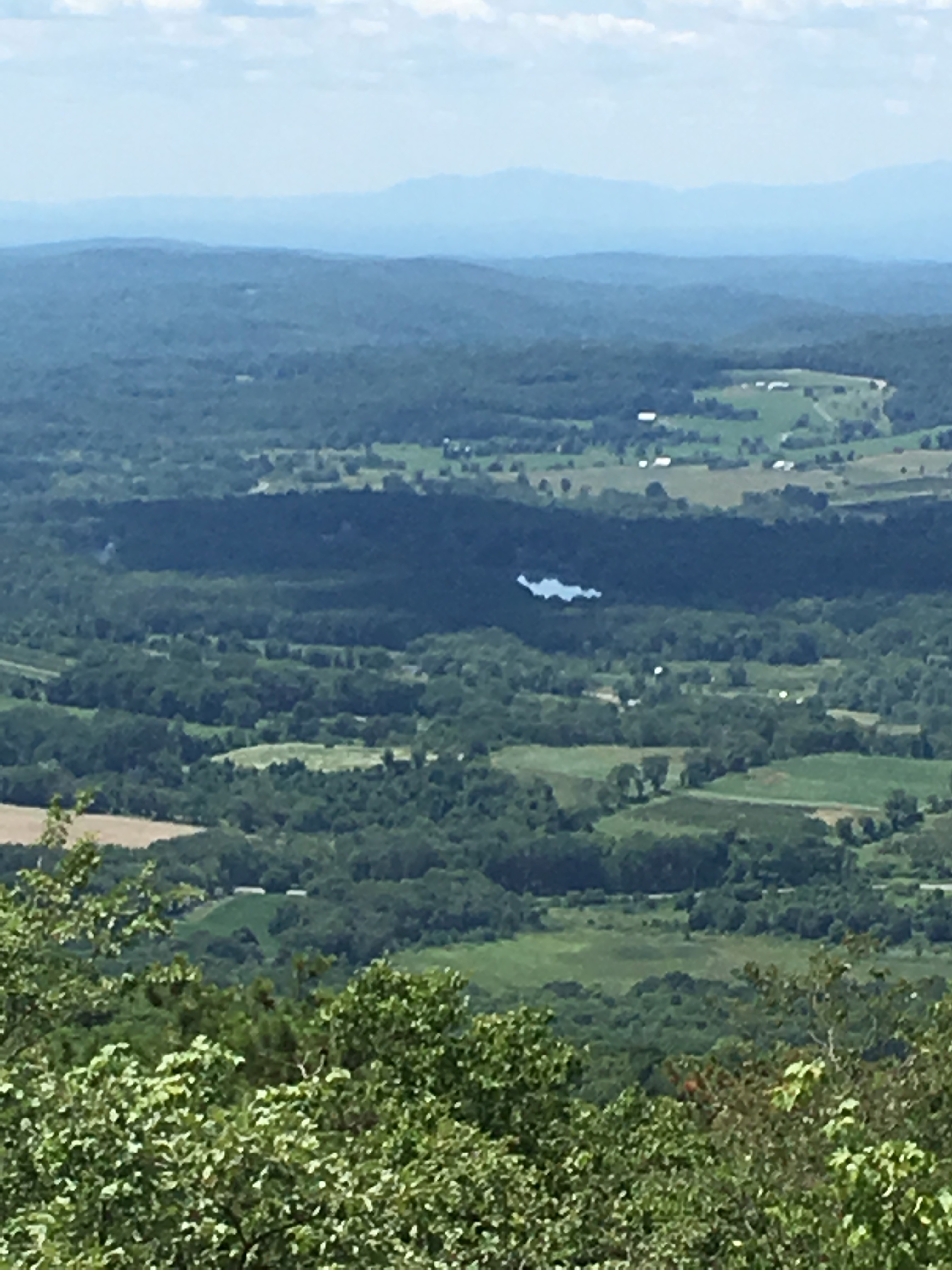
The Sunset Rock Trail, which is a little over a mile round trip, does not seem as long when you’re hiking it. It could be because it changes so drastically in such a short time, or it could be because after not much effort at all you get to sit on a rock and look down over the Peaceful Roe Jan Valley and out into the Catskills, infinity and beyond while you eat your peanut butter and jelly sandwich. 

I would have expected that a trail that leads to a rock with a million-dollar view would be a tough uphill climb, but most of the uphill is in the car on the seasonal dirt road to the parking lot. I sure enough feel the burn where my leg hit the desk on the one steep ascent, but my walking stick does most of the work. 
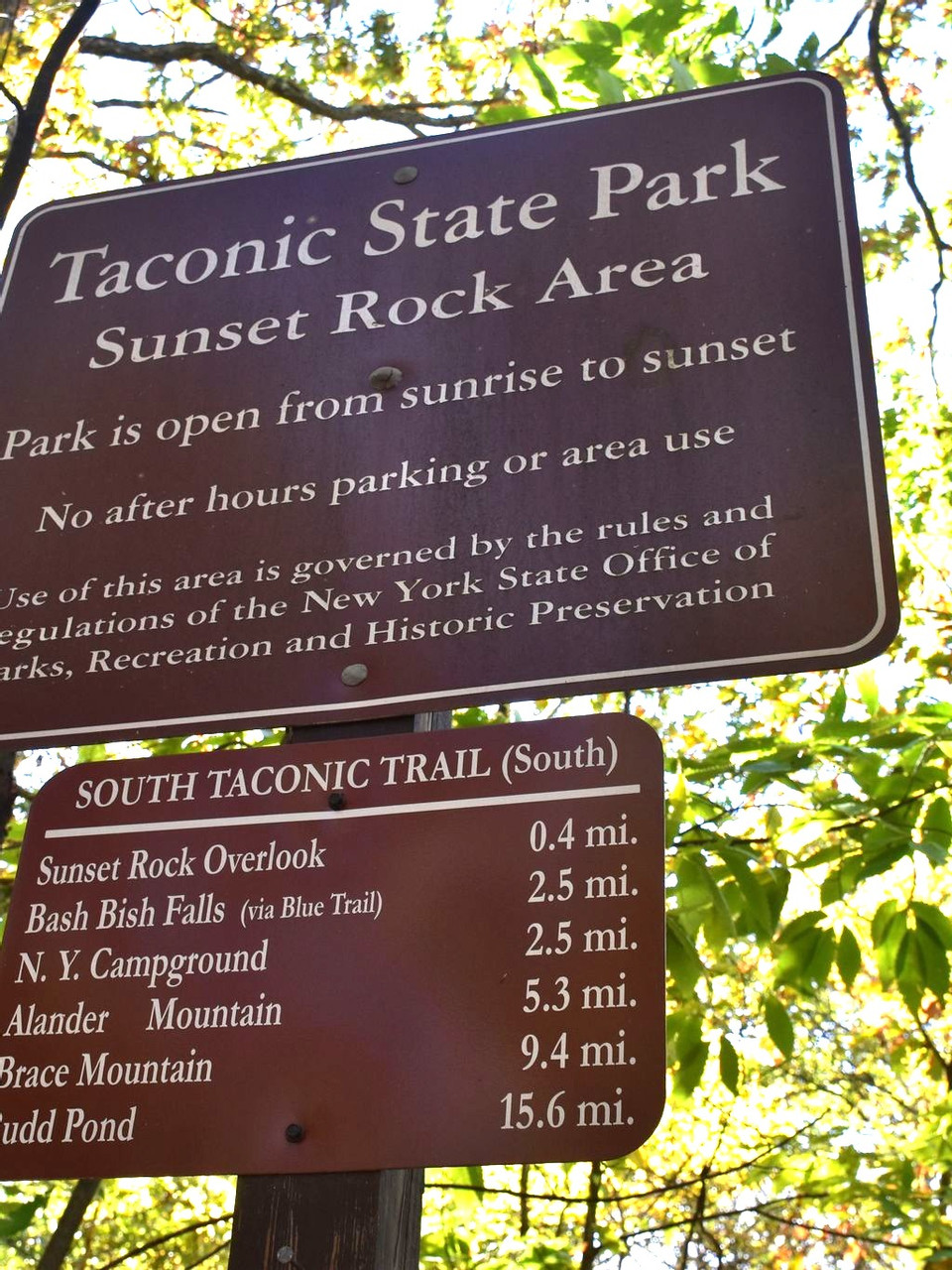
Once you level off on the Sunset Rock Trail, you’ve reached a new climate with a little dash of alpine.  Here you enter a clearing where there are smaller trees and bushes. There are big clumps of mountain laurel blooming in June and July. The air seems to improve suddenly. You’re at the turnoff where the Mighty South Taconic moves on north to its terminus at Catamount Ski Resort, and if you go that way by mistake, you’ll be back in the deep woods and you’ll miss the rock and your peanut butter and jelly sandwich. So don’t do that. Walk to the right.

If you go the right way, you pass through a wild place that looks like it was personally landscaped by God. It’s a tunnel created by high hardwoods on either side leading you through a path of ferns. One does have to be aware of mother#$%ing snakes up here, as they like to move towards the light when it starts to warm, and they like big sunny rocks as much as people do. And those particular Taconic-Berkshire mother#$%ing snakes just happen to be deadly rattlesnakes. 

I’ve never run into one, thank Jesus, but I keep them in the back of my mind, like my own impending death. But so far, I’ve evaded both. I’m told that rattlesnake encounters are relatively rare. Besides which, this one little stretch of trail seems so removed from civilization that you might just as likely run into gnomes and fairies, which, while they can enchant you, will not attack you with venomous poison. 

Still, I never let my guard down. 

The view from Sunset Rock just goes on and on and on, and under ideal conditions, it will make all your worries disappear and you will be born again. But there’s always the chance that a few of the droves have broken loose from the Bash Bish Trail and have wandered up to the rock, waiting to annoy you upon your arrival. A friend of mine who hiked the Mighty South Taconic all the way up from the campground to the rock one day ended up having to share the view with a group of people who just wouldn’t shut up, a situation he described perfectly as, “kind of a buzzkill, John Daniel.” 

Not to take anything away from the Bash Bish Trail. It is the Kingdom of the Droves and it always has been, but it’s a beautiful, beautiful place that, ultimately, people can’t ruin, although they have tried very, very hard. 

First Insider Tip on the Bash Bish Trail: Take a Monday or a Tuesday off from work. Or be prepared to share it with lots and lots of people on a Saturday or Sunday. Second Insider Tip: All Massachusetts State Parks are alcohol-free, by decree of Governor Michael Dukakis forty years ago. So if you happen to be working on a forty in a brown paper bag as you swagger along the trail, because that’s how you roll, you’re going to have to either finish it or pour it out on the state line. 

Third Insider Tip:  When you get to the falls, don’t even think about climbing up to the top and diving 200 feet down into the inviting pool of water below, because if you make it you’ll likely get arrested by the Mass Park Police, and if you’re anything like twenty-five reckless or inattentive people in the last century or the mythical Native American woman named Bash Bish with a lot of emotional baggage who didn’t make it, it will be the last thing you do.

Trisha would call this an “unchristian” thought, but it is kind of cool to live near one of the most dangerous tourist attractions in the world. More no street cred. And the thing I love about the falls most of all is, no matter where I am or what I’m doing, It’s always up there Bashin’ and Bishin’, twenty-four-seven, waiting for me to come back and stare at it. It’s Bashin’ and Bishin’ right now. People like me who have been hiking up to the falls for years feel a sense of ownership, like they’re on their way to the home of an old friend who’s always up for a visit. People who have visited once never forget it, and they usually plan to get back there someday. 

The trail from the parking lot to the falls is the epitome of a good little hike. Which is to say, that, among good little hikes, there is no better good little hike. Especially if you’re Mookie. Three-quarters of a mile through a state and a commonwealth, deep woods full of interesting scents rising to your left, the trail wide enough to ensure social distancing for people and dogs passing the other way, although Mookie doesn’t really know what those words mean. All he knows is there are people and dogs of all sizes everywhere and the freshest swimming water in two counties. It’s a festival of external stimuli. 

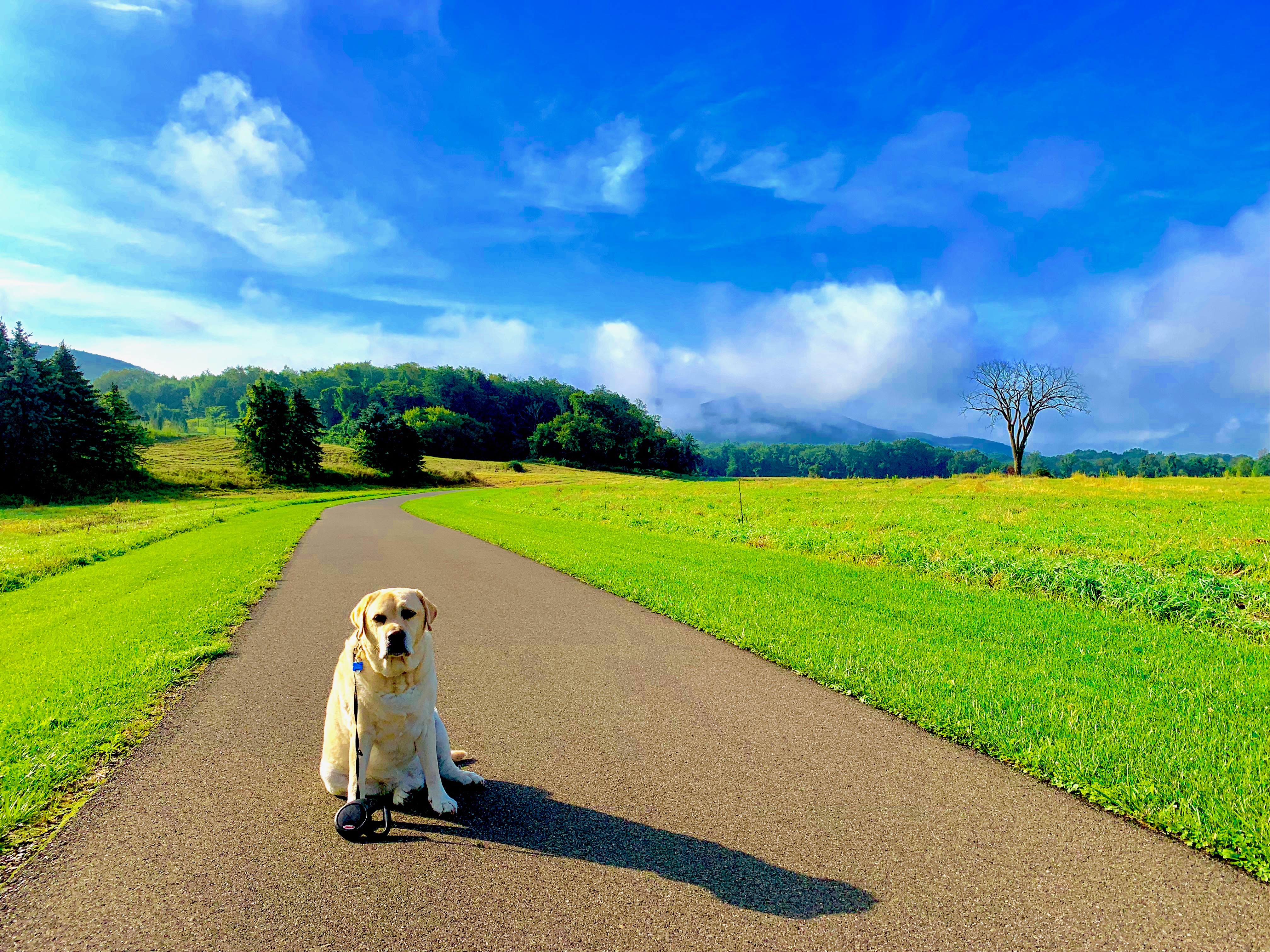
The instant that my nine-and-a-half-year-old labby gets out of the car at the Bash Bish parking lot, he’s a puppy again. The first stop is to check the trail kiosks for the latest pee mail. Then he knows the path slopes down gradually until the place where he goes swimming, so he takes me for a walk, and I let him lead. 

On one good little hike, when we he was around two years old, Mookie and I were playing in the Bash Bish Brook when we met some nice Massachusetts hippie girls – paisley bandana kerchiefs, nose rings and everything – who had a baby girl with them. The baby was six weeks old, but the hippie girls thought it would be cool for the baby to meet Mookie, and Mookie thinks it would be cool to meet everybody on Earth. And there I was, standing in cold water under warm summer skies, watching an animal for whom I was legally responsible and whose teeth were designed to rip through flesh and bone leaning in to sniff the face of a six-week-old baby. It was one of those moments early on when I realized I was walking around with God’s Most Perfect Dog. 

And by the way. That water? Go ahead and drink it. Fill up a bottle with it. Yeah, I know, dogs and barefoot droves. Still. It’s holy water. It cures everything. @ me. 

Everybody loves this stretch of the Bash Bish trail. On hot days, people stake out a spot on the brook and just sit there in for hours. There’s lots of big boulders in the middle of the brook to play on or take your narcissistic selfies on. Please be advised though, that if you decide to build a little balancing stone statue on one of the boulders, which seems to have been a thing for a while now, the manager of Taconic State Park, normally the most affable of gentleman, will come along at some point and angrily kick them over. God put the stones where he needed them. As much fun as stone balancing is, God know what he’s doing. Leave the damn stones alone. 
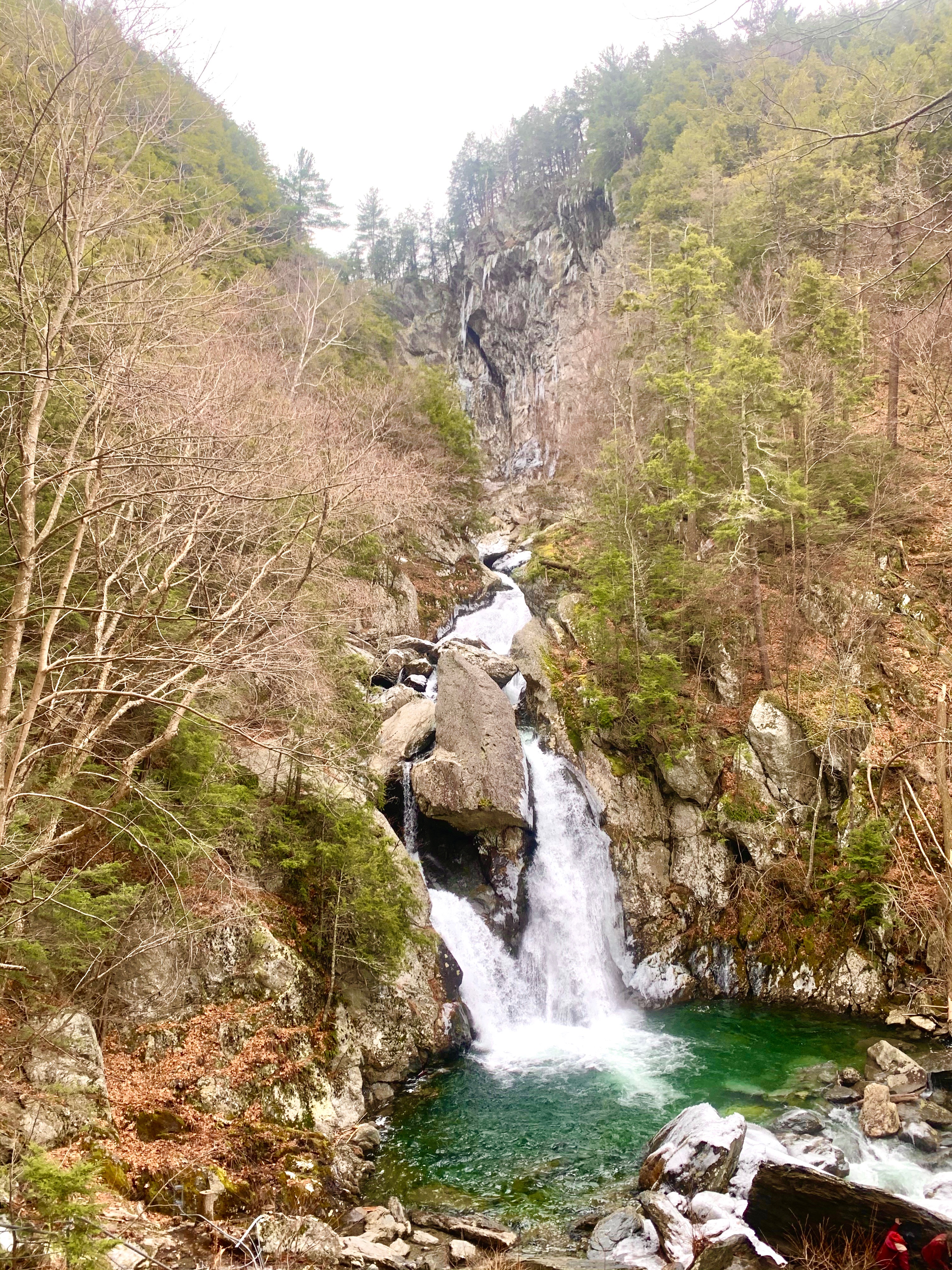
Things got out of control in the summer of 2020 during the Pandemic. Droves invaded from every direction. They parked all over Copake Falls and dragged barbecue equipment and other bad ideas into the park and down the trail to the falls. On the weekends of these Drove Invasion Days, Mookie and I went up to the Roe Jan Park that the droves don’t know about – yet- to get in our swim and our good little hikes. 

By the third week of July, there were police roadblocks at the two entrances to Copake Falls off Route 22. To go get take-out from Dad’s Diner or the Church Street Deli, I’d have to get waved on to make the left out of the hamlet, then fifteen minutes later, smile, roll down the window and say, goofily, “Hi! Just goin’ back to my house with lunch!” to armed law enforcement officers. Fact is, all my ID says I’m from Long Island, so I had to rely on their kind nature to gain entry to Route 344. 

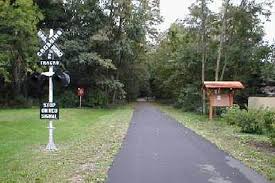
This insanity reached its zenith when people began lining up in their cars in a staging area for hours on Saturdays and Sundays just to get the chance to get in a good little hike to Bash Bish Falls. Mookie and I stuck to the Rail Trail, the Roe Jan Park and our secret little spot under the bridge. 

You can’t blame the droves. Not all of them were unrepentant assholes from Long Island. Some of them were good, nature-respecting folks who were just trying to get out of the house. Of course, I didn’t have to clean up after the unrepentant assholes, so my sympathy comes easy. But these have been miserable times, and I’ve been using a good little hike through the woods to Bash Bish Falls for years to inject my spirit with some instant happy. Why would I, a nauseatingly lucky son of a bitch, deny that to anybody else, especially now? 

Mookie and I went back to the Bash Bish Trail on the last day of September. It was a Wednesday. To the untrained, non-park-employee eye, the area showed no signs of the human invasion it had experienced over the summer, but the friendly Mass Park Policeman on duty that day to make sure nobody jumps off the falls told me stories that would bend your bones. The air was crisp, the trees were in color, and the brook was not too cold yet. So Mookie got in his swimming, then we walked along and said hi to people in masks as we climbed the big hill past the Mass border and up into the trees, where you’re at eye level with the birds. Our old friend was waiting for us up at the end of the trail, Bashin’ and Bishin’ away, and we sat on a rock, and we stared for a while.

We were there again for the First Day Hike on New Year’s Day of 2021, when everyone was guilty of a little magical thinking, but that’s how it should be. The First Day Hike was led by the affable park manager and his beautiful Newfoundland dog Mahi Bear, whom Mookie resents because Mahi gets more attention. There were only about ten or twelve people with us on the hike, but there were lots and lots of other visitors on the trail. The weather had suddenly improved and a few hundred people had the same idea at the same time: 2020 was such catastrophe of sadness that they were damned if they weren’t going to start 2021 by heading up to Bash Bish Falls for an injection of happiness. We greeted every single one of them, and they greeted us back. A few of them told Mookie how beautiful he was, and he wagged to say he knew that, but thank you for saying it. 

Mookie and I love the Bash Bish Trail, and the Harlem Valley Rail Trail, which is great for broken down old guys from Long Island. Neither one of us needs to walk to Maine, or even the three mountains of the Mighty South Taconic Trail. But it is nice to know they’re up there. In his good dog life, he has gotten little licks of peanut butter while looking down from Sunset Rock over the Peaceful Roe Jan Valley. And if I want to go get lost in the woods for a while, my giant oak tree bench on the Wood Thrush Trail is there waiting for me. If it’s time for a little excitement and some holy water, we’re off on another good little hike to check on our old friend, always up there Bashin’ and Bishin’, and always up for a visit.  

And if it ever seems like I’m taking any of this for granted, please don’t hesitate to pick up a couple of stones from the brook and aim them at my head. 

Copyright 2021 by John Duffy

All Rights Reserved

Chapter 4 of Mountain High, Valley Low or My Life As a Wishbone: Tales of Valley Stream and Copake Falls, New York: “The Road to Nowhere”

Mookie Dog knows he’s got it good up in the country. In his Labrador heart, though, I think he’d always rather be in Valley Stream. For one thing, he has deep and soulful connections with all three of his cats, and it’s difficult for all of them to be separated. But that’s a story for Chapter 5. I feel bad for him because his puppy brain struggles to make sense of things these days. You can explain the what, the where, the who and sort of the when to dogs, but they’ll never fully understand the why. We do too many things that just make no canine sense. 

For the first eight and a half years of Mookie’s life, we took one or two long trips in the car in July and/or August. He stayed at his friend Gina’s K9 Bed and Breakfast a mile away because he wasn’t supposed to be in the cabin, and I’d come by to take him out to play for the day, then bring him back, and then after a couple of days we’d take another long car ride and everything went back to normal. For the rest of the year, including all the cold months, we were in the home he first arrived in as a nine-week old puppy. So you can certainly imagine his confusion as he finds himself, at the equivalent of 63 years old, suddenly going on two and a half-hour car trips every couple of weeks. 

But if I told him right now that we were going for a ride in the car, he would immediately begin wagging and hopping up and down and panting, because it would mean that we would possibly be going somewhere where things smell differently and there might be water for swimming or at the very least people who rub his face and say hi. We’d get there, wherever there might be, have our fun, and as soon as that fun was over and he came back to wherever we started, he’d have a short nap, then return to staring at me and moping, like he’s doing right now. He’s a fun junkie, my dog is. 

And even though he willingly and joyfully gets in the car every time I suggest the idea, he plainly dislikes the sensation of the wheels moving under him. Though a purebred labby, he’s just not a head sticking out the window dog, which is something I’ve accepted about him. I don’t shoot ducks out of the sky and he loves me just the same. As any long car ride evolves, If he’s not lying down across the back seat in defensive sleep, he sits up and stairs down at the seat with an expression I can only describe as existential dread, and I say, “everything’s OK! Everything’s fine! Lie down, Puppy!” until he lies down again and tries to sleep. He especially dislikes exit ramps. They mess with his large center of gravity. 

But while long car drives are stressful, staying home while I disappear for a couple of days is far more so. There were a few trips when I needed the whole car for transporting stuff and I left him home, safely with the others in the pack who have access to the dog food, but still this was not acceptable. So when he sees the duffle bag and the cooler come out, he never lets me out of his sight. And the cycle continues. 

This place where we go these days, which I realize will never truly be home to him until his cats are there, only recently got comfy couches, a dog crate and a big comfy queen bed. For the first eight months, he had a dog bed on the floor and an air mattress that made him nervous. But while he enjoys these amenities we’ve provided, and he loves his big upstate backyard that smells like bunnies, he misses his neighborhood around Duffy’s Creek. He’s spent most of his life marking every tree and pole within two square miles of his house, and that’s not an accomplishment that’s easy to just walk away from.

In Valley Stream, we’ve gotten to the point where he takes me for walks, and ideally, to him, those walks are circular in nature, or at least Q-shaped. He has pre-determined routes where he has to check and respond to his pee-mail at specific poles and trees. My job is to follow along with plastic bags and keep him out of trouble.  

And while he certainly enjoys the variety of scents that one can encounter in and around Copake Falls, it’s taken him some adjustment to accept that the majority of our walks in the country are linear. We go somewhere and then we go back the way we came. It’s the Road to Nowhere. Picture a man and his dog on two ends of a taut leash, debating about which of two opposite directions is the way they have to go now. It looks as ridiculous as it seems. 

But he ultimately recognizes and accepts my position as the Alpha Dog. Actually, it’s bigger than that. He thinks I’m God. And of course, God doesn’t always give you what you want. Sometimes you can’t go lick the baby in the stroller and sometimes you can’t try to jump in the hammock that your favorite neighbor set up in his garage and that’s the way it is. God is all-knowing, and Mookie accepts this because he has faith. Every walk with God is essentially a good walk, circular or linear. Just like my own relationship to my own God, he’s a stubborn mule and his God loves him anyway. Besides, only a loving and benevolent God would know about a place like the Harlem Valley Rail Trial. 

My relationship with the Rail Trail predates my relationship with my dog, never mind my human child. It goes back to the year 2000, the first year that Trisha and I took a full week of vacation in Columbia County. It was three days of camping with the hippies on Long Hill at the Falcon Ridge Folk Festival in Hillsdale (what a scene, man) then four days in cabin GH1 at Taconic State Park. Back then, everything was new to us and everything was the greatest thing ever. (“Hey! The Methodist Church is having a chicken barbecue!” “There’s a school near here where kids learn about organic farming!” “Did you know Copake had a lake? It’s huge!” “Look at the price on this house! Two acres!”). And since (blessedly in retrospect) we didn’t have any magic rectangles with Internet connections while we were there, the first two days back home on Long Island would be filled with wasted hours looking up every single thing I’d come across in Columbia County the week before. (“Hey honey! Those cows we saw last week on North Mountain Road? Brown Swiss!”). 

I walked up to the Depot Deli the morning after we checked into cabin GH1, and there it was, something to do, forever: A paved path that hadn’t been there before with a sign explaining that I was entering the Harlem Valley Rail, which “derives its name from The New York and Harlem Railroad, chartered in 1831 and opened in lower Manhattan in 1832 with horse-drawn cars. In 1842, the line crossed the Harlem River, and in 1973 joined the New York Central Railroad, becoming known as the Harlem Division. By 1852, it extended north to the village of Chatham. In all, the line stretched 131 miles of track. What you see today while hiking and biking on this recreationway is a glimpse of Columbia and Dutchess Counties as thousands of paying customers saw the countryside until a little more than two decades ago, when passenger service was discontinued between Dover Plains and Chatham in 1972.”

Post-vacation research uncovered that this had all been developing under my radar for years. The first segment of the Harlem Valley Rail Trail opened in 1996, eventually connecting Wassaic, the last stop on Metro-North, and hence the southern end of the Rail Trail, to Amenia, which is a nice, little place. A connection from Amenia to Millerton, an equally nice, somewhat bigger little place than Armenia, came later, but I wasn’t hip to any of it at the time, as these were just the towns I passed through on the drive north and I wasn’t going to be in them again until my drive south. I also learned that there are a whole lot of people who have volunteered a whole lot of time and energy to building and maintaining this trail, and the guilt I feel at not being one of them is manifested annually to this day in the form of a charitable contribution to the Harlem Valley Rail Trail Association the week after Christmas.  

The Copake Falls to Valley View Road to Undermountain Road in Ancram section of the trail opened in 2000, just in time for me to stumble on to it that morning. The first thing I thought to myself as I began ambling along is I gotta bring my bike up here next year, though it was plain as the years passed and the Rail Trail Culture evolved that I’d be no match for serious fellows in black speedos and wicking shirts with bright yellow and orange patterns and calf muscles like beer kegs who’d often pass me by. No matter, I like my calf muscles as God made them, and for me the bike would be just a way to get to the places where the cool birds are. 

Birdwatching has always been one of my things, growing up on a creek and all. I had to know that those little ducks with the black and white heads who showed up in the winter were hooded mergansers, and not just  those little ducks with the black and white heads, and I had to know that they bred in wooded lakes, ponds in rivers in Canada and migrated to tidal creeks and estuaries all over the U.S., including mine. When I meet birds, I want to know their names and I want to know their stories.

That morning, I walked the first section of the trail, a little over a mile to Valley View Road and back again (while my fiancée, who was told only that I was walking to the Depot Deli for newspapers, waited back at the cabin, in days before I would’ve thought to take my cell phone just to walk to the Depot Deli). I walked over the bridge the spans the Bash Bish Brook, little knowing at the time that the swimming hole directly under that bridge would be my dog’s favorite spot someday, or that I’d be pushing a stroller across that bridge not four years later, or that I’d be following behind a red Radio Flyer tricycle on that bridge a couple of years after that, or that twenty years later I’d be riding across that bridge on one of the two bicycles that I bought on Craiglist from a guy who I’d exchange $350 with in the parking lot of the Pittsfield, Mass. Wal Mart so I wouldn’t have to keep lugging two bikes back and forth from Long Island, which I’m embarrassingly aware was a First World Problem. 

A little ways past the bridge, the west side of the trail opens up into a view of farmland sweeping up a gently rolling hill. Later, when I hit the trail at sunset, I found out why they had decided to put a bench there, as the sun sets directly behind that hill all summer. And I’ve got a thing for sunsets. On the east side is more farmland, but on a steeper climb, leading to the houses on the top of Valley View Road that are built into the side of Washburn Mountain, a point at which, if you can get a bike up the ridiculously steep hill that starts where the Rail Trail meets the road, whether by walking it up or with your overly-developed calf muscles, you can do a 30 mph coast about three quarters of a mile straight downhill and around a big turn right back to the Taconic State Park cabins. Just watch out you don’t get killed.  

In case you’re interested in trying the Valley View Downhill Challenge, this is where you’d disengage the brakes.

The morning I discovered the Rail Trail was a sweet, summer stunner and it was a Tuesday, so I pretty much had this whole thing to myself, and I knew Trisha wouldn’t be mad at me for wandering off once I told her what I’d found. While the spectacular views emerge in front of you, the trail is still lined with trees and bushes, and the birds were bursting at the seams. A line of thick brush along a farm or an open field or a meadow is what the good people at the Cornell Ornithological Society would tell you is “edge habitat.” 

I met some of my usual friends walking along the edge habitat that morning; cardinals, robins, sparrows, chickadees. My favorite bird, the grey catbird, was following me all down the trail, greeting me by name as he always does. “Johhhhnnnn!” I started to get the feeling that I’d be spending a lot of time here. 

At the point where the Rail Trail meets Valley View Road, the paved trail ends, and one has to follow a mostly uphill dirt road for about a half mile before reaching the next paved section that takes you south to Undermountain Road in Ancram. There are several properties along this dirt road. I may not have this story straight, but as I understand it, there’s a property owner who not only owns the road in front of his or her house but also the small meadow that looks out over the Peaceful Roe Jan Valley (hence “Valley View”) on the other side of the road. Apparently, this property owner refused to allow the road to be paved. There are also benches set up to take in the Valley View, adorned with angry “POSTED!” signs on poles surrounding them in case you even thought about sitting on one of them. 

When the Harlem Valley Rail Trail is complete, it will run 46 miles from Wassaic to Chatham, and that half mile might be the only part that isn’t paved. The HVRTA has purchased 14 of the privately held miles from Copake Falls to Chatham, and NYS State Parks, who run the Rail Trail, are “in negotiation” for the other 22 miles. Knowing the way people are, they’re bound to run into a few more selfish types before they can connect the whole thing. Some of our neighbors on the bottom of North Mountain Road have the trail right in their backyards, and down in Millerton, there are houses you could jump into from it, and I don’t think anyone is being terrorized by gangs of thuggish nature enthusiasts. 

I can tell you two things: One, I have passed the property in question on Valley View Road probably fifty times over twenty years. It’s built into a hill and has lots of windows.   Every shade in every window has been pulled down every time I’ve gone past. Two, while riding past that in that meadow, I saw the biggest male deer I’ve ever met in person, and he didn’t give a rat’s ass that he was on private property. 

I didn’t continue on to the Undermountain Road section on my first visit to the trail that morning, again because I’d wondered off without telling Trisha, which I can attribute to less than a year of having to tell someone where I was going after going wherever I wanted whenever I felt like it for most of my adult life to that point. On the way back along the dirt road, in a heavily wooded area at the point where the rail trail to Downtown Copake Falls goes to the left and Valley View Road goes straight up in the air, I saw a wood thrush low in the bushes after following his call;  a deep, rich “bood-dood-a-weeeeee!” with bass in the “bood-dood” and treble in the “weeeeee!”. It’s a Morning in Copake Falls Sound, and like the nighttime sounds of bats chatting in the trees and coyotes howling at the full moon, I get homesick for it when I’m on Long Island. 

On the way back to Copake Falls, at the point where the sun goes down behind the hill, I saw a meadowlark singing his heart out from the top of an evergreen tree. I said screw the bike, I gotta come back here with a pair of binoculars. And Trisha.

I don’t know if it was that year, or two years later in ’02, when we walked the trail from Copake Falls to Undermountain Road to get in some intensive birding, early in the morning, heavily caffeinated and armed with binoculars and the Peterson Guide. I know it wasn’t ’01 because we were a little preoccupied with getting married that summer, and though we managed to squeeze in a couple of nights of camping out on the hill with the hippies at Falcon Ridge, we didn’t make it down to the park. We haven’t missed a year since then, and now we never miss a month, but I digress. 

The best birding turned out to be in a stretch with big trees adjacent to farmland most of the way, but with enough high trees along the trail itself for some kick-ass edge habitat. The catbird followed us along and called me by name. The wood thrush played their stereophonic flutes in the deep brush. All the cool songbirds were there: Little warblers and vireos that are only pass through Long Island in spring and fall all darting around here like they owned the place, swallows and flycatchers swooping over the fields while vultures and hawks hovered in circles above like guys cruising their hot rods around town. We found a whole family of cedar waxwings, Trisha’s favorite bird, with their new wave haircuts and their squeaky metallic “zeeet” call that sounds like feedback from tiny guitar amps. 

We took a lot of walks specifically to watch the birds back then. We followed people with very expensive spotting scopes around the pond at Jamaica Bay picking up pointers. I dragged the poor woman around the dunes on the West End of Jones Beach when she was six months pregnant, but we did see a saw-whet owl sleeping in a fir tree.  We spent my fortieth birthday circumnavigating Camusett Park and Target Rock Wildlife Refuge on the north shore of Long Island. We saw lots and lots of birds that day, but the highlight was spotting a bluebird flying across a field. 

When I think back on that first walk to Undermountain Road with my gal, that will always be the day of the indigo bunting.

Indigo Buntings are bluer than bluebirds. They’re as blue as blue gets before it starts turning black. They’re the blue of the denim jacket you got for your 13th birthday. And they chirp a little song like an overly friendly storekeeper who’s had too much coffee. “Helloo! It’s a beautiful day! Nice to see you! Thanks for coming! Isn’t this great! Please! Look around!”. He sat on top of a bush in plain sight, no binoculars needed, and sang to us and showed off his magnificent blueness for as long as we wanted to look at him, and we looked at him for a long, long time. 

Indigo Bunting: Photo credit Wendy Paulson – Birds of Barrington.

Once we got into the baby business, we had to curtail the birding adventures a bit, but by that time we’d built a wildlife refuge on the creek in the backyard, and there were still lots of high trees around that have since been cut down, so we put out lots of seed and let the birds come to us. One snowy January night in the Early Aughts we had twenty-one cardinals visit the feeders at dusk, something that will never happen again, as their homes were all cut up with chain saws over the ensuing ten years. But up in Copake Falls, where time stands more still and the trees are still tall, there was no better place to push a stroller than up and down the Rail Trail. And when it was time for the guy in the stroller to start powering his own wheels, that was the place to do it. 

And since you can’t rightly stare at trees with binoculars at the same time you’re making sure your five-year old doesn’t ride his bike into a ditch, we started to really appreciate the stunning variety of wildflowers just as much as the birds on the trail. Summer is a hippie festival of color and fragrance up and down the trail, and you can eat the wild blackberries and raspberries you come across and I promise that you won’t get sick and die. 

My son loves the Rail Trail. It’s never not been part of his life. He went from three wheels to four wheels to two wheels in the blink of five summers. Then of course Dad had to teach him about the Valley View Road Downhill Challenge, just to scare the crap out of Mom. I loved sitting on our front porch at GH7 waiting for him to come whipping around that corner as he coasted in. We regularly biked the Copake Falls to Undermountain Road and back again route together as part of our week in the park. 

They’re there.

Speaking of Undermountain Road, it’s under mountains, the biggest ones in the part of the Taconic Range that overlooks the Peaceful Roe Jan Valley. When you get to this section of the Rail Trail, you’re literally under Alander Mountain. The trailhead is just down the road. There’s another big boy called Brace Mountain that is easily accessed from Copake Falls. These mountains are not much taller than Baker Mountain in Saranac Lake, which I climbed twice in the last three years. When I was a whole lot younger, I climbed Mt. Marcy, the highest point in New York State and a mile up in the air, at least five times. I have a brother who is four and a half years older than me who still climbs mountains whenever he gets the chance and is working on being an Adirondack 46’er. I’ve also got a pack of Marlboro 27’s on the patio table. 

My excuse for not climbing any Taconic Mountains to this point is that I didn’t have a day when I happened to be up that way and the weather conditions would make it worth the effort. Now that I’m a part-time resident, that excuse is trickling away. I know I could always ask one of the people I know in Copake Falls who are in their 80’s, and don’t have a pack of Marlboro 27’s on their patio table, to serve as a guide. They climb the local mountains all the time. There’s something in the water up there and I sure as hell hope it works for me. 

Less intimidating is the challenge of a bike ride from Copake Falls to Millerton on the Rail Trail, which should be possible by 2021, when the newest eight-mile section is completed. That would be 12 miles of mostly level or slightly downhill rolling, with a sandwich and a ride back from Trisha waiting at the Millerton parking lot. Hell, we could even make it to Wassaic, 22 miles away, as long as I get that sandwich and that ride. Dream big, that’s what I say. 

I could point out to anyone who might actually be using this document as a guide to the Harlem Valley Rail Trail that you could stop wasting your time with me right now and got to hvrt.org, but I could also tell you that the two and a half miles of trail south of Millerton to Coleman Station (I haven’t made it to Armenia or Wassaic) is just about the nicest walk or ride you’d ever want to take. Right after you pass through the pretty little town, and right before the trail opens up to some beautiful scenery, you go through a section that was originally created by blasting through solid rock, and the solid rock they didn’t blast remains on both sides of you, so it’s always about fifteen degrees cooler on this part of the trail than it is everywhere else, which was a blessing on the hot day that Jack and I finally got around to riding this trail last summer, which was the same day I inadvertently cooked a mouse in the oven, which is a story for Chapter 6. 

In 2010, ten years after the Copake Falls to Undermountain Road section opened up, the trail was extended north to Orphan Farm Road, which now borders the Shagbark Tree Farm. This is the stretch where you’ll find Mookie and I most often these days. It’s a nice mile and a half jaunt with what is probably the most spectacular scenery that the paying customers on Harlem Valley Line saw from the trains, although I can’t state that for a fact. There is also a small section across Route 22 from Black Grocery Road (the etymology of which I want nothing to do with) to the Herrington’s Hardware store parking lot in Hillsdale. Eventually, the plan is to build a pedestrian bridge over 22, connecting Orphan Farm Road to Black Grocery Road, thereby connecting everything from Wassaic to Hillsdale, which would give the trail 26.6 of its eventual 46.1 miles to Chatham. The motto of the Harlem Valley Rail Trail Association is “Chatham or Bust!”, and I take them at their word. 

The Orphan Farm Trail.

Meanwhile, the end of the Orphan Farm trail is where Mookie questions the need for walks to be linear rather than circular in Nature. His nose tells him that his second home in the country is right up there at the top of a very steep and narrow path that runs between the hill full of Happy Little Trees and a heavily wooded patch of the Rail Trail right-of-way leading into my neighbor’s backyards. This shortcut back to Trisha’s Mountain is easily accessible from the Orphan Farm parking lot. He’s sniffed it and seen and it for himself while sitting on his front porch up on the hill. As a matter of fact, we could make this a completely circular walk by traveling down North Mountain Road to the rail trail, then climbing back up this path right back to our mailbox. What he doesn’t know is that 1) It’s private property, which he wouldn’t care about anyway, and 2) Trisha has already seen a coyote and I’ve already seen a black bear emerge from that path in broad daylight, not at the same time of course (that’d probably be newsworthy, even in Columbia County), and if my stubborn dog thinks he can talk shit to animals that live in mountains like he does to dogs and cats and squirrels that live in Valley Stream he would be tragically mistaken. God watches after fools, little children and their dogs. 

And since Mookie can’t think figuratively, which is really one of the best things about him, I wouldn’t be able to explain to him that these one-way walks are sort of metaphoric. While I hope we’re walking together for a couple of more years, mortality will eventually come between us. He’s a 9-and-a-half-year-old dog and I’m a 57-and-a-half-year-old human doing his best to stay alive in the midst of a pandemic. The road we’re on is not a circle, and one of these days, we’ll have gone as far as we can go. 

But the good news is that neither one of us I really have anything left to prove to anybody. We’ve both been good boys, and now we’re just trying to live in the moment, both happy to be walking relatively pain-free. Our journey is our destination. We’re on the road to nowhere, but baby, it’s all right. Despite all of our shared internal conflict about leaving behind everything we’ve loved and marked back in Valley Stream, when we’re out on the Harlem Valley Rail Trail, and the sun is shining and the birds are chirping and the breeze is blowing and the wildflowers are blooming, there’s just nowhere else we’d rather be. 

Copyright 2020 John Duffy

All Rights Reserved

Chapter 2 of Mountain High, Valley Low or My Life As a Wishbone: Tales of Copake Falls and Valley Stream, New York – “One Runs The Risk of Weeping a Little”

106359156_10213483135272533_3362060296191845768_n

(With acknowledgement to Antoine de St. Exupery for the help). 

My father was a Covid-19 statistic. He died at the age of 90 on April 26th, 2020, at the height of the Pandemic in New York. He suffered from advanced dementia, and the fight left in his body was no match for the virus. As he was living in a skilled nursing facility, none of his children or grandchildren (or great-grandchildren) could be with him to say goodbye. The last time I saw him was on February 16th and I could see even before he was stricken that he had taken a general turn for the worse. Of course, if you tell me that his contacting coronavirus was a blessing in disguise I’m gonna come over there and kick your ass.

Neither he nor my mother, who died in 2012, ever saw Copake Falls. If they had been just a couple of years younger and healthier back in the Early Aughts, maybe they could have come up and stayed at a local B & B and hung out with us at Taconic State Park for a day or two. I sure would’ve liked that. As a matter of fact, it’s a recurring dream that I have every once in a while, and I even like the distorted dream version of them visiting.

IMG_1481
My parents at a house they rented on Rainbow Lake in the late 1970’s.


They were the ones who first took me upstate after all, and they would have loved the Peaceful Roe Jan Valley. They actually kicked the tires on a house way up in Rainbow Lake in the Adirondacks when they retired, but they decided that it was way too much of a hassle to have two houses hundreds of miles apart. They were practical people.

I had a conversation with my father once about moving upstate. We were standing in the backyard on the creek in Valley Stream, the one that used to be theirs and became ours. He had grown up in an apartment in Astoria, Queens, so the 60 x 100 plot was all the room he’d ever hoped to have. He was a city guy.

Of course, since he started me out on the 60 X 100 plot, naturally I wanted something bigger someday. So we were talking in the backyard on the creek that day about how Trisha and I were very happy with buying the house in Valley Stream, but that we always followed the upstate real estate market around the place where we went on vacation every year.

This is how that conversation went:

Me: “… So we keep an eye on the properties for sale. I mean, this is great, but for what you pay on Long Island, you could have a couple of acres of land upstate, and that might be nice someday.”

Dad: (Genuinely perplexed) “What would you do with a couple of acres of land?”

Me: (Slight pause, unprepared for the question) “Stare at it! Walk around on it!”

At which point he responded with his hearty laugh and his million-dollar smile and we moved on.

Around this same time, I started teaching in a school in Ozone Park, Queens where I’d work for the next 16 years. I parked my car outside one morning in September right near where my new assistant principal (who would later become principal) had just gotten out of his parked car. I noticed that he had Vermont license plates. I thought to myself, “well, heck, there’s some pleasant small talk for the walk inside. This guy has a house in Vermont and I’ve been to Vermont. In fact, Copake Falls, where I go every summer, is only about 60 miles from the Vermont border. I’ll ask him about Vermont. Maybe he drives up Route 22 to get there.”

This is how that conversation went:

Me: “Vermont, huh? Beautiful up there. We go to a place near the Berkshires every summer. Copake Falls, New York. Ever hear of it?”

Him (distractedly): “Maybe. I think so… What do you DO there? Do you ski?”

(Narrator: “The Catamount Ski Mountain is one of the big tourist attractions nearby”).

Me: (Again unprepared for the question, and at a complete loss for what to say next) “Not much… Uhhh…We hang out. We watch the birds.”

Him: (long pause). “Hmmm.”

And then we went to work. But (sorry, boss) after I reported this disastrous attempt at friendly conversation to Trisha, it became an inside joke between us. We’d be sitting staring at a campfire or watching the trees swaying in the wind from the front porch of the cabin, and one of us would say to the other, loudly, “What do you DO there?”

IMG_1436
What we did there. On the front lawn of Cabin GH 7 in Taconic Star Park.


Well, now we have a place of our own in Copake Falls. With 1.9 acres of land. And to be honest, when we’re there, we don’t do a damn thing, really. In the words of the great Robert Earl Keen, “I kinda like just doin’ nothin’. It’s somethin’ that I do.”

You might see me taking Mookie Dog for a swim in the brook and a walk on the rail trail in the morning. You might see me and Jack on that same rail trail later on riding the bikes I bought from a guy on Craigslist who I met in the parking lot of the Pittsfield Walmart. You might even see us doing a little tree trimming and minor brush clearing around the yard. You might see me and Trisha watching birds from the front porch. We have campfires. We make dinner. We play ping-pong, pool and darts in the basement. We read and watch stuff. We drive on country roads to re-stock or to look around, then we drive back to the Mountain. Then we stare at it and we walk around on it.

IMG_0994
Mookie on the Harlem Valley Rail Trail.


And when weather conditions are favorable, and the Earth’s orbit is aligned correctly, we watch The Show.

106359156_10213483135272533_3362060296191845768_n

The Show, also known as the Trisha’s Mountain Driveway Sunset Festival, is made possible by four elements: The Earth’s rotation around the sun, the topography of the Roe Jan Valley and the surrounding mountains and hills, a road that rises to 800 feet up the side of a 1200-foot rise, and the Shagbark Tree Farm.

It was in 2002 when Trisha and I first stayed in Copake Falls for a full week together. One of my hobbies that week was to learn every road in the area, and how those roads connected to each other. It was so long ago that I did my research with a paper Hagstrom Map of Columbia County that I bought at the AmeriStore gas station. (Today, of course, you could look up our Valley Stream address on Google Earth and see Trisha getting out of her car in the driveway).

Early in this grand pursuit, I found North Mountain Road. The south end of North Mountain starts in the hamlet of Copake Falls off Route 344 and raises you up steadily. The north end takes you for a big twisty up and down ride past some very expensive houses set back on lawns with the square footage of the Pittsfield Walmart. Right in front of these fabulous properties is a small cemetery where the first St. Bridget’s Catholic Church was located. (Upstate New York: Home of the Incongruent Cemetery). The road then twists you sharply downhill and quickly back uphill several times for a roller coaster ride around a dairy farm where they raise Brown Swiss cows (imagine that) before it finally plunges you straight downhill and it spits you out on Route 22 close to the Hillsdale Town Line.

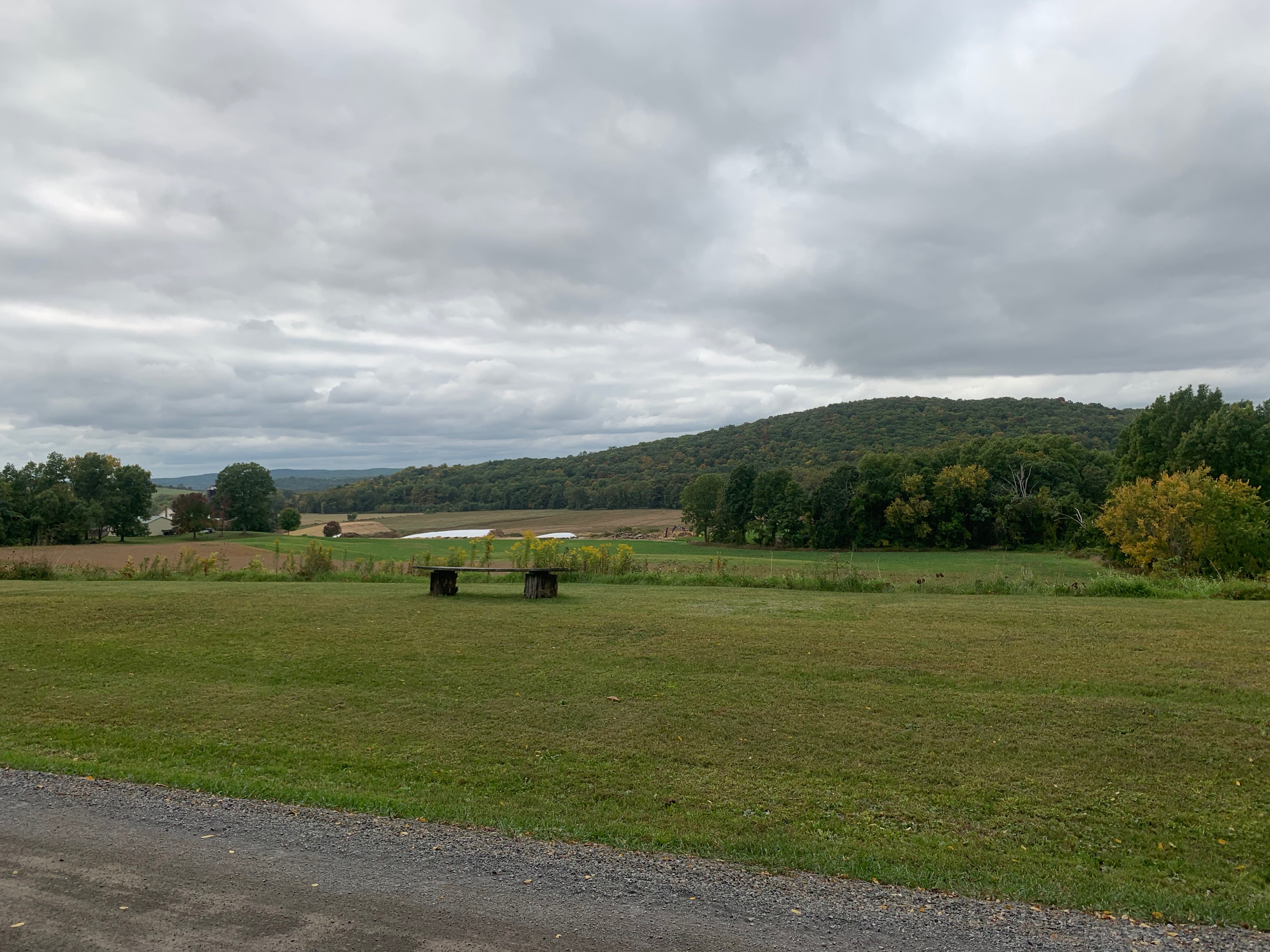
In the middle, when you’re up about as high as you’ll get, there’s a leveling off, and to your west about three or four miles away are hills that are just about equal in elevation to the one you’re on. Between you and those hills is the Roe Jan Valley, which we always refer to as the Peaceful Roe Jan Valley, because in 2002 we saw a guy who called himself the Singing Dentist perform a really campy song by that name in the auditorium of Taconic Hills High School and we laughed and we laughed. “I will spend my days / singin’ songs of praise / in the Peaceful Roe Jan Valley”. It’s catchy, isn’t it?

The Peaceful Roe Jan Valley is dissected by the meandering Roe Jan Kill, which is short for Roeliff Jansen Kill, which was named for a guy who led a party from New Amsterdam that got stuck in the ice on the Hudson River one chilly day in the 1630’s and stumbled across a tributary that runs 56.2 miles through Dutchess and Columbia Counties. And when the sun hits the valley just right, you can see the reflection of the Roe Jan Kill from North Mountain. It looks like silver mercury in a giant crooked thermometer. I already have a favorite creek, but the Roe Jan is my favorite kill.

Meanwhile, back in the Summers of the Early Aughts, Trisha got used to me taking the better part of an hour to come back from a ride to the IGA in Hillsdale five miles from Taconic State Park because I’d always have to check out another road that I found on the map. North Mountain was a no-brainer, as it led directly off 22 and planted me right in Copake Falls, so it was one of my first detours, if not the first.

I was flat-out flabbergasted by my first glimpse of the million-dollar view I’m going to try to describe here in words, and I should point out that among the mental pictures I took on my first journey was that of a yellow house that looked like an oversized mobile home, but had a little piece of that million-dollar view. How much less than a million dollars for that?

At the point where the hills level off along the top ridge of North Mountain, if you’re traveling south from Hillsdale, you pass a couple of gorgeous properties with ponds on the west side of the road. Past there, and continuing for about three-quarters of a mile, the entire long slope in front of you is part of the 800-acre Shagbark Tree Farm, on land that used to be a dairy farm called Orphan Farm. Here you’ll see seemingly infinite rows of happy little Aspens and Birches and Colorado Blue Spruces patiently awaiting their adulthood in backyards and bank parking lots.  And if you look into the distance beyond that slope, where the Peaceful Roe Jan Valley below levels off, you’ll see another piece of the tree farm that runs along Farm Road west of Route 22. As the hills on the other side rise up, the biggest piece of the tree farm looks straight back at you from Overlook Road. Behind that is more hill and behind that in the afternoon is the sun.

IMG_2610

And to make it even more fabulous, if you turn around and look north or south, the Peaceful Roe Jan Valley ends right below Copake and right above Hillsdale, so it’s nothing but mountain peaks stretching out to the horizon. Squint your eyes and you can see the faint outlines of Catskill Mountains on the other side of the Hudson.

All of this adds up to some motherf#%&ing beautiful sunsets.

I was a big fan of Bill Geist on CBS Sunday Morning. His thing was reporting little offbeat stories, mostly from small-town America. One of his best was about Sundown Days in Hanlontown, Iowa (now called the Sundown Hoedown), where they tried to promote the town with a festival built around the fact that right around the time of the Summer Solstice, the sun sets directly in the middle of the abandoned Union Pacific railroad tracks that run through town. I was totally charmed by the idea, as I am by every goofy idea (as is Bill Geist, God bless him), and luckily, there was a beautiful sunset that in fact lit up the railroad tracks for the CBS cameras.

The people in Hanlontown admitted they came up with this idea because there wasn’t much else to do. But if you’re watching the sunset, you’re doing something, even if it looks like doing nothing.

Our asphalt driveway on North Mountain Road is not quite straight like a railroad track. It is, however, directly in front of the southern boundary of Orphan Farm. Going south down the road from there towards downtown Copake Falls it’s all private property, with lots of big trees that block a full view of the sunset from the road. But from early spring to early fall we have a front row seat to the sun setting behind the hills to the west, above thousands and thousands of happy little baby trees. And for week or two after the sun lights up the rails in Hanlontown, Iowa, it lights up our driveway in Copake Falls.

Being apparently desperate for attention, I’ve shared a lot of pictures of those sunsets on Facebook. I’ve even apologized for it and flat out admitted that I was just showing off. People keep telling me they like the sunset pictures and they don’t mind seeing them at all. But as I turn The Show into more and more a ritual, because I have obsessive-compulsive disorder and it’s what I do, I’m trying to turn it into more of a meditative thing, like a Japanese Tea Ceremony. And if you want to meditate successfully, it’s always a good idea to unplug yourself from that stupid phone and walk away from it.

From the website kcbinternational.com:

In ancient times, Buddhist monks designed the tea ceremony to directly work to affect all five senses, to wake up the person both physically and spiritually. The double nature of the ritual works in such a way that it brings a deep inner peace and tranquility by bringing the mind and body together.

Of course, sometimes I’ll bring the camp chair down to the driveway and the sunset will be so gorgeous I will not be able to fight off the impulse to run back up to the house and get the stupid phone and take a bunch of pictures. I’ve done videos, time-lapse, panorama, crazy photo edits, and portrait mode. I’m weak of will.

In my mind, Buddhist monks shake their heads and softly say to me, “you’re freaking hopeless, dude.”

But I’m trying.

And though I know you’re not supposed to think about anything but the Here and the Now when you’re trying to achieve enlightenment, down on the driveway watching the sunset, I’ve gained a little self-knowledge (and not-self-knowledge) from thinking about the little prince.

The 2019-2020 school year was already going to be my last as a middle school English teacher. Knowing that I was eligible for a full pension at the end of 25 years, I pretty much decided in September of 2019, while staring forlornly at the long line of red break lights stretching in front of me and Lou the Subaru on the Belt Parkway at 6:08 am, that I was done.

Oh, and by the way: When people tell you about teachers spending all those hours of their own time doing prep work, communicating with parents and grading papers, when they tell you how much of their own money teachers spend on supplies, when they tell you how many obstacles are thrown in the way of doing the job effectively, they’re telling you the truth.

And all that stuff about it being a rewarding career? That’s all true, too. I met more great people and saw more of the good in humanity close-up in 25 years than many people ever will. You’ll have to trust me on that one. That was my reward for a workday that was like being hit in the head repeatedly with a two-by-four. But I got to live deeply as heck for 25 years. It was exhausting, but I don’t regret it, and I’m glad I took over the family business from my Mom. I might start tutoring at some point, but as for juggling 90 eighth graders for 185 days a year, twenty-five trips around the sun was plenty.

My last day in a school with kids in it was supposed to be June 26th, 2020. Instead it was March 13th. For many of those 106 days, it was my job to keep the kids going with “virtual lessons” on Google Classroom. However, acknowledging that many teachers had to keep their own kids going through remote learning, the periods were shortened from 42 to 25 minutes. There’s really not a whole lot you can accomplish as a teacher in 25 minutes. That’s where pdf’s come in.

We finished the novel we had been reading in class before Trump broke the country, The Wednesday Wars by Gary D. Schmidt, which I loved teaching because through of a funny and charming coming-of-age story set on Long Island, the kids got to learn what a mess everything was in 1968, and why it’s still a mess. That took about three weeks. Then what? Well, for my next trick, I was planning on breaking out Steinbeck’s The Pearl to teach the young ones to avoid greediness and how to spot unrepentant assholes, and lo and behold, there it was in public domain on pdf’s all over the place. Mission accomplished. However, my ingenious plan, breaking the book down into 15-minute bites with questions meant to promote critical thinking, ‘cause that’s how I rolled, gave me three more weeks to fill up after Memorial Day.

What to do, what to do. It was totally on me. And even if it weren’t, who was going to stop me from doing whatever I wanted? It had to be something relatively short and simple, that was old enough to be ripe for stealing from a pdf. file. Ideally, something good. The kids had suffered for the incompetence of their leaders. Some of them never saw the light of day for the three and a half months that I was in contact with them online.

One of them lost his father just like I did, except his father was younger than me, probably a lot younger, and he also lost 45 years with his father that I got with mine, so it wasn’t like I did at all. I was communicating electronically every workday with 13-year-olds in the epicenter of a Pandemic. Just writing that sentence feels surreal. There was misery and anger and confusion and sadness all over the place, and I know Duffy’s Google Classroom was a bright spot for many of them. There was something there to think about, and somebody thanked them for thinking. I had to go out with a bang, even if I was sitting on my couch with a laptop computer. I needed a book that could help them think about sadness and loss, about love and friendship, about hypocrisy and human folly, about seeing with your heart.

There’s only one book in the world like that. And I’m happy to report that it was a smash hit on Google Classroom.

the-little-prince-in-a-big-coat-lithograph-by-antoine-de-saint-exupery-1

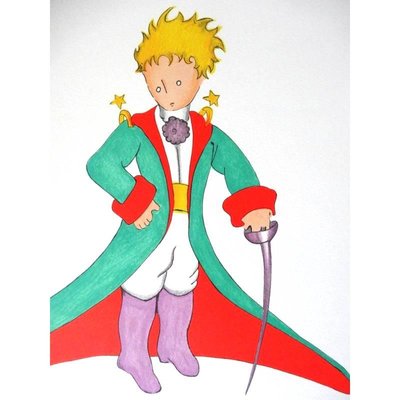
Here’s The Little Prince by Antoine de St. Exupery in short with  too much left out:

A pilot has crashed his plane and is stranded in the desert. He meets a tiny little prince from the Asteroid B-612, who has come to Earth after a long journey through the universe, a journey he took because the love he felt for a single flower was too much for him to bear. The little prince recounts his journey through different planets to the pilot, telling of his conversations with, among others, a king, a man who has nothing but believes he is rich, a drunken fool, a lamplighter, a cartographer, and a train switchman. They each allow him insight into some paradox of human behavior. On Earth, he meets a fox, who teaches him true wisdom, which he then imparts to the pilot. When the little prince leaves the pilot (I’m not telling you how) he promises that pilot will be able to see him in the night sky.

images

And if you’ve read The Little Prince, you’ve already figured out what this all has to do with sunsets. This is from chapter 6:

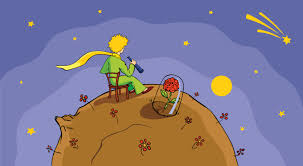
Oh, little prince! Bit by bit I came to understand the secrets of your sad little life… For a long time you had found your only entertainment in the quiet pleasure of looking at the sunset. I learned that new detail on the morning of the fourth day, when you said to me:

“I am very fond of sunsets. Come, let us go look at a sunset now.” “But we must wait,” I said.
“Wait? For what?”
“For the sunset. We must wait until it is time.”

At first you seemed to be very much surprised. And then you laughed to yourself. You said to me:

“I am always thinking that I am at home!”

Just so. Everybody knows that when it is noon in the United States the sun is setting over France.

If you could fly to France in one minute, you could go straight into the sunset, right from noon. Unfortunately, France is too far away for that. But on your tiny planet, my little prince, all you need do is move your chair a few steps. You can see the day end and the twilight falling whenever you like…

“One day,” you said to me, “I saw the sunset forty−four times!”
And a little later you added:
“You know−− one loves the sunset, when one is so sad…”
“Were you so sad, then?” I asked, “on the day of the forty−four sunsets?” But the little prince made no reply.

In Chapter 10, on the first stop of his journey, the little prince meets a king who lives alone on a planet with no subjects. The king tells the prince that he has absolute authority over everything. The little prince is intrigued by this notion, and so asks the king if he can command a sunset, since he is feeling homesick and hasn’t seen one since he left Asteroid B-612.

Such power was a thing for the little prince to marvel at. If he had been master of such complete authority, he would have been able to watch the sunset, not forty−four times in one day, but seventy−two, or even a hundred, or even two hundred times, without ever having to move his chair. And because he felt a bit sad as he remembered his little planet which he had forsaken, he plucked up his courage to ask the king a favor:

“I should like to see a sunset… do me that kindness… Order the sun to set…”

“If I ordered a general to fly from one flower to another like a butterfly, or to write a tragic drama, or to change himself into a sea bird, and if the general did not carry out the order that he had received, which one of us would be in the wrong?” the king demanded. “The general, or myself?”

“You,” said the little prince firmly.

“Exactly. One much require from each one the duty which each one can perform,” the king went on. “Accepted authority rests first of all on reason. If you ordered your people to go and throw themselves into the sea, they would rise up in revolution. I have the right to require obedience because my orders are reasonable.”

“Then my sunset?” the little prince reminded him: for he never forgot a question once he had asked it.

“You shall have your sunset. I shall command it. But, according to my science of government, I shall wait until conditions are favorable.”

“When will that be?” inquired the little prince.

“Hum! Hum!” replied the king; and before saying anything else he consulted a bulky almanac. “Hum! Hum! That will be about−− about−− that will be this evening about twenty minutes to eight. And you will see how well I am obeyed.”

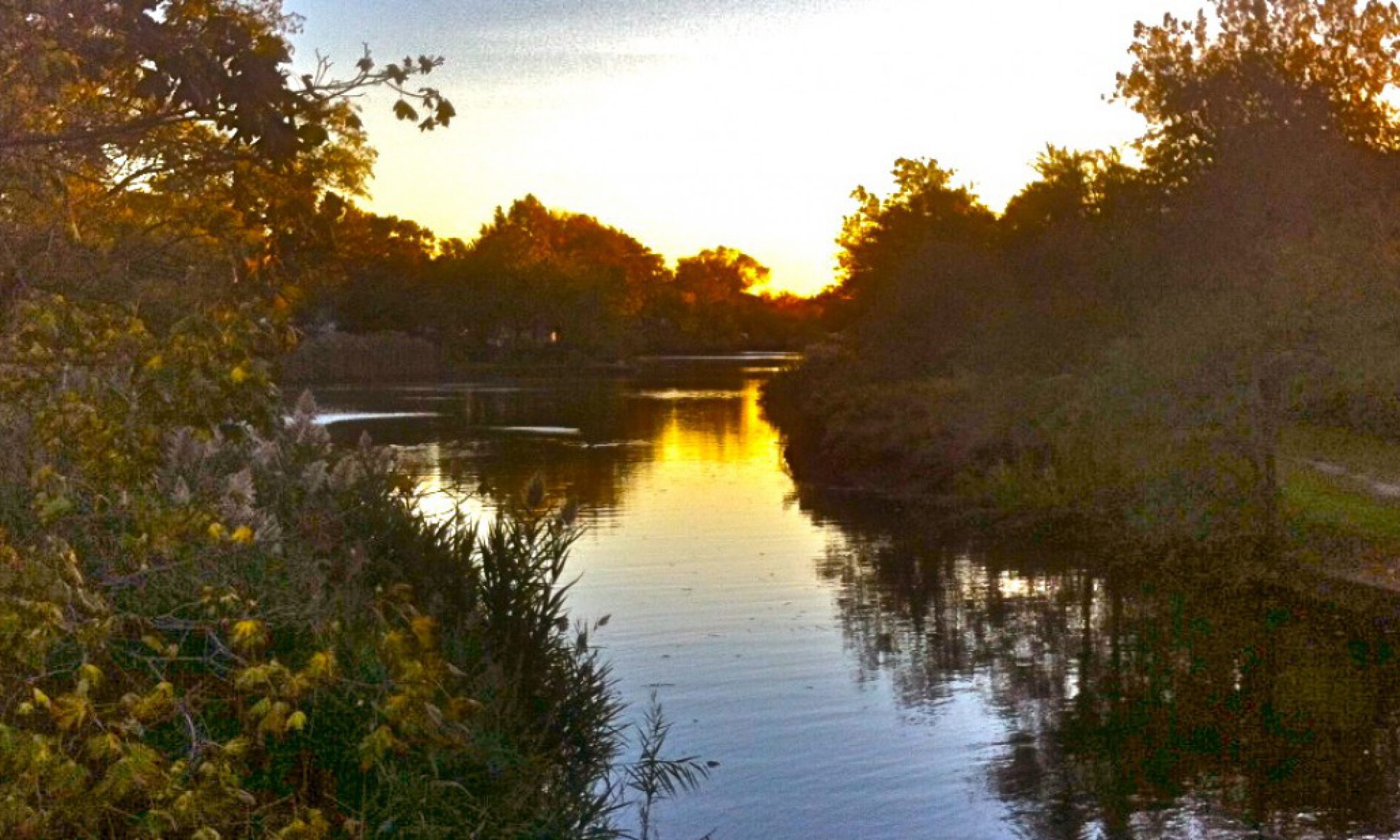
Just as the king commands, twenty minutes to eight is about what time The Show starts in Copake Falls, during the weeks when the Trisha’s Mountain Driveway Sunset Festival is in full swing. It’s completely reasonable. We carry the camp chairs down to the end of the driveway and we sit there, like we’re at the Village Green Bandshell in Valley Stream and The Nassau Pops are coming out to perform. Sometimes we shoot the breeze while we watch the show, and sometimes we start getting silly and laughing ‘cause we do that. Sometimes we point phones at it. But other times we sit there and stare, and we think our own thoughts.

And as all sunset fans know, it’s different every time. Sometimes fluffy cumulous clouds glow like they’re being heated on a stove when the sun sets beneath them. Sometimes there’s a little break in a blanket of cloud cover so that the sun suddenly appears right before it sets behind the mountains and throws a ribbon of orange and red straight across the ridge. Sometimes cirrus clouds splash streaks of peach and mustard and cherry red against the darkening blue like brushstrokes from an abstract painter, and sometimes giant stratocumulus dragons and bunnies change colors as they float by. You never know what you’ll see, so it’s always worth watching.

So shortly after the day of my final sign-off on Google Classroom, I was up on The Mountain, sitting in a camp chair next to Trisha in an illuminated asphalt driveway as the clouds and the sun and the tree farm and the hills performed another new, never-seen-before version of The Show and I was thinking about the little prince.

“You know, one loves the sunset – when one is so sad…”

There’s something intrinsically sad about a sunset. It’s the end of another day of one’s life. It’s the last gasp of light before total darkness sets in. So even if one is sitting happy as a clam watching a spectacular sunset, one is bound to feel a little bit of melancholy. I suspect it has something to do with the fact that we’ll all be dead someday.

But besides feeling sad for the state of the world right now, and sad about all the grief in the collective consciousness, and all the unnecessary suffering that has been inflicted by greed and stupidity, and of course sad about the death of my father in the middle of all this, I realized I was also feeling a little sad watching the sunset that evening because there are flowers back on the creek that have tamed us, and Trisha and I are responsible for them.

Our backyard in Valley Stream faces west, and the sunsets there are no slouches. If they were the sunsets we watched for the rest of our lives, we’d die lucky. But nothing compares to the big sky over Copake Falls. It almost feels like we’re cheating on our house. But we’ve allowed ourselves to be tamed by this 1.9-acre plot of land on a hill overlooking a tree farm, and since the day we first stepped foot on it, nothing has been the same. And sometimes it feels like the future is coming at me too quickly.

The little prince loved a rose that grew on Asteroid B-612. Being the only rose there, he thought she was unique in all the world. But his rose was very vain and very demanding, and she was breaking his heart, which is why he decided to tidy up his volcanoes, pull up the weeds to stop the baobab trees from taking over and go out into the universe to find wisdom. Later, while exploring Earth, he comes across a garden of roses, and realizes that his rose is not unique, which makes him cry.

He next meets the fox, who wants the little prince to tame him, but the Little Prince doesn’t understand the concept, so the fox explains:

“It is an act too often neglected,” said the fox,” It means to establish ties.”

“‘To establish ties’?”

“Just that,” said the fox. “To me, you are still nothing more than a little boy who is just like a hundred thousand other little boys. And I have no need of you. And you, on your part, have no need of me. To you, I am nothing more than a fox like a hundred thousand other foxes. But if you tame me, then we shall need each other. To me, you will be unique in all the world. To you, I shall be unique in all the world…”

The fox goes on to explain the process of taming:

It will be as if the sun came to shine on my life. I shall know the sound of a step that will be different from all the others. Other steps send me hurrying back underneath the ground. Yours will call me, like music, out of my burrow. And then look: you see the grain−fields down yonder? I do not eat bread. Wheat is of no use to me. The wheat fields have nothing to say to me. And that is sad. But you have hair that is the colour of gold. Think how wonderful that will be when you have tamed me! The grain, which is also golden, will bring me back to the thought of you. And I shall love to listen to the wind in the wheat…”

maxresdefault

So at the fox’s insistence, the little prince tames him. Part of the process is to establish rites. The little prince has to show up at the same hour as he did the day before so the fox can look forward to that hour. Soon, the fox has been tamed. But the little prince, who never wanted to tame the fox in the first place, feels like he has to move on.

“But now you are going to cry!” said the little prince.

“Yes, that is so,” said the fox.

“Then it has done you no good at all!”

“It has done me good,” said the fox, “because of the color of the wheat fields.”

“Go and look again at the roses. You will understand now that yours is unique in all the world. Then come back to say goodbye to me, and I will make you a present of a secret.”

The little prince comes to realize that the rose he left behind on Asteroid B-612 is unique from the other roses because it has tamed him. And he tells the other roses just that:

“But in herself alone she is more important than all the hundreds of you other roses: because it is she that I have watered; because it is she that I have put under the glass globe; because it is she that I have sheltered behind the screen; because it is for her that I have killed the caterpillars (except the two or three that we saved to become butterflies); because it is she that I have listened to, when she grumbled, or boasted, or even sometimes when she said nothing. Because she is my rose.

And he went back to meet the fox.

“Goodbye,” he said.

“Goodbye,” said the fox. “And now here is my secret, a very simple secret: It is only with the heart that one can see rightly; what is essential is invisible to the eye.”

“What is essential is invisible to the eye,” the little prince repeated, so that he would be sure to remember.

“It is the time you have wasted for your rose that makes your rose so important.”

“It is the time I have wasted for my rose−−” said the little prince, so that he would be sure to remember.

“Men have forgotten this truth,” said the fox. “But you must not forget it. You become responsible, forever, for what you have tamed. You are responsible for your rose…”

“I am responsible for my rose,” the little prince repeated, so that he would be sure to remember.

The House on the Creek tamed me as a little boy, then it tamed me all over again when our son was a little boy. I know every single flower and weed that grows on that 60 x 100 plot of land. I have spent thousands and thousands of hours taking care of it.

There’s a wisteria bush that grows in the corner of the yard next to a large and beautifully crooked maple tree that leans out towards the creek. Both of these plants were there before my parents were. If not for our regular intervention, the wisteria vines would have swallowed up the maple tree long ago. Someday we’re not going to be there and there will be nothing we can do about it, but on some level, we’ll still feel responsible for it.

Over almost twenty years on the Creek, Trisha and I have planted over a hundred perennials, roses shrubs and trees. We’ve grown thousands of flowers and fallen in love with every single one of them. We made a place surrounded by too much ugly into something uniquely beautiful. We tamed it and it tamed us. Though the siren call of Copake Falls was always calling, we made a little paradise in Valley Stream.

But the first time we drove up that asphalt driveway on North Mountain Road, we both knew we were going to be tamed all over again. The sweep of grass that slopes upwards to a trail through the woods in the backyard, the solitary mountain standing watch over the cornfield next door, the way the house itself nestles into the hill like a giant stick of butter on a plate, the big old trees that needed a little help from the vines trying to eat them, the leaves of the tall cottonwoods dancing in the breeze along the driveway, and those sunsets over the Peaceful Roe Jan Valley.

The little prince points out that on Earth “Men set out on their way in express trains, but they do not know what they are looking for. Then they rush about, and get excited, and turn round and round...” And not only that, they “raise five thousand roses in the same garden−− and they do not find in it what they are looking for.”

That’s us all right. All the years we spent building a little Eden in Valley Stream surrounded by crowds and noise and litter, we kept looking for our place in Copake Falls, and just like when the little prince and the pilot go in search of a well in the desert, we just kept going until it found us. And when we did, it was as if it had been waiting to be found, waiting to be tamed, and waiting to tame us.

The first time we walked up the hill in the backyard, I said to Trisha that this was a canvas that we could paint something brand new on, something that started with us. She was always more than cool about making a home and a family in a place where I had already been part of one, instead of us building from the ground up together. Now this was her turn. Trisha’s Mountain. But after twenty years and a thousand roses, she’s just as tamed by the creek as I am. To let go of it completely is, to quote one of her favorite expressions, something I can’t get my head around right now.

Monsieur St. Exupery said it best: “One runs the risk of weeping a little, if one lets himself be tamed…”

When it comes time to say goodbye to Valley Stream, to say goodbye to the place where I was a little boy and where we raised a little boy, time to say goodbye to that physical connection to my parents, it just ain’t gonna be easy.

But the fox reminds the little prince that, “it is only with the heart that one can see rightly; what is essential is invisible to the eye.”

So when I’m doing nothing on Trisha’s Mountain, sitting and staring or walking around, I may not be able to meditate like a Buddhist Monk, but I’m trying like hell to stay in the here and the now, to see with my heart, everything essential that happens to be right in front of me, and everything essential that I love that can’t be right in front of me. It’s all there if I see rightly.

IMG_2932

When it’s time for little prince to leave the pilot, on the one-year anniversary of his descent to Earth, he comforts the pilot by telling him to look up at the stars.

“And at night you will look up at the stars. Where I live everything is so small that I cannot show you where my star is to be found. It is better, like that. My star will just be one of the stars, for you. And so you will love to watch all the stars in the heavens… they will all be your friends. And, besides, I am going to make you a present…”

He laughed again.
“Ah, little prince, dear little prince! I love to hear that laughter!”
“That is my present. Just that. It will be as it was when we drank the water…”

“What are you trying to say?”

“All men have the stars,” he answered, “but they are not the same things for different people. For some, who are travelers, the stars are guides. For others they are no more than little lights in the sky. For others, who are scholars, they are problems. For my businessman they were wealth. But all these stars are silent. You−− you alone−− will have the stars as no one else has them−−”

“What are you trying to say?”

“In one of the stars I shall be living. In one of them I shall be laughing. And so it will be as if all the stars were laughing, when you look at the sky at night… you−− only you−− will have stars that can laugh!”

And he laughed again.

“And when your sorrow is comforted (time soothes all sorrows) you will be content that you have known me. You will always be my friend. You will want to laugh with me. And you will sometimes open your window, so, for that pleasure… and your friends will be properly astonished to see you laughing as you look up at the sky! Then you will say to them, ‘Yes, the stars always make me laugh!’ And they will think you are crazy. It will be a very shabby trick that I shall have played on you…”

And he laughed again.

“It will be as if, in place of the stars, I had given you a great number of little bells that knew how to laugh…”

There isn’t much room for the stars in our neighborhood on light-polluted Long Island. There’s no limit to the stars on our hill in Copake Falls. After The Show fades to dark red and then to black, you can move the camp chair to the wide-open hill in the backyard and take them all in. And of course, the longer you look, the more stars you see.

IMG_2078

The little prince is up there. You know that. But then there’s all the people whose time in my life has passed like another day’s sunset. Some of those little stars up there are all the thousands of kids and thousands of grown-ups I met in 25 years as Mr. Duffy the Schoolteacher. Some of them are people I met before those 25 years even started, people from my neighborhood, people from school, people I met while working at the supermarket, driving a cab, working at a magazine and a newspaper, going to college, going out to bars and clubs, going on an Outward Bound expedition when I was 16, going to Camp Lavigerie in the Adirondacks every summer and every other thing I ever did.

Some of those stars are friends and family who I haven’t seen in too long because of this Pandemic, and I hope every one of them of them can come here and sit down on this hill someday. But in the meantime, they’re out there. So I’ll think of them and hope they’re doing well and I’ll pick each one out a star for the time being.

But the brightest stars up there, some of whom are planets following the path of the sun?

Those are my parents, and Trisha’s parents, finally getting to visit, and to share in all this beauty that has tamed us. Those are the stars that guide our way into the future.

Because someday, when we cross the Whitestone Bridge with nothing left to go back to on the other side, the sun will go on rising and setting, and we’ll have a front row seat to a beautiful sunset every night there is one. Over time our sorrows about leaving Long Island will start to be soothed. And some of those stars on that hill at night will be all the flowers we grew on a little 60 X 100 plot of land along a creek in Valley Stream.

And we can say it’s what we did there. And we can say it was something.


Copyright 2020 by John Duffy

Fair use (hopefully) of excerpts and illustrations from The Little Prince, which was written in 1943 but renewed in 1971, copyrighted by the widow of Antoine de St. Exupery.