Taking a Walk: An Abridged 10,000-Year History of South Valley Stream


224_w_full

There have been Duffy’s on Duffy’s Creek since March 9, 1955. There have been people on Duffy’s Creek since about 4600 B.C. So the existence of people has a long and colorful history here, though the existence of too damn many people is a relatively recent phenomenon, out of which I was born in 1963, the youngest of five children, an unwitting part of the problem.

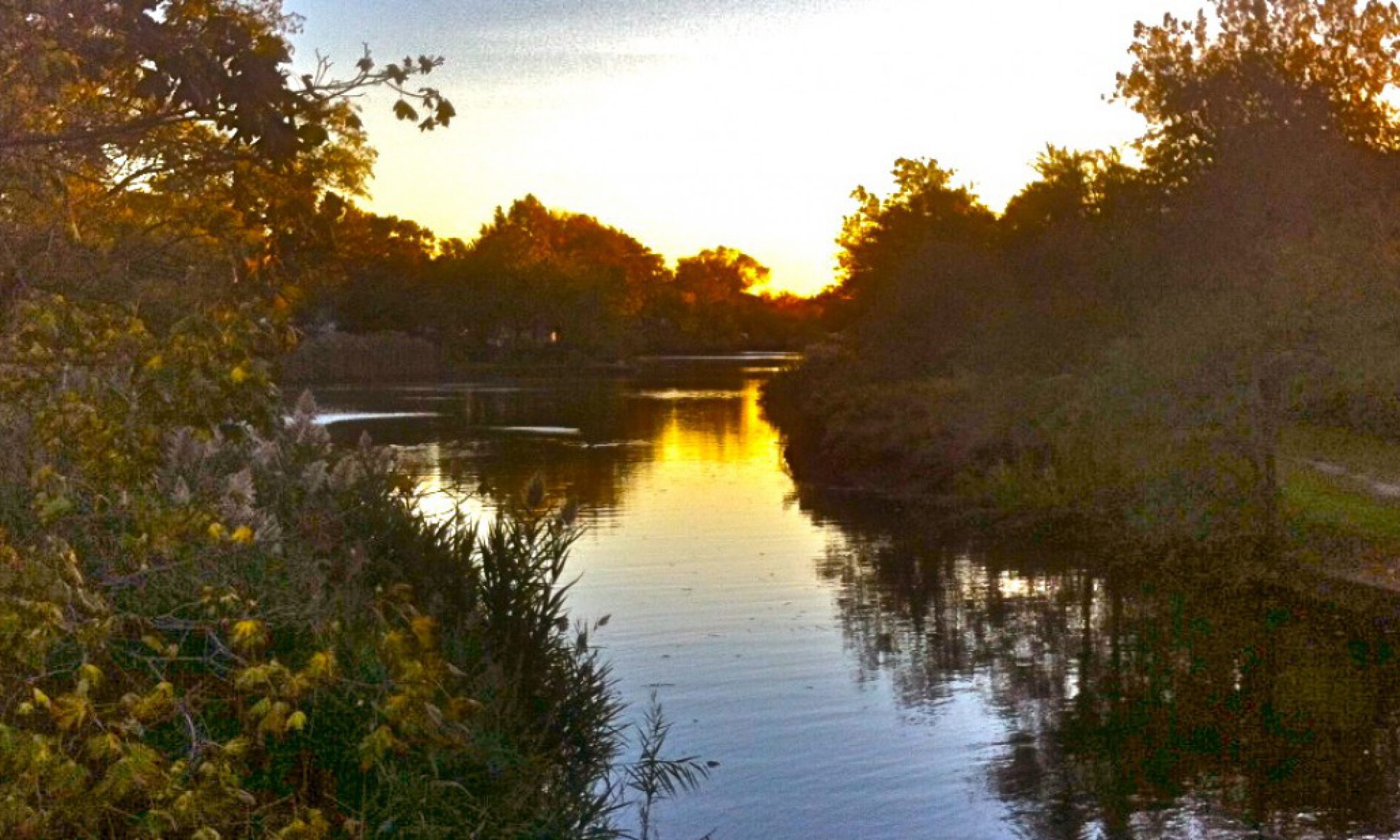
On summer nights, Trisha and I sit out in the backyard, and we talk some, while alternately staring at our little light-up magic rectangles and staring through the flowers towards the sunset over the creek. I like to imagine a Rockaway Indian couple sitting right in this spot in summer twilight a thousand years ago, without the stupid iphones and kindles, maybe listening to the “crawwwk!” of night herons, or watching swallows and bats circling the orange sky, or just watching the flow of the creek, the same tide and the same current, and maybe some of the same water molecules as we look at today, but maybe without so much spam in them.

But I don’t have to imagine being a little kid a hundred years ago, before the sprawl, walking into a deep, majestic forest at the end of Westwood Road in Woodmere, walking less than three miles to emerge from that forest into a farm field that overlooked this creek. I don’t have to imagine it at all because about ten years ago I discovered a book titled The Lord’s Woods: The Passing of an American Woodland written in 1971 by a noted birder and naturalist named Robert Arbib. And Mr. Arbib told me all about it; what this place was like for thousands of years before cape cods and split levels ate it alive. And we’ve become friends, though he died twenty years ago, because I love learning about the history of places, and I’ve spent a whole lot of time hanging around this one. And so did he. I like him and I think he would’ve liked me. md10207462402

A little disclaimer before I go on: I know a lot of people who are passionate about digging up the history of Valley Stream and the surrounding area, and some of them will read this post and want to point out possible discrepancies. (Gleefully). Please just relax. This is but a jumble of the stuff I know from reading Mr. Arbib’s book and a whole lot of other stuff, including stuff from the Hewlett-Woodmere Library website and the Valley Stream Historical Society Facebook page , called “Valley Stream of Yesteryear.” (You’re all wonderful people, and thank you for uncredited pictures, but you didn’t credit them either). I also know some history from my mother, who wrote the Valley Stream Historical Society newsletter for ten years or so, and my father-in-law, Jack McCloskey, who visited this neighborhood in the 1930’s for watercress and garden lime. But this is definitely not meant to be the definitive history of anything. (And by the way, it would be much easier to refer to Robert Arbib as “Bob” from here on in. “Mr. Arbib” sounds like I’m trying to be the New York Times, and I happen to know that his friends called him Bob. Anyway). What I am trying to do here is to put words and context to the pictures that I can I see in my mind sometimes when Mookie and I go walking.

Everybody knows us, Mookie and me. We’re local characters, and we’re proud of that. One sunny day in the middle of last winter, a woman called out to me from a car on Wood Lane as Mookie was reading his pee mail. She said, “you two really get around, don’t you! I see you everywhere!” I said, “Yes, yes we do.” And Mookie looked up and wagged his tail.

I knew at that moment that I had achieved my ultimate purpose in life: Being a local character. I’m the slightly crazy looking thin man with the very large happy yellow lab who you see walking around South Valley Stream all the time. But Mookie, of course, is superior to me in so many ways, particularly in his full-minded commitment to The Here And The Now. He’s living in the present when we’re out walking because he’s a dog, and that’s what dogs do, which is why they’re so much better than us. I try to stay in The Here And The Now, but I’m just not Mookie and I never will be. Often I’m living in the future as we’re walking, figuring out what things I can turn into things I’ve already done in the hours and the days ahead. But sometimes I’m living in the past, imagining what this place was like before the cars and the trucks and the poles and the lights and the wires and the fences and the signs and the asphalt and the whole rest of it. And it makes me wistful for a place I never knew, even though I’m walking through the middle of where it was; a place that, had it not been altered forever in the decades before I was born, actually would have made me as I know me impossible.

robert_arbib_200
Robert Arbib

Bob’s story starts in 1920, as a nine year old boy exploring the woods that actually stretched from Lawrence to South Valley Stream, which he learned were called The Lord’s Woods after the very rich, successful lawyer who had owned the land at one time. (There’s a Lord Avenue way down in Lawrence in the area behind Rock Hall, where nobody ever goes unless you’ve got business there or you’re lost. It’s quite a beautiful area). The woods that Bob and his friend begin to explore stretched from about three miles southwest of here just about to my backyard. The entire Lord Estate stretched back through Cedarhurst and Lawrence all the way to Far Rockaway. My son is twelve and we can’t yet in good conscience let him cross the four lane road (Mill Road) that separates us from the rest of the world. Once upon a time, Mill Road was where the woods thinned out and the farms started. Bob and his friend walked through the woods, teeming with hundreds of different bird species and happy little animals. They discovered cool stuff like an Indian marker tree that was bent on purpose to indicate a trail, and a rope swing along a brook in the middle of nowhere. They crossed streams and marshland and followed along a dirt road until the realized they were following a gigantic water pipe, half-buried in the ground. The pipe led them to the “waterworks”, the Long Island Water Property, where the last little postage stamp of woods remain to this day.

IMG_0395
A picture I took of the current “waterworks” building at the end of Starfire Court, before that camera picked me up and people started chasing me. Not really.
imgres
The waterworks that Bob found in the middle of The Lords’ Woods in the 1920’s.

They realized that the Water Company actually owned all the land that they were walking on. and that the land was kept undeveloped because they needed to pump water from under it. (One of the main reasons they ultimately sold it off to development and bulldozed it was that the technology was developed to dig deeper wells, thereby needing less land to protect the aquifers). But people had been trespassing on and enjoying these woods forever, and Bob and his friend soon found like-minded young nerdy fellows who liked identifying birds.

I like identifying birds. When Trisha and I first took over at Duffy’s Creek, we started keeping track of how many different bird species we could attract, including the waterfowl, who just hung around with us because we have a creek. Over the course of three or four years of keeping neat little notebooks (before we became parents and chaos ensued), I counted somewhere around 105 different species. Many of them just showed up once or twice, inexplicably, like a Brown Thrasher or a Tri-Colored Heron. But in The Lord’s Woods, apparently all these birds were as common as pigeons. And this is how Bob became a famous orthinologist, and how I helped get Andrew Cuomo to promise South Valley Stream $3 million dollars to help rehabilitate the Left Bank of Duffy’s Creek, money which he may or may not be still holding on to, because they haven’t spent it yet. I suppose because he’s not up for re-election. But that’s a story for another post.

In the first half of The Lord’s Woods, Bob tells the story of his youth through his seasons exploring own local primitive wilderness. As a guy who likes birds and plants and stuff, I just ate it up. There’s also a particularly gut-wrenching storyline about showing his first girlfriend all the secrets of The Lord’s Woods, then losing her to a car accident several years later when she was away at college, which was absolutely heart-breaking to read. Nonetheless, It’s all beautifully written, and topped off by a really cool map (pictured below) that helped me follow exactly where he was (and what is there now) as he describes his discoveries. I live along what is called Mott’s Creek or Foster’s Brook on the map. When I was growing up, my father told me it was called Watt’s Creek. On USGS maps (United States Geological Survey) it’s called “Valley Stream”. About fifteen years ago, when I had some time on my hands, I wrote to the USGS and tried to get it changed to Duffy’s Creek. The nice man from the USGS patiently explained to me that: 1) The don’t use apostrophes, which was a total buzzkill, and 2) I would have to die.  I know that Foster, Mott and Watt were also local characters who just started calling the creek by their own names, so until I die and someone does the paperwork, that’s my plan.

LordsWoods2-1

In the middle of the book, as Bob is still grieving for his lost love, first the Hurricane of 1938 and then a giant fire decimate the woods. (I’ve seen more than once what a big hurricane can do to big trees). And the omens begin to rise around this same time: Giant electrical transmission towers go up, and surveyor marks plot out Peninsula Boulevard (which you can see on Bob’s map cuts right through the heart of what he called The Big Woods).

IMG_0402
Looking north on Peninsula Boulevard.

A wilderness would eventually recover over time from a natural disaster, but it didn’t stand a chance against the the post-WWII boom, and it is this point in the story where the book rises from beautiful to powerful and unforgettable. In the chapter entitled “Boom”, Bob begins:

“It was not fire that destroyed the Lord’s Woods. Fire and storm, blizzard and drought, even hurricane and flood were all natural events in the woods’ long history, often experienced and somehow survived, their wounds slowly self-healing and finally obliterated in forgiving beauty. Before the final act could be staged and the curtain rung down on the last of the drama that had been unfolding here for thousands of years, there had to appear on stage the villian of the piece – modern man – and there had to be a motive. It was not fire or storm that came to destroy our woods. It was greed and duplicity, avarice and ignorance and apathy.”

The “Boom” chapter, and the following chapter, called “The Threat” take you through a truly American story: How people saw what was happening to the woods and tried to stop it, and other people laughed and said “Fuck you. We’re doing it anyway.” As more and more of the woods were being bulldozed for development, people began to realize that “what remained was the only remnant of wet woodland left” in Southwest Nassau County, “the only place where one cold lose himself from the frenetic world and be an Indian brave or a Thoreau, a Daniel Boone or a John James Audubon, or just oneself, a child learning about the world around him.” 

Here’s the short version: In 1955, the year my parents bought a house on a creek in a five-year old development of cape cods, the Lord’s Woods had been reduced to a box bordered approximately by, from what I can tell, Gibson Boulevard, Peninsula Boulevard, Woodmere Middle School, Hungry Harbor Road, Rosedale Road and Duffy’s Creek. The entire neighborhood of North Woodmere came after West Sunbury, so the ancient woods probably met the Hoeffner Farm all the way down Rosedale Road and went along Doxy Brook and blended into marshland as it got closer to Jamaica Bay. And in the other direction, I know for sure that there was a scout camp on the land where Peninsula Shopping Center sits now. You would need a lot of trees for a proper scout camp, so that was likely part of the woods as well. The neighborhood of North Woodmere on the opposite side of Rosedale Road from ours has bigger trees, because it was a woods and this was a farm. (I figured this one out all on my own).

IMG_0397
At the corner of Mill Road and Peninsula Boulevard, where a scout camp in the woods was up until the 1950’s.

The community got wind of a deal between the water company and a developer to buy up and bulldoze what was left of the Lord’s Woods. Bob tells of a woman named Helen Bergh and a man named Ben Berliner who were the leading forces in trying to save the woods, working with the Audubon Society to develop ways that the area could be used as a sanctuary and interpretive nature center.  As the last acres of what was by that time called the Woodmere Woods were being eaten up, Helen Bergh (what a great name) led the Woodmere Woods Conservation Committee. They tried everything. New York didn’t want it for a state park. Nassau County didn’t want it. Officials from the Town of Hempstead suggested they would consider a park if Bergh, Berliner and their committee could show a public consensus for saving the last virgin woodlands in Southwestern Nassau County. But as Bob points out, “to prove that all people, everywhere wanted an esoteric amenity like a public wildlife preserve in 1956 was no easy task.” Some people wanted a park with lots of ballfields and tennis courts and swimming pools, which they eventually did get in North Woodmere Park. Other people, newer arrivals to the area, “would let the developers proceed; homes and gardens were more desirable neighbors than thickets of poison ivy and rat-infested woodlands where rapists can hide.” There wasn’t much you could do to convince people who had such disregard for the concept of open space that it would be in their interest to have a large undeveloped area around them. They’d no doubt never go in it anyway. Mosquitoes. Rapists. Very unsafe. Best to stay in the air conditioning.

By 1957, Helen Bergh had joined forces with a neighbor and friend who had also grown up enjoying the woods. His name was Edward S. Bentley. Together, they wrote a bill to present to the New York State legislature giving the Town of Hempstead authority to create a park district out of the Woodmere Woods. Before they could find sponsorship for the bill, the Water Company sold the land. Bob describes a race between the bulldozers, chain saws and graders, moving “like an invading army into the Lords’ Woods. One by one, the century-old oaks, maples, tulips, hickories, ashes and sweet gums crashed to the frozen ground.” 

Sudddenly, as the woods came crashing down, people started paying attention to the destruction of the woods. Newsday was an up and coming newspaper at that time, according to Bob, and they took up the cause, but “while the editorial pages endorsed the principles of conservation and preservation, the business section, real estate section and its general news rang with announcement after proud announcement of the latest shopping center, housing development, industrial park, power station, highway expansion, population growth, property values and prosperity…No one was talking about the intangible cost of smog and summer heat, and the deprivation of natural beauty and an oasis of solitude and silence. Quality of life was of little concern to most people in 1957.” I’m sure if my parents knew about this story, and I’m sure they did, they were too busy to even think about joining a fight to save some woods.

Needless to say, the park proposal was shot down. Bob points out several bad guys in the tale, including lawyers and elected officials who were working both sides of the fence, pretending to help Mrs. Bergh’s cause for the public support it would bring them and working with the developers to destroy the woods at the same time. By the end of 1958, five years before I was born, the Lord’s Woods were completely gone. There is a little postage stamp of woodland around the waterworks, and some land that creeps up behind backyards up Doxy Brook to the reservoir on Hungry Harbor Road. When I was a kid, we’d sneak into those woods sometimes. My older brother and his friends used to catch turtles, bring them back to the house, paint their initials on the shells and set them free again. Today, most of it has barbed wire around it. And apparently, If I see something, I should say something. I assume it would be about what I saw, but I can only see though the fence, and there’s not much to see.

IMG_0387
What’s left of Doxy Brook at Rosedale Road
IMG_0394
Through the fence into the woods


IMG_0393
A picture of a path through the woods that Mookie and I are not allowed on, and neither are you, taken through the fence on Brookfield / Rosedale Road. If I see you there, I have to say something.

When I was younger than my son is now, I would go off in the summertime on my bike searching for rabbits in the parkland built behind the backyards in the Green Acres neighborhood, which is across Duffy’s Creek from our own neighborhood, which was called West Sunbury when Mr. William Gibson’s company built it in 1950. When I was a little older, I would take the aluminum rowboat from our backyard and row it down to Rosedale Road, pretending I was an Indian paddling along the creek. You could “park” the boat and climb the bulkhead into Brook Road Park in Green Acres. About twenty years ago, maybe more, they changed the name of the neighborhood to Mill Brook, because the residents did not want to be associated with the gargantuan shopping mall that sits right next to it (The same developer, Channan Corporation, built the houses and the shopping mall on land that once once divided between the Hoeffner Farm and Curtis Field, a famous airfield in the 1920’s that was visited by Ameliah Earheart and Charles Lindbergh. There’s a plaque in the middle of the Home Depot parking lot you could go look at if you don’t believe me). 10414459_10152187517227983_633736653996581073_nThe shopping mall is still called Green Acres, and it’s about thirty times the size it was when I was a kid. I may be exaggerating there a little bit. All I can tell you is that there aren’t any kids looking for rabbits or pretending to be Indians around here anymore. Lately they’ve been looking for Pokemon.

hub00031Mr Gibson built our house. Thirty years before, he bought up a wooded area north of the farms and south of Sunrise Highway (which apparently was a hunting ground up until that time, though I don’t know who was hunting what) and built a planned neighborhood south of Sunrise Highway and north of the Lord’s Woods. Some of the houses were brick capes, but most of the houses were called “Gibson Colonials”. I’ve been in lots of Gibson Colonials12510280_10153935905123060_3823137400778803684_n, and they’re great houses. Before the 1920’s were over, 12345517_10200991102777741_2972661268509285498_nGibson started building bigger, pointy colonials on Munroe Boulevard and the surrounding streets. They’re great houses, too. In the middle of it all, he built his own Long Island Railroad Station in 1929.

300px-Gibson_LIRR_StationAfter World War II, Gibson bought up some more farmland and built hundreds of cookie-cutter capes and rickety ranches. Not as big as the colonials, but darn comfy, and with slightly less claustrophobic backyards. My parents bought a cape  from an original owner who left after five years (for a bigger house). Gibson cranked out South Valley Stream in the course of thirty years. Our house was built in 1950 on what was the a small patch of woods at the edge of potato fields belonging to Reising Farm, which was divided between the Gibson development called “West Sunbury”, Harbor Road Elementary School (later renamed Robert W. Carbonaro School) and Valley Stream South High School.

Three houses still exist on Hungry Harbor Road right around the corner from here that predate Mr. Gibson’s West Sunbury neighborhood and the North Woodmere neighborhood that begins just south of it. (The name Hungry Harbor goes back to the 17th Century, and referred to squatters who lived on the land). One of the houses (the red one below) is condemned, but there may or may not be a guy still living in it. And don’t think I don’t now his name, because I do, because you learn things when you hang around a place for 53 years. I’m just not telling you about him because I feel sorry for him. You can see “the farmhouse” from our front yard. Close enough that you could holler across the potato field from the back step and tell Pa supper was ready if he were standing in our backyard. It must have been beautiful. There was actually a buffer of woods between the field and the creek, which is tidal and would probably eat your potatoes if you planted them too close. You could probably take a quick swim in the creek and not smell like the back of a garbage truck when you came out.

IMG_0419
This was the original Reising farmhouse, across Hungry Harbor Road from the 1920 house. I can’t find the date it was built, but I imagine it starts with an 18. Notice that the house has been boarded up but there’s an air conditioner in the window. There’s somebody in there, and he’s a Mets fan.
IMG_0418
The Reising Farmhouse, built in 1920, where Jack McCloskey’s father bought lime for his nursery in the 1930’s.

My late father-in-law, the great Jack McCloskey, was a nursery man. His father started McCloskey’s Florist and Nursery in Rego Park Queens in the 1920’s. When Jack visited our house for the first time, I thought he would enjoy knowing that you could see the  farmhouse from our front yard. The farmhouse has a large outbuilding. Not really a barn but more like a  series of attached garages. Thanks to Jack McCloskey, I now know that in the 1930’s, he would ride out to Valley Stream with his parents, where his Dad would buy the garden lime the Reisings sold wholesale out of that building and he would pick watercress along the creek with his mom. We were standing in my driveway when he told me what he remembered. We would have been in the trees at the end of the potato field.

12003216_10207585835106945_4639068511083787735_n
A very cool aerial map, courtesy of my friends at The VS Historical Society.

At the end of the chapter of The Lord’s Woods when Bob recounts how the last of the woods were lost, he interrupts the narrative and takes you back all the way to the glaciers to drive home the point of what was lost when those chain saws and bulldozers attacked the Lord’s Woods. He includes the ancient history of the place to illustrate just how disgusting the systematic destruction of this land for tract housing really was, how parts of the area surrounding me were literally untouched from before the birth of Christ until just after the arrival of Francis and Joan Duffy.  He describes the arrival of the Rockaway Indians, a great bunch of people with a really cool name who showed up here around 1000 b.c. “For centuries untold, these people lived on these lands and waters making no destructive impact on the environment…They belonged to the woods and were as much a part of it as the turkey, the bear and the wolf.” 

Of course, once the English Settlers showed up in the 1600’s and created Ye Olde Town of Hempstead, the jig was up for the Rockaway Indians. Within about two hundred years, in 1818, the last of the Rockaways, an old man named Culluloo Telewana, died in his little house in Woodmere. 70 years later, a local man named Abraham Hewlett, who “was enthralled with his stories as a boy” erected a monument to Cullulo Telewana. As Bob points out in The Lord’s Woods, “It is the only memorial to a 7,000 year history to be found anywhere.” And here it is:jedziegler6a-1

And so Mookie and I go for a walk a hundred years ago, in 1916, before Gibson, before Curtiss Airfield. It’s very, very quiet here. We start at the creek and walk through a small patch of woods until we’re walking along farm fields towards Mill Road. We cross the dirt road and stroll beside the mill on Watt’s Pond. Mookie jumps in for a quick swim while I watch the ducks fly off. We walk back along the dirt road, maybe seeing people out working in the fields. The land is completely flat, so you can see the farmhouse all the way from the pond. Mill Road disappears into the woods. We walk through a cathedral of trees along an old Indian path. Maybe it’s the end of October, and the leaves are on fire as they rain softly from the giant trees, and the autumn sunshine streams down, bringing the whole scene into sharp focus and preposterous color, like an old Kodachrome print. We walk about as far as Peninsula Boulevard then we turn around and head back to the 21st Century, our footsteps and birds singing around us the only sounds we hear. Yes, folks, there could have been a beautiful, majestic nature preserve right in my backyard, an ancient woodland preserved for the benefit of my son, his son, his grandson and all our dogs. But as Bob Arbib writes at the end of the final chapter of The Lord’s Woods, “greed and apathy, deceit and arrogance, ignorance and blindness to future needs had finally done their dirty work.”  

1609624_10201977582374721_88654407_n
Mill Pond at the turn of the 20th Century.
miller_charles_henry_oldmillatvalleystreamqueensnewyork
A lithograph from 1878 of Mill Pond by an artist named Charles Henry Miller.

One of my favorite passages from The Lord’s Woods appears on page 175, when Bob is explicitly expressing his opinion of  my neighborhood, the place my parents fell in love with, the place my son loves. This is how he saw it:

North of the woods along the Old Grey Road (Rosedale Road was its official name) the farms were disappearing fast…Grids of roads were slashed across them and the houses went up blocks at a time, more densly crowded, more monotonously uniform than anywhere around…I looked upon them as rural, ready-made slums, quickly and badly thrown together…they were sold and occupied as fast as they were built. This was a sorry wasteland, now, with no single inhabitant of any of those tacky boxes who could remember what had once been here: The corn, the rows of lettuce, the potatoes, the bluestem grass. No one could remember a horse and buggy shooting up banners of yellow dust as it raced along, one summer’s morning years ago.”

I can remember it, Bob. I can remember what it looked like, even though I wasn’t there, and I’m part of the reason it’s gone.  I see it sometimes when I’m out walking my dog. It’s beautiful here.

IMG_0429


Mookie Rescues A Kitten And Grandma Writes Her Own Final Script, Exits Stage Left: A Long-Winded Story

DSCN4732The last story I told my mother was about how Mookie the Dog rescued a kitten. It happened three years ago this week. Today, I’d like to tell it to you, just as she would’ve, with enough painfully intricate detail to make you want to run screaming.

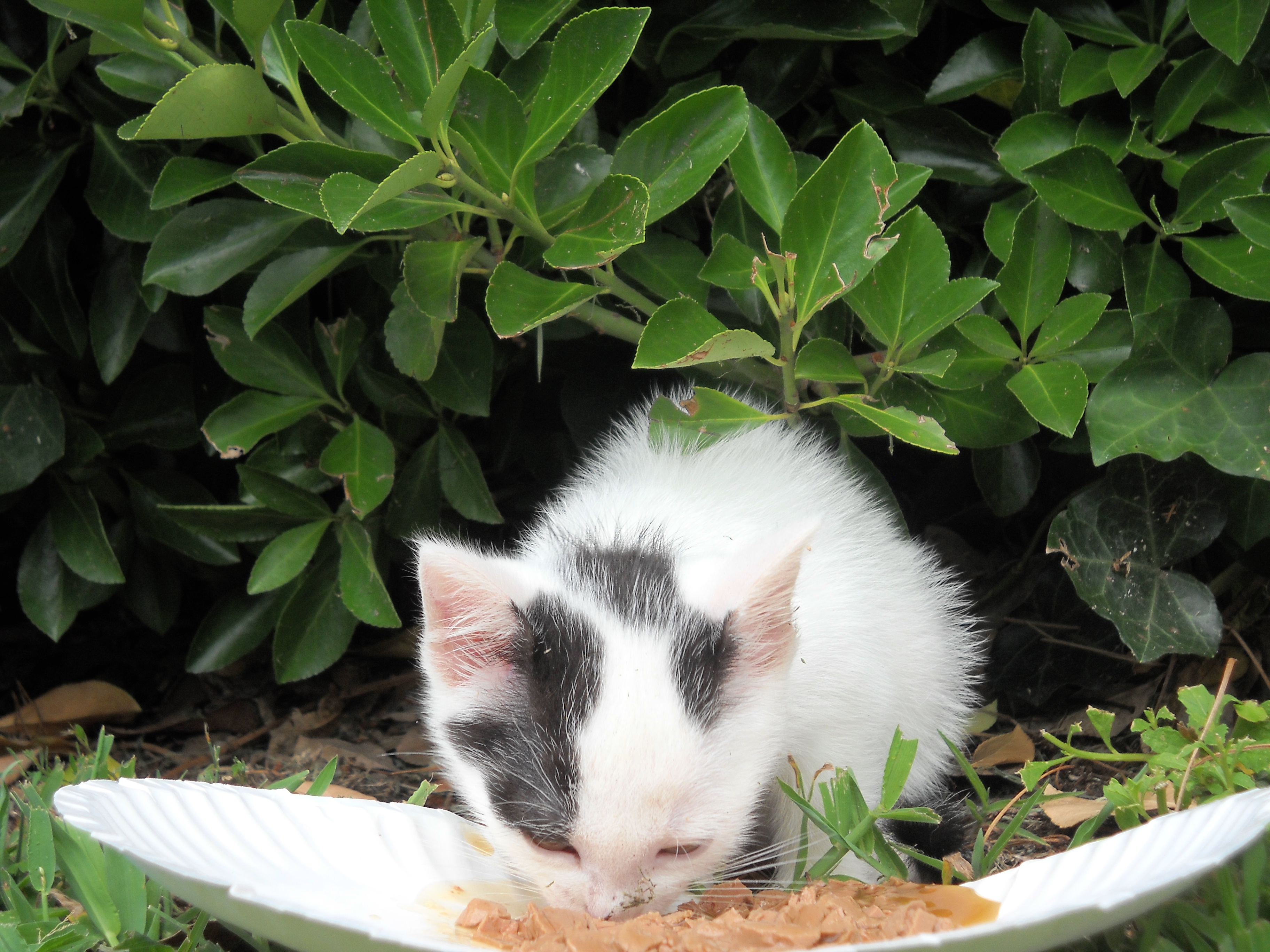
Somewhere, probably within ten miles of here, this scrawny little black and white kitten has grown into a fat, healthy three-year old house cat, all because he had the good sense to follow a dog that should have been named Jesus. It’s a good little story, and you not only get to hear it, you get to know The Dude’s Grandma Duffy a little bit along the way. Anyone who ever met her would tell you it’s your lucky day.

If she had one glaring weakness, or one great strength, it would have to be the incredible twists, turns, detours, asides and complete non-sequiturs that my mom would take you on when she told a story. I never met anyone who didn’t like her, so I guess it was a strength. People enjoyed listening to her, she enjoyed listening to other people, and she remembered every single thing anyone ever told her. Therefore, if she were telling you a story about running into someone at a store, you would come away from the experience learning not only the person’s life story, but more than likely the history of the store as well, plus an overview of the inventory, some background on the owner and his employees, and the parking situation outside. But if you were, on any given weekday, trying to get work done, or take care of a child and his animals, make dinner and clean the house all at the same time, and the phone rang, and Mom had a story, and you didn’t want to be rude, because you were rude last time, you would be sucked down into the abyss, and the hands of the clock would start spinning around like they do in cartoons and old movies.

So we had our fights in her last couple of years before she died because it drove me crazy to get stuck on the phone when I had pressing matters to see to. I’m really not a phone guy in the best of circumstances. But the problem was that Mom had nothing to see to, nothing to do really except be in pain from Parkinson’s Disease. And though her body was shot, her mind remained sharp as a needle until her last days. She became a prisoner of a body that didn’t work anymore. Yet she had spent her whole life busy at something, and had always had an innate need to connect to other people, to be part of the action. She raged like hell against the dying of the light. Her mind was a housefly trying to get through a plate glass window.

In 2001, after 46 years in Valley Stream, she and my father moved from Duffy’s Creek to a “life care community” in Suffolk County, about 50 miles from here, and sold the house to us. If you go to live in a life care community, you start in a cottage, then you go to an assisted living facility, then you go to the skilled nursing floor, then you slide into the back of a Caddy. Mom went through the four steps of life care in the space of 11 years, the last three in two years. And through those years, most of our catching up was done over the phone. The problem was that a lot of the time I had nothing to share except the stress of the daily grind, which was not the slightest bit interesting to me, so I really didn’t want to be on the phone. More than once I was unnecessarily nasty about it. But she got even. She died.

Oh, and I should mention that no one was allowed to call HER between 7:00 and 7:30 weeknights because she’d be watching Jeopardy, which I got her hooked on. My entire goal in life some weekdays in the winter is to get to the point where I can sit down on the comfy couch and watch Jeopardy on the DVR. Some days that doesn’t happen until 9:30 or so. Mom never learned how to work a DVR. It wasn’t her style. But God forbid you went a week without calling, or not calling back in due time if you let the answering machine pick it up because you were tossing chicken cutlets. She’d attack with all the Irish Mother guilt in her arsenal.

So I made it a point to call her on Thursday August 16, 2012 and tell her what happened that day. I knew she would appreciate it, and I had time to talk, and to listen if necessary. It was a story about Mookie, and she loved Mookie. She would introduce him to people when he came out to see her at the life care community as “the youngest member of my family.” And Mookie fell in love with Grandma Duffy instantly because she was the first person to sneak him human food under the table, specifically McDonald’s french fries. Mookie loves everybody, but after those french fries he always had a special place in his heart, and under the table, for Grandma Duffy.

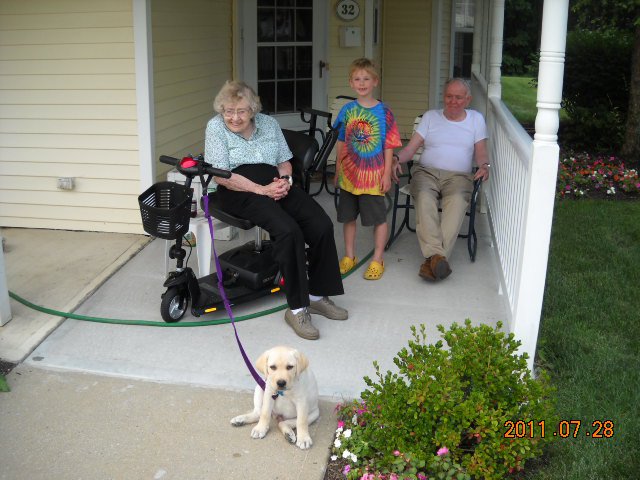
Mookie's first Meet and greet with Grandma and Grandpa Duffy in July of 2011
Mookie’s first Meet and Greet with Grandma and Grandpa Duffy in July of 2011
Mookie's last visit to Grandma and Grandpa, August 2012
Mookie’s last visit to Grandma and Grandpa, August 2012

On the morning of Thursday August 16th, 2012, Mookie and The Dude and I were walking on the Left Bank of Duffy’s Creek. On our side, most of the backyards have a little buffer zone between the property line and the creek (we encroached on it and built a wetland garden). On the Left Bank, there’s a path that starts at a four-lane road and winds along the creek, with short streets dead-ending along it. It used to connect to a bridge that connected to another path that connects to Valley Stream South High School, which never did me any good. They took the bridge down about ten years ago because (they said) it was getting old and unsafe. The high school kids had trouble behaving themselves on the path leading to the bridge. Thirty years worth of Valley Stream kids had found fun and trouble hanging out by that bridge, I among them. Lots of people got real nostalgic when they took it down.

So there we were, down by where the bridge isn’t, and Mookie was sticking his nose under the gigantic holly bushes at the end of Elderberry Road. Under one of the bushes I heard a tiny little, “mew!” And my very first reaction was, “oh, crap.” This whole area is rife with stray cats (You can’t swing a cat without hitting one). My parents actually fed a small colony of them at one point, until it became a large colony. They kept one cat that moved out east with them and ended up living 15 years or so.

We have three cats.  They live inside. The last thing I needed was for The Dude to find a litter of kittens under a bush.

Mookie heard the “mew!. He knew exactly what he had found and was very excited about it, as you could imagine. But The Dude didn’t hear it at first. (Sometimes he’s in a different stratosphere, even when he’s five feet away). I gave Mookie a quick pull and a “leave it!” He looked at me and expressed his disappointment and reluctant acceptance, as only he can. We started walking onward where the path veers away from the Creek and goes behind some houses.

mother-298x225And the kitten came out of the bushes and started following Mookie along the path. I immediately thought of the “Are You My Mother?” story. The little bird is left alone in the nest and flies around asking people, and things, if they are his mother. That story had a happy ending. I wasn’t feeling too good about this one.

We turned around and walked back towards the kitten, who at that point turned chicken and ran back under the bushes. There were no other cats to be seen. Although I didn’t express my thought process to The Dude, if figured the kitten had been either separated from or abandoned by it’s mother, and he would probably just lay under that bush and starve and roast until he was food for whatever eats dead kittens around here. Unless we rescued him.

And we couldn’t rescue him. In theory, sure, but in reality, well, we have three cats. Sunny, the oldest, is a very mellow zen master. She’s even trained Mookie to stop chasing her and sit his fat behind down when she comes in the room. They keep each other company. Then there’s Allie. Allie is a sweet, fat little ball of fur who is scared of her own shadow, and only leaves the attic at night when Mookie is asleep on The Dude’s bed behind a closed door.

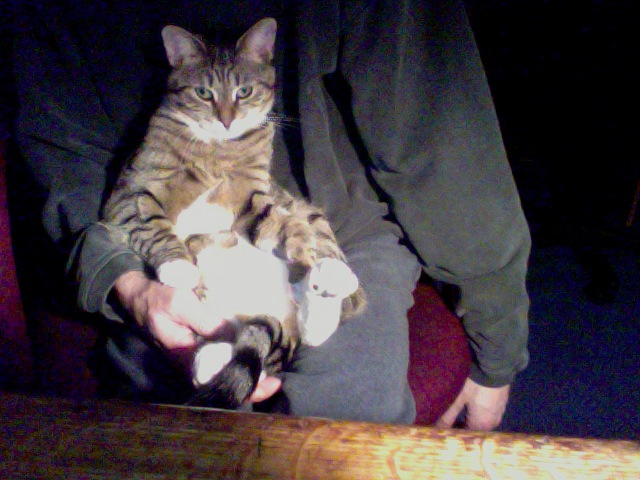
Gansta Cat.

And then there’s Lyle. Lyle is gangsta His back legs are too long, so he even walks gansta. Or really, more like a gunslinger that just got off his horse. He spends a lot of time catting around at night, until he gets bored and  harasses me out of a dead sleep to get up and feed him. He does this every single night. And once he wakes me up, usually by batting at my eyelids or dropping his ass directly on my face, I have to pee anyway, ’cause I’m a guy in his 50’s.  So I get up and I feed the cats. It’s gotten to the point where I set my alarm for 2:30 a.m on work nights, even though I don’t have to get up until 5, just so I know I can avoid being attacked and get back to sleep for a few hours. It’s a sad state of affairs, but Lyle decided from the beginning that I was his mother, and he’s very attached to me, although I regularly call him abusive names. Therefore, of course, Lyle is highly jealous of Mookie, who will follow me, follow me wherever I may go. Lyle will be happy to try and rip Mookie a new snout if he gets too close. And Mookie can’t understand how anyone could possibly not like him, ’cause everybody loves Mookie, so he keeps coming back for more abuse. Lyle and Mookie have a classic dysfunctional co-dependence.

Mookie can't understand while Lyle acts like such a jerk. And yes, I have repainted that radiator cover.
Mookie can’t understand while Lyle acts like such a jerk. And yes, I have repainted that radiator cover.

So right away I knew that I was not going to be able to adopt this kitten, because Lyle would more than likely kill him the first chance he got. He’s a stone-cold killa gansta gunslinger. Ask the mouse that got into the house once. Actually, you can’t. He’s dead. Lyle snuffed his ass.

But I called Trisha at work and asked her anyway. Honey, Mookie found a kitten and it followed us, can we keep him?

Now, mind you, Trisha will be the first to tell you that she had planned to become a crazy cat lady but married me instead, AND she had three cats when we met, whom I loved as my own for the rest of their seven years. So we’re talking about a woman who has a soft spot for cats. And this is what she said (verbatim) when I told her what we found and asked if she wanted a fourth cat: “NOOOOOOOO!!! ABSOLUTELY NOT!!! NO WAY!!!”

So I called my pals at Broadway Vet in Hewlett. I knew that they often had kittens for adoption sitting in a cage in the waiting room. And I knew that Dr. Glenda Wexler had a soft spot for Mookie, and wouldn’t want to disappoint him. They reluctantly agreed to take the kitten if I could catch him. No problem. I had a pet carrier, plenty of cat food and a dog named Jesus. The thought occurred to me, though, that the mother might come back for the kitten, and that I was sticking my nose into cat business that shouldn’t concern me. But I also knew that being a feral cat is nothing but a one-way ticket to Palookaville, so it was in the kitten’s best interest to leave the wilds of the Left Bank of Duffy’s Creek behind.

We drove over with the cat carrier, the cat food and Jesus the Dog, who of course found the kitten right away. I had The Dude hold Mookie while I got the kitten to eat some cat food off a plate, then put the plate inside the crate. And just like that, the kitten was in the back seat of a minivan on the way to his new life in the Five Towns, no longer a feral animal. The entire process took about an hour. The kitten was adopted within a week. He has no doubt grown into a beautiful cat, and I wish we could’ve kept him. But I like Lyle well enough, even if he is an asshole.

The first person I wanted to tell my Dog Rescues Cat story to was my mother. I called her that night and we had a nice long chat, and she listened to every word of the story and asked the right follow-up questions and pressed for the right details. I knew that this would give her a story to tell my father, who takes lots of naps and doesn’t like staying on the phone very long. Then she could tell her neighbors, and the people who took care of her, and her dinner companions at the community center (which we called “The Big House”) where she and my father ate every night. Then she could tell the waitress and the busboy. It was a good story. A yellow lab rescues a kitten. You can’t beat that. I knew that she would see that it was conversational gold. And now it was hers.

Less than 24 hours later, on Friday August 17th, my sister called. Mom had been taken to the hospital. They had found her “non-responsive.” I immediately knew it was the beginning of the end from just those words. In 82 years, no one had ever described Joan Duffy as non-responsive.

And I had a decision to make. The next day, Saturday August 18th, was or annual one-day trip upstate for Copake Falls Day. What is Copake Falls Day? I’ll let Mookie explain in his words: “We go for a long ride in the car, we say hi to a lot of people, we go swimming, we walk around, we sit in the shade, then finally we walk up a hill where there’s music playing and people hand you big slabs of barbecued meat, which turns out to be what Mookies like best. Then you sleep in the car all the way home.” That’s pretty much it in a nutshell. We haven’t missed it since they started doing it seven years ago.

I knew Mom was going to die, but nobody had officially told me that yet. I figured the worst that could happen is she would slip away during the 16 hours we’d be unavailable, and if she did, I could rationalize to myself that because Mookie rescued a kitten, and we had a nice, long phone conversation about it, and there was nothing she loved more than a nice long phone conversation, not to mention Mookie, so I could always say that we went out on a high note. I just didn’t feel the need to rush to her bedside. I thought of Albert Camus’ character in “The Stranger”  – which of course Mom turned me on to – who is found to be a menace to society because he didn’t show emotion when his mother died.

But she wasn’t dead yet. And I have two older brothers and two older sisters. Mom would be covered for Saturday, and I’d be out there as soon as I could on Sunday.

So how did I know she was going to die? Well, In the true spirit of long-winded storytelling, it’s important to interject two details before we go on here. One is about her mother, my Grandma Scully. Julia Scully was a widow from 1958 until she died in 1989. She decided shortly before my grandfather died to drag him out of Astoria, Queens and follow my parents to the Creek in Valley Stream when the house next door to them was up for sale. William Scully died of complications from diabetes within a year and Julia Scully stayed next door and systematically drove my parents nuts for the better part of three decades. When the paramedics carried Grandma Scully out of her house in 1983 after suffering a stroke, she lingered in a nursing home for six years until she died at the age of 98. And my mother told me, and hundreds of other people more than likely, that Julia “thought she was going to write her own script. She thought she’d die in that house and never have to leave it.” And the point was, of course, that, as my English Teacher, Devout Catholic mother would say, quoting the gospel of Matthew, “we know not the day nor the hour.”

Mohonk Mountain House in New Paltz, N.Y. (AP Photo/Mike Groll - used without permission)
Mohonk Mountain House in New Paltz, N.Y. (AP Photo/Mike Groll – used without permission)

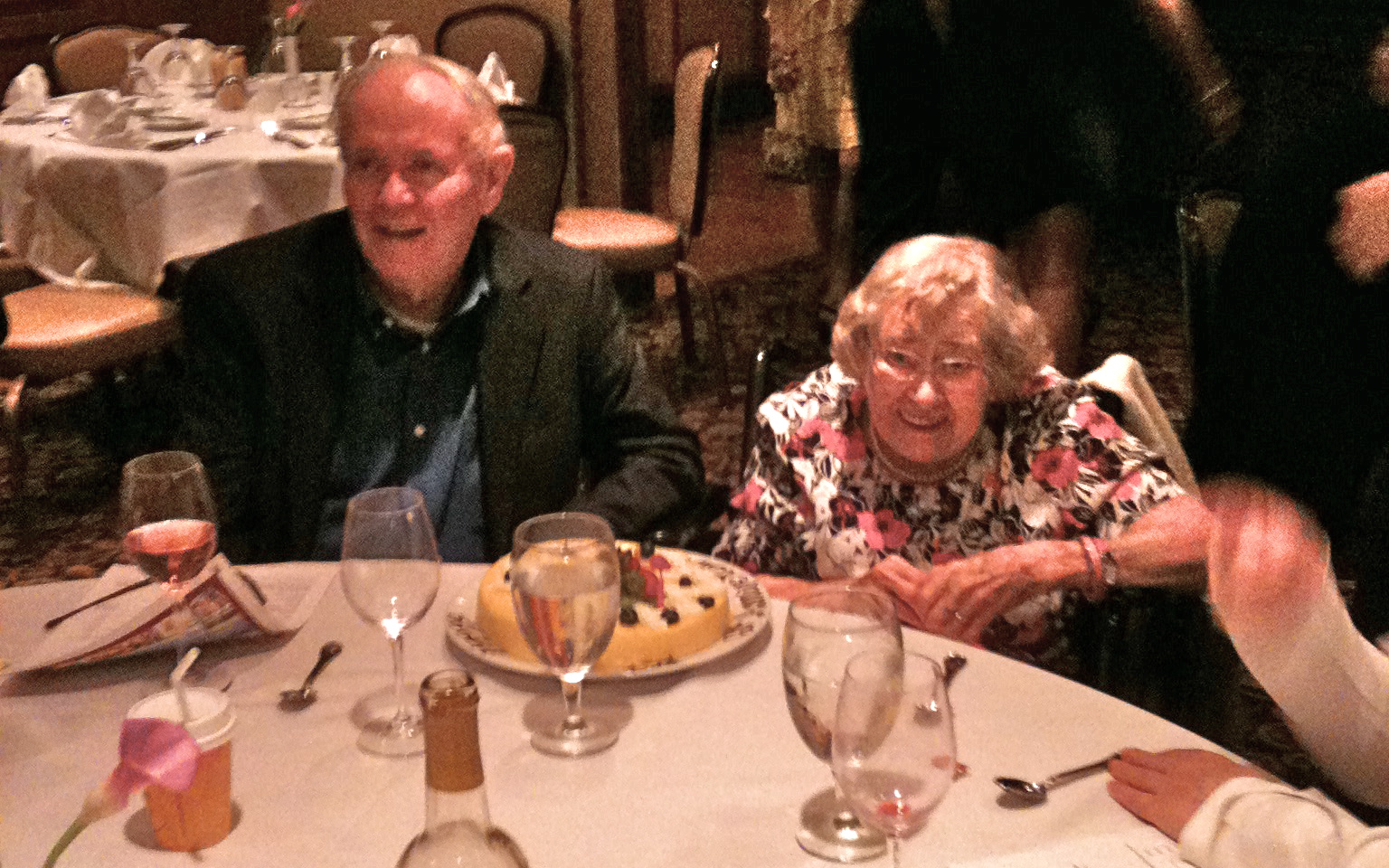
The other detail takes us to the Mohonk Mountain House in New Paltz, New York. And buckle yourself in, ’cause this a big detour. Mohonk is a stunningly beautiful place. It has no equal. It’s also stunningly expensive to stay there. But Mom didn’t care. She heard about it from a friend and decided in 1982 that she and my father would stay there to celebrate their 30th wedding anniversary. Then in 1992, she dipped into the cash that Grandma Scully had piled in her house by collecting rent from the buildings she owned in Astoria (my father called it “The Scully Fortune”) to bring the entire family, fifteen of us at the time, up to stay for a weekend. Like a bunch of friggin’ Kennedys we were. A big Irish Catholic family all gathered up in suits and dresses for dinner, playing tennis and going to the spa or out on canoes on the lake during the day.  I got to see how really wealthy people relaxed and had fun on vacation. I have to say, they have it down. Mom obviously had the time of her life because we did it again ten years later for their fiftieth wedding anniversary in 2002. There were 18 of us by that time. We had a wonderful time. I don’t want to know what it cost.

But that was Mom. She loved a good party, and she thought it was worth it. My father, bless his soul, was madly in love with her from the day she helped him out in 10th grade math class at William Cullen Bryant High School in Long Island City. If she wanted it, he did what he could to make it happen. When they left the city to come to the suburbs, Mom said she wouldn’t buy a house unless she could see water from it. That’s why you’re reading duffyscreek.com. It was the best water they could afford at the time. Us too.

So when 2012 rolled around, and Mom was already separated by a floor in the skilled nursing building from Dad because he couldn’t take care of her anymore, and against the advice of just about everybody, she said fuck it, we’re all going back to Mohonk for a 60th Anniversary Reunion. Matching tee shirts and everything.  She tortured my brother who handles the finances and my sister who handles the health care for the better part of the year over making the arrangements. She was going to get back there if it killed her. My father’s opinion? Whatever your mother wants.

They were transported from Long Island to New Paltz in the back of an ambulette. They were accompanied by two home health care aids, who stayed with my parents the entire weekend. They were delightful women. Mom had a list of everything she wanted to do while she was up there from Friday night until Sunday afternoon, including having somebody push her around the grounds and going to the outdoor picnic on Sunday afternoon.

And it rained more that weekend that it rained all summer. It rained buckets, for hours at a time. And Mom was pissed, as only Mom could get pissed, until I told her to look around. We were on the porch of the Mountain House, with the rain dancing off the lake below and off the roof above us. And everybody was there, because it was raining, and there was nowhere else to go. At the 40th and 50th Anniversary Weekends, my brothers and sisters and their families went their own way during the day and met up at meals. Now we were all stuck together, just talking, enjoying each others’ company. But I told her, If the sun was shining you’d be sitting here by yourself. You paid for all these people. Now you get to see them. And more importantly, you get to talk to them. Enjoy it.

My parents' 60th Anniversary Dinner at The Mohonk Mountain House, July 19th, 2012
My parents’ 60th Anniversary Dinner at The Mohonk Mountain House, July 19th, 2012

She thanked me for changing her attitude. And though the pain she was in wouldn’t quit, and it was tough for her to keep up, she knew she had lived her dream. She had pulled it off. She got the band together to rock Mohonk Mountain House one last time.

Mookie and The Dude and I went out to see them about a week and a half before she died, a few days before I got to tell her the incredible saga of how her favorite dog rescued a kitten. We took her and my fahter outside to the patio of the nursing home – it drove her crazy that she couldn’t go outside any time she damn well pleased – and we sat and we talked.

And we did go to Copake Falls Day and did everything we always do and nobody died that day. The next day, Sunday August 19th, I brought my father to the hospital to see my mother. It was not the first time I had done that. The other times, she got a little better and they released her. This time, as my father sat with my mother, the doctor consulted me with the results of all the tests they had done. The short version was that she had pneumonia, and when combined with all the things that were already wrong with her, she would probably be gone within a week. And then I got to walk back into the hospital room where my mother slept and my father watched, and I, the forty-nine year old baby of the family, got tell him that the woman he had loved for nearly 70 years was dying.

I tried for a good five minutes. He wasn’t getting it. He didn’t want to get it. I went to get the doctor. He tried for another five minutes. Dad finally acknowledged what we were telling him. The doctor left the room and we sat in silence for as minute. He didn’t cry. I don’t think I cried. We’re not really criers. He just said something that will stay with me forever, something I say every time I try to acknowledge someone’s grief and express my sympathies. You know what my father said when he found out my mother was dying? He said: “No matter how much time you have, you always want a little more.”

Mom woke up long enough to talk to me a little bit. She was back to being responsive, at least for about ten minutes of every hour. I told her that I we had gone to Copake Falls Day the day before and she understood, and she was happy to hear it. She’d never been to Copake Falls, but she knew I loved it, so she loved it. After I gave them some time alone, I brought Dad back home. On the way out of the hospital, we stopped for a little snack and a coffee to go for the driver at the cafeteria. My dad wandered away for a minute and came back with the biggest black and white cookie I’ve ever seen in all my life. I thought that was a very intelligent response to situation. A yin-yang full of sugar. I drove home to tell Joanie Duffy’s youngest daughter-in-law and youngest grandson that they had to come back with me tomorrow and say goodbye.

We wanted to do something special, and since The Dude was seven years old and was really impressed with his own reading ability, we prepped him to read one of Mom’s favorite poems to her, W.B. Yeats, “The Lake Isle of Inisfree.” Once he started reading, she started reciting it from memory right along with him, right through to the end. It was an amazing thing to witness. Mom was an high school English teacher – “a goddamn good English teacher”- as she told me in confidence on her deathbed. She loved literature, but she also loved all kinds of music and all kinds of art, and she kept everything she had ever experienced in her head right until the last day. I could’ve played “Name That Tune” with her as she was dying of pneumonia and she would’ve batted 1.000.

DSCN4643

Trisha took The Dude for a little walk around the hospital so Mom and I could have some one on one time. That fifteen minutes or so was great theater. There were certain people in her inner circle that Mom would feel comfortable enough with that she would curse like a sailor when she got together with them. I was fortunate to be one of those people. We regularly laced our conversations with f-bombs and characterized people as assholes and pieces of shit, usually Republicans. So I should have been ready for her last little bit of passive-aggressive snarkiness, as it was one of the great gifts she passed on to her youngest boy.

I told her I was sorry. I was sorry for all the times I got annoyed at her, that I should have been more patient, no matter what I was up against. because the pain she had suffered in the last ten years of her life was a monster, all the more monstrous because her mind had stayed so sharp. I was especially sorry for not taking the time to call more often, or for chasing her off the phone. “Or lettin’ that goddamn answering machine pick up.” she added. Yeah, that too.

I told her I was sorry and I hoped she could forgive me. She looked straight at me through all the pain and the fog and hung the wiseass smirk that I learned so well from her. “Naaaaah,” she said, “Fuck you. I’m takin’ that one to my grave.”

I believe I replied with something along the lines of, “well played, old lady.” It didn’t matter. She had a heart as big as an Adirondack mountain, and she loved me with all of it, every day from May of 1963 on. We shared music and poetry and baseball and art and gardening and animals and food and all the things that make your life your life. She taught me what living is. But she also took no shit. She’d hit you with the verbal frying pan to the head with no mercy if you had it coming. And I had it coming.

Later, she told my sister, “I think this is really hard on John. He’s still my baby you know.” She knew.

By the time I got out on Wednesday, she wasn’t talking anymore. They had moved her from the hospital back to hospice care at the nursing home so my father could be with her. They talked Wednesday morning, somebody took Dad to lunch, and when they got back, she wasn’t talking anymore. and she died late Thursday night. I didn’t bring Mookie to see her before she died, because of all the people who would’ve said what the hell are you bringing a dog in here for, but I brought him to see Grandpa as we all gathered Friday morning to start the send off.

She had a great turnout for an 82-year-old woman who had moved 50 miles from her home. Well over a hundred people. One of her oldest friends, a nun, said to me, “we have a new saint.”

I can’t help it. She made me what I am. I smiled and chuckled and said, “well…I don’t know about that.” Not quite sure how the nun actually took that, but she smiled back.

It was tough on The Dude. I could see it in his eyes when he saw her at the wake. I lost my own Grandma Duffy – Molly Gerahty Duffy of County Longford, Ireland- in 1971, at the same age he was in 2012. They wouldn’t let me see her at the wake. I had to sit outside. But I snuck a look at her lying in the coffin, and the image stays with me to this day. We decided that there was no point to shielding The Dude from anything. And it was actually gratifying to see him show raw, unguarded, profound human emotion, and gratifying to know that he loved his Grandma Duffy deeply and would never forget her. She had worried that he would never get to know her. She worried about a lot of stuff that never happened. She passed that one on to me as well.

I sang and played one of her favorite songs at her funeral: “Morning Has Broken”. I also wanted to perform “Four Strong Winds”, which she loved: “‘Cause our good times are all gone / and I’m bound for movin’ on/ I’ll look for you if I’m ever back this way.” (How many people do you know whose mothers asked them to mix them CD’s?). The nice people at the Catholic church would not accept “Four Strong Winds” at a funeral mass, but “Morning Has Broken” is on the acceptable list – “in the canon” as they put it to me. I thought it was kind of funny that it was written by a guy named Yusef Islam.

And when it was all over, when she was buried in the Scully Plot at St. John’s Cemetery, I was able to let my mind wander across the whole course of events of her final month, and back over her whole life. I don’t know where I was when a magical thought occurred to me. I was probably in the backyard on Duffy’s Creek that she loved so much. I thought about her incredibly stubborn insistence that she get to The Mohonk Mountain House that summer. I thought about how she rolled her eyes when she talked about how her own mother believed she could dictate the terms of her own death.

“But you did.” I said to her memory. “You went out like a rock star. You knew your body could never handle that trip, and you were in awful pain the whole time, but you did it anyway, ’cause nobody was going to tell you you couldn’t live while you were still alive. You wrote your own script.”

Well played, old lady.

My Mom in the backyard on Duffy's Creek in 1984. She's 54 in this picture, two years older than I am now. Much thanks to cousin Ann Marie Lenihan for digging this one up.
My Mom in the backyard on Duffy’s Creek in 1984. She’s 54 in this picture, two years older than I am now. Much thanks to cousin Ann Marie Lenihan for digging this one up.