Stories, Essays, Rants, Appreciations, Long Walks With Mookie The Dog, History Lessons, Occasional Social Justice Warfare and Bad Advice For Parents from the Left Bank of Duffy's Creek.
Here’s where it starts: At the very end of 2019, the week between Christmas and New Year’s Day, the week when nobody does much of anything, my wife Trisha and I did something complicated, extravagant and totally unnecessary. We bought a house.
Everyone with whom we shared this news was ecstatically happy for us. Nobody called us stupid. Not to our faces.
I suppose if somebody had a problem with us buying this particular house, the problem would be that we already own a house, and the majority of people on Earth don’t own a house, and many don’t have a home, and now we have two. From that perspective, of course it’s clear that we didn’t have any damn business buying another house.
But we bought it anyway. We had our reasons. We think some of them are almost valid, but I’ll leave that to you. If you’re a capitalist, maybe you’ll say we’re smart people and we know what we’re doing and it’s not a problem at all so go ahead and enjoy it. If you’re a Marxist, you’ll likely call us out for the selfish pigs that we are. Fortunately for us, there are way more capitalists than there are Marxists, at least in our circle.
Trisha and I bought my parents’ house eighteen years ago in Valley Stream, Long Island, New York. It’s a little 1,300 square-foot cape cod-style house on a 60 x 100 plot of land. It’s cute. You’d like it. We grow a lot of flowers. The backyard overlooks a pretty little winding creek, the official name of which is actually “Valley Stream”, but people who don’t know me usually either call it Hook Creek or Mill Brook.
People who do know me call it Duffy’s Creek. Some, anyway. Because I asked them to. My parents bought the house in 1955, and I grew up there, the “baby” in a family of five kids. I never went very far, never changed my mailing address. I got married, came back, entered into a real estate transaction, had a son of my own, and began growing old right on that creek. The tide comes in and out from Jamaica Bay, and by the grace of God, I go right on living. It’s a nice story so far, isn’t it?
But here’s the thing: Three weeks after Trisha and I met on the boardwalk by the ocean in Long Beach, Long Island in 1999, we spent a perfect early-November weekend staying in a cabin in Taconic State Park at Copake Falls, in Columbia County, New York, a place we had both discovered independently, she from going to the annual Falcon Ridge Folk Festival in nearby Hillsdale, me from years when I would periodically get in my car and drive long distances because I didn’t have anybody to go to the Falcon Ridge Folk Festival with. We lit a campfire on a crackling cold and clear Friday night full of stars, and on Saturday morning we hiked to Bash Bish Falls under Indian summer skies full of crazy blue jays hopping through orange and yellow trees yelling, “Stay! Stay! Live Here!” We fell in love with each other and we fell in love with the place. And for the ensuing twenty years, we returned there every summer and a couple of falls, probably logging about six months of elapsed time. Our son Jack has never known a year that didn’t include at least one week in Copake Falls.
“It’s like our second home,” we’d say.
But that wasn’t true. It just sounded nice.
So our home away from home stayed up there on the map and up there in our minds year after year as we continued to grind it out on Long Island. The sound of the blue jays and the turns in the country roads stood behind us, tapping on our shoulders to remind us what we were missing; the ancient mountains, the cleaner air, the bigger trees, the wide open roads, the farm stores and the church barbecues, the people who wave when they drive by, the absence of malls and chain stores (except for the Stewart Shop up in Hillsdale, which is perfect and cannot be criticized). I wasted hours and hours of my precious time here on Earth scrolling though Zillow listings.
OLYMPUS DIGITAL CAMERA
Copake Falls was an alternative reality. And as Valley Stream continued to get louder and louder year after year, summer after summer Copake Falls stayed mellow.
Valley Stream is a lot of things. Many of them are good. But “mellow” is not one of those things. A quick check for “antonyms of mellow” on Merriam Webster reveals “discordant, dissonant, grating, harsh, inharmonious, jarring, strident, unmelodious and unmusical.” I guess it would be harsh, maybe even unmelodious, to describe my hometown in these terms. But still, it sure as hell is not mellow, except in our backyard, and then only when our surrounding neighbors aren’t shooting fireworks or holding dance competitions. And if you want to see jarring and strident, live near a mall on Long Island during those seasons when people get in their cars every half hour to go buy more stuff. If grating and harsh is more what you’re after, listen to a Long Islander who has been inconvenienced.
Robert Frost came up with the line, “I had a lover’s quarrel with the world.” It was such a good line that he requested it as the epitaph on his gravestone. As you might guess, Jean-Paul Sartre doesn’t have an epitaph on his gravestone (cool issues and all), but he sure could have gone with one of his best lines: “Hell is other people.”
People are what make a place more than anything. Or break it. There are rural parts of America and suburban parts of Long Island where I’m not too arrogant to say I wouldn’t be caught dead. People who are proud of where they live, wherever they might be, like to come up with slogans to promote their hometowns as places that other people might like to see, possibly even live in, because people spend money, and that’s what keeps places alive. Valley Stream once sold itself as “The Gateway to Suburbia”. Kind of a Dante’s Inferno thing really, but I suppose it was meant as a compliment at the time. The Town of Copake sells itself to this day as “The Land of Rural Charm.” That’s a good one, huh? I hope whoever thought of that at a meeting got the praise and recognition that they earned. But I could show you lots of uncharming rural places around town if I had to. And tell you about some less than charming rural people.
So In fairness to my fellow Long Islanders (and – whether they like it or not – my now-fellow Copakeans), let’s start with the premise that the vast majority of people everywhere, in every place with a name, are really all right. I truly do believe this. But sadly, as you know, while most people are wonderful, some people just suck. So it follows that if there are more people, more people will just suck. That being established, here are what I believe are the four basic groups of problem humans:
1. The Slightly to Extremely Dangerous: Those who have had hard lives or some sort of trauma and have decided than instead of nobility or faith, they will instead make it a point to project their hurt and anger on convenient targets they find around them. While this group of people have to be treated like walking landmines, as a child of God, one can’t judge them if one is not one of them and hopes not to be. I just try to stay out of their way and not to make things any worse for them.
2. The Insufferably Annoying: Those who have been sadly brainwashed by too much TV into thinking they are the star of their own little reality show, and thereby have developed a need to create drama and tension where none should exist in order to compensate for an otherwise tedious existence. Long Island is saturated with people like this, possibly because of its wealth. If your main problems are not the procurement of food, clothing and shelter, you really have no problems, so if you want some, you have to invent them. Ideally, it would help every one of them to be slapped silly, but violence is never an option.
3. The Head-Scratchingly Frustrating: Those who, for a variety of reasons, from deeply neurological to not getting hugged enough as babies, just can’t grasp the simple rules of getting along. They’re not particularly dangerous or overly dramatic. They just flat out boggle the mind. Ask anyone who’s ever worked in retail. But, as my father would have said, you can’t make their problem your problem. You can suffer fools gladly or ungladly. You’re still going to suffer fools.
Now, If you give people in these three categories the benefit of the doubt, and assume that in their essence they really just can’t help themselves, and they probably have many good qualities as well, that leaves us to grapple with the problems perpetuated and the damage done by Group #4, The Unrepentant Assholes: Those who live to purposefully and gleefully gain negative attention from the rest of us by being as unpleasant, uncooperative and self-centered as they can possibly be.
My personal sampling of the several hundred-thousand people I’ve interacted with in 57 years suggests that groups 1, 2 and 3 represent between 7% and 10% of the overall population. Maybe as much as 15% in higher-end neighborhoods. The Unrepentant Assholes in Group 4 are actually a very, very small percentage of the human population. I asked Trisha, and she said 2%. I was thinking three, but I’ll go with her answer.
There are 284.7 square miles of land in Nassau County, New York, and approximately 1,359,700 people call it home, making for a population density of 4,787 people per square mile, with all the people noise and chaos they generate. Bear in mind that there are large swatches of Nassau County where billionaires have reserved lots of land for themselves and their horses and their golf courses, leaving the rest of us to fight over what’s left. The population density of South Valley Stream is 7,583 people per square mile.
Traveling from Nassau County to Columbia County, you’ll pass Co-Op City in the Bronx, which has a population density of 47,000 per square mile. So really, I should just shut up. I’m very much aware of this. But we’re born where we’re born, for reasons that are seemingly random and certainly not fair, and we know what we know. I would like to build a little house with a garden for every family in Co-Op City on all the land currently being used for golf courses. I have no beef with horse farms.
Meanwhile, In Columbia County, there are 635 square miles of land, which is home to 59,461 people, which is 93 people per square mile. This includes Hudson, the county seat, which is two square miles and has 6,144 people, 1238 of whom sell antiques. Extrapolate that funky little metropolis, and now we’re down to 84 people per square mile, and 2% of 84 is 1.68.
This all means that in every square mile of land in Nassau County, you will find 94 Unrepentant Assholes (150 in South Valley Stream, most of them driving). Whereas in Columbia County you might find two. Plus you can factor in the variable that being known as having manners and not being a big fat pain in the ass is much more important in Columbia County, because you don’t want everyone else to agree that you’re that one person in their square mile, whereas in Nassau County, every asshole is competing for attention against 93 other assholes within one square mile, and it’s hard to keep track of them all.
There is no cure for any of this. Not in this life, man. More people create more stress. As the Pandemic of 2020 set in, I started seeing clickbait on my rectangle about how people would start moving from the city up into the Hudson Valley “in droves”. Since it’s an issue that affects my life, I was interested to know how many a drove is and how many droves you could multiply that by, but I try not to fall for clickbait. And the proliferation of people in Groups 1, 2 and 3 will only get worse as cell phones get better. And more Group 4’s means more chances of something unpleasant happening to you or around you every time you leave the house.
So the choice for us seems to have become one of either standing in the Gateway to Suburbia as the Barbarians continue to storm through, or goin’ to the country and buildin’ us a home in The Land of Rural Charm, hoping that agricultural zoning regulations will keep the droves at bay for a while.
And that’s why at the end of the twenty-first year of complaining about the miseries that follow the overpopulation of Long Island, and of idealizing the alternative existence of Columbia County, Trisha and I bought a second home two and a half hours away from our first one, a mellow-yellow ranch house on 1.9 acres of land bordering the very state park where we had once walked around all gooey in love under the autumn sun with the blue jays and everything so many years before. Since I had named the creek in back of our house in Valley Stream after myself, because who could stop me, and since the funds that made this real estate transaction possible were bequeathed through my wife’s family, I insisted that we call our new second home, perched on a ridge 840 feet above sea level, “Trisha’s Mountain”.
We had a dream. We had the money. We jumped off the cliff. And then the whole country broke. And then I quit my job.
Not really, but sort of. I actually retired from 25 years as a middle school English teacher. It’s an important job, and somebody has to do it, but it is no longer me. However, the pension I earned is a lot less than if I had stuck around and made more money for a couple of more years, thereby assuring that eventually, if I wanted to live in the style to which I’ve become accustomed, house in the country and all that, I’d have to suck it up and find a part-time job. So, I gave myself four months to decompress, while the Covid-19 Pandemic and the complete collapse of American Society that will likely precede or follow the Presidential Election of 2020 play themselves out.
In the meantime, in between traveling up and down State Route 22, I thought I’d write a book. But I didn’t know what to write about. I had some ideas, but I don’t like it when people are angry at me, so I had to keep thinking of other ones.
The whole “we left the crowd in the city and moved to the country but we didn’t know the cows next door would smell so bad and why are there bees and snakes” thing has been done to death. That’s not what I’m after here. There isn’t a whole lot of Upstate / Downstate culture shock for me to write about because I pretended that I had a house in the country for twenty years before I actually had one. And nobody up there has to explain to us how not to be “citiots.” We get along just fine with everyone. Not much material there. Of course, In order to be considered a local in Copake, your family has to have lived there for two-hundred years, so we know we’ll always be outsiders. We try to counter that by being polite.
So ultimately I decided to write a book of stories and word pictures, twenty of which are set in Columbia County, the other twenty in Nassau County.
My only claim to originality is that I write from the perspective of one whose heart truly lives in two places at the same time, and who knows his time in the one place, the place that created him, is likely winding down.
A Little Side Note: Right now, if you’re reading this book in its competed form, and not in installments on duffyscreek.com, you’ve established that 20 plus 20 equals 40 and not 41. Very astute. Chapter 1, the longest one in the book, is mostly about New York Route 22, the road in between (and how I found it). As we’re making this several years long transition, the road from here to there and back has become sort of my third home.
Valley Stream and Copake Falls, while they are almost united by a common language, and while you can drive from one to the other in two and a half hours, and while by virtue of boundaries drawn up 400 years ago are both in New York State, could not be less alike. But this book is not about comparing and contrasting them. It’s about things that define these places for me. They are both home now. When I’m in one place, I feel the other one trying to pull me back. Neither of them seems to understand that I can’t be in two places at once.
I have become a human wishbone.
I grew up in Valley Stream (and by extension, Long Island) in days when it wasn’t quite as strident and jarring. As another one of my heroes, Mose Allison, said of Tippo, Mississippi, “I am of that place, and the stamp is upon me.” But the little hamlet of Copake Falls has been yanking at the sleeve of my soul for most of my adult life, and now our plan is to go there for good someday.
But not today.
I guess you could say we have a plan. But we don’t, really. Our right-now-16-year-old son has two more years of high school and likes it upstate just as much as we do. So he would be more or less on board if we actually had a plan. Trisha is very successful at her mommy-takes-the-train-to-the-city job, so she’s not in a hurry to leave (as we’d be broke, and she’s in charge of the money) but I know Long Island’s obnoxiousness gets to her even more than it gets to me. And as I write this in the summer of 2020, you can’t even go sit on the beach unless you want to risk getting horribly sick (or getting somebody else horribly sick), and Long Island is pretty much pointless without the beach and the ocean. It seems predetermined which way the wishbone will eventually snap, and I guess if there is a plan, that’s the plan.
Abraham Lincoln said that the best thing about the future is that it happens one day at a time. I’ve outlived him by a year, so I’m happy to be here at all.
And as people suffer all over the world, my main purpose in life in August of 2020 is waiting for people to call me to schedule delivery of some comfy furniture.
I never thought it would come to this.
Of course, If we decided to put our house in Valley Stream on the market tomorrow morning, it would take the better part of two years to shovel out of it anyway. So for the foreseeable future, part of me is watching the tide come and go on the creek and part of me is watching the light dance across the mountains. I am a stupidly lucky son of a gun and I have not a thing in this world to complain about, but if you’re nice enough to read on anyway, I’ll try not to be boring.
When a friend at work would complain to me, he’d often say, indignantly, “this is not what I signed up for!” Well, this is exactly what I signed up for that mellow December day last year in the lawyer’s office in Millerton.
I am a human wishbone. I am Gumby, damn it. With one arm and one leg stretched north, the other arm and leg stretched south.
Which would put my center somewhere around the Red Rooster.
It’s been another long, inexcusable break from blogging, but for better or worse, A Creek Runs Through It rises from the ashes today. Today, it’s time to go for a good, long walk. If you’re up for it, Mookie and I would be pleased to take you along on a tour of Valley Stream, Long Island, New York, or at least a nice, big chunk of it.
Of course, we’re wired very differently, and our respective life experiences are very different as well, so no doubt Mookie would at some points be putting things in a more positive light for you than I might. But he doesn’t speak English, and he doesn’t blog. So today I’m your somewhat unreliable narrator.
We are eight summers and seven winters into walking our turf together now, Mookie and I, and we’ve interacted with hundreds of our neighbors along the way. And I’ve learned to appreciate his perspective. As a writer named Edward Hoagland wrote about dog training theory, I’ve learned ”to open up myself the possibility of becoming partly a dog.” We even negotiate over which way we’re heading on our walks, since he knows his way around as well as I do. If he could speak English, and he could blog, he’d just look at you with a big smile and say, “Isn’t this great?” But then again, he would say that about every place he’s been.
Futhermore, my dog believes that every person who opens every house or car door as we’re walking by has arrived in his field of vision purposely to see him and tell him what a beautiful big dog he is. He collects people. We’re just walking by your house and you happen to walk out your front door or get out of your car. Mookie stops dead in his tracks, squares his paws, sucks in his gut and targets his prey (you) with his best Labby smile, as if to say, “Hey! Hey you! Here I am! I love you! Wanna say hi waggy waggy?”
He’s very good at it and he scores a “Hey, Buddy!” or a smile back at the very least almost every time. Subsequently, he’s made me like people a little more in general. They’re actually not so bad, most of them.
Mookie deciding whether to bolt over to someone and tackle them, just to say hi.
Yes, my dog loves it here in Valley Stream. So does my son, whose grandparents moved here from Astoria, Queens in 1955, lived for 46 years on a house on a creek and raised five children in it. My son is already planning to send us away someday and buy this house. For the record, that never occurred to me when I was 14. I’m glad he likes it.
Me, I’m the youngest of those five children and right now the I’m guy who lives with his family of three people, three cats and a dog in that same house on that same creek. Do I love living in ValIey Stream? Well, honestly, a lot of the time I’m pretty much awash in ambivalence. I’ve met a lot of great people here, and a couple of soreheads. Plus I suppose it would be impossible not to feel affection for a place where you’ve spent most of fifty-five years and three months.
On the other hand, most of fifty-five years and three months is a very, very long time to live in the same anywhere. I feel like the place where I live could be a lot better if people in general had different priorities. But that’s true of all of Long Island, where people often have some really ass-backwards ideas about what’s important. And I will say this: What strengths Valley Stream does have put it way ahead of a lot of places not only on Long Island, but also in America in general.
So I’m going to take a cue from Mookie and try to keep it positive when I can. We’re going on a big, circuitous, approximately five-mile walk, but we’re going to take our time, and sometimes go back in time. Mookie will need to read his pee mail on the poles and trees, and I’ll be telling you some stories and acting as your tour guide. The goal is to see a place, a town in America in 2018, close up for what it is, as well as what it was and where it seems to be going. Remember, no matter who we happen to meet along the way, Mookie loves them. As for us, you’d probably agree with me that any day is a good day for a walk, and most people are likable enough. So I’d like to show you around our hometown. At its best, it’s a microcosm of the best things about our country. At its worst, maybe not so much. You wanna go for a walk? Come on! Let’s go for a walk!
Duffy’s Creek
Terrapin escaping troubled waters for a bit of sun on a rock
Egrets, we have a few. And I try to look out for them.
The walk starts from the house in which I was conceived and raised, and where I live more or less happily today. The house is on a winding street that follows a winding creek, and it’s called Jedwood Place for no good reason. In that house, on a 60 x 100 plot of land abutting tidal waters flowing in and out from Jamaica Bay (home of many interesting birds and one big-ass airport), I have been a baby, a son, a little brother, a snotty teenager, an occasional host of rowdy parties, a smart kid, a troublemaker, a mostly frustrated , bored but sporadically inspired young adult, a lot of peoples’ friend “Duff” who lives down the block from South High, a college student, a guy who’s been in his parents’ house too long, a guy carrying laundry and Ancona pizza on a visit home, a happy and loyal husband, a pleasant enough neighbor, a not-so-awful father and the guy with the big yellow dog.
Two big, fat side notes before we go walking (you can use this time to stretch, maybe tie your shoes. Mookie Dog will wait patiently on the front lawn and sniff the air) :
Note One: There is no other Jedwood Place on the face of the earth. But after 55 years of using the same mailing address, the name “Jedwood” feels as much a part of my name as my name. Yet there is no logical explanation why Mr. William Gibson, the man whose development company built my neighborhood in the early 1950’s and who built most of the neighborhoods of South Valley Stream thirty years before that, would have named a street “Jedwood Place.” The two most frequent citations of “jedwood” that you’ll find on Google refer to a hunting ground in Scotland and “jedwood justice”, which was a practice rooted in 19th Century Maryland wherein a person suspected of a crime was put to death without trial. Neither of these things have anything to do with Jedwood Place. Hopefully, they never will.
Note Two: Jedwood Place is in it’s own little development, bordered by Duffy’s Creek and dead-ending at Valley Stream South High School. Mr. Gibson called it “West Sunbury” but that name never stuck. The other three street names in this little development are Cluett Road, Sanford Court and Virginia Court. A Google search reveals that the man who developed the process of pre-shrinking fabrics known as “sanforization” was named Sanford Lockwood Cluett. Hmmmm. I have no idea if he was a friend of Mr. Gibson, though they were contemporaries, and captains of industry, sort of. I could find no mention of Sanford Cluett, who was born in upstate Troy, NY, hanging out on Long Island, though if I were from Troy I guess I’d jump at the chance. And oddly enough, Sanford Cluett was married to a woman whose maiden name was Camilla Elizabeth Rising, and the land Jedwood Place was built on was once part of the Riesing Farm, a different spelling but coincidental just the same. I have no idea who Virginia was. All this is interesting to me (if not to you, as you and Mookie wait for your promised walk) because Jedwood feels like part of my name, and it’s only because somebody pulled it out of nowhere in 1950.
Such is the randomness of our existence. Creek Street would have worked just as well.
I wanted you to know all this before we go because I ‘ve spent most of my life walking or driving around in circles, starting from and ending at Jedwood Place, of which there is only one on the face of the earth. And over the last seven years, in partnership with our beautiful, loyal, insanely friendly Labrador Retriever, I’ve taken walking in circles starting from Jedwood Place to a whole new level.
During the twenty-five years in which I was between dogs, I had often wished I had a dog just so I could go for a walk without having a destination in mind (and of course because dogs are generally so, so much better company than people). As we’ve established, Mookie’s mission in life is to say hi to as many people as he can, which in his best-case scenario means you rub his face and he stares deeply into your eyes and tries to kiss you. If you were actually here, you’d know that already, and as you may have guessed, I’m somewhat more reserved. But I enjoy all this about him greatly, and hundreds of people we’ve met on our walks have as well.
Everybody loves Mookie. He’s like walking around with 100-pound bag of magic happy dust.
And so (surprise), having a friendly, good-looking dog and taking long, rambling walks around town is a great way to observe and often meet people, and when you observe and often meet people, sometimes you get talking to them. And when you get talking to people, you get to know the true character of a place. And I can say without any reservation that I (and to an extent, Mookie) know the character of Valley Stream – at least the south half of it – better than anyone, particularly anyone who works at Money Magazine.
Why Money Magazine? Well, apparently, somebody at Money Magazine really likes Valley Stream, so much so that earlier this year Money Magazine voted it the Best Place To Live in New York State. For heaven’s sake why? Well, this is what they said:
First settled by Scottish immigrants in 1834, Valley Stream is a Nassau County village that attracts residents with a reputation of being “neat, clean and safe”. The location is a big draw—it’s just 35 minutes from Manhattan, near two major highway arteries, and served by the Long Island Railroad. Snapple originated in Valley Stream, which also boasts several historic colonial sites, a diverse population, and a close-knit suburban community.
So, to use a buzz phrase that my boss loves, “let’s unpack that.”
First of all, Snapple. Really? What the hell is Snapple doing in three sentences of copy about Valley Stream being the best place to live in New York State? And I believe we have one colonial site. This is why I mostly avoid magazines.
Second of all, I’m very aware of the “major highway arteries” and the Long Island Railroad, thank you so much, as well as being five miles from JFK Airport. It’s often very noisy around here. It’s not “Manhattan noisy”, or even “Queens noisy”. You can still hear the birds. There still are occasional moments of relative quiet. But if you listen for it, there’s almost always a dull roar of the motor noise of trains, plains, automobiles and leaf blowers emanating from our surroundings, and I’m not entirely sure that this isn’t all slowly driving me insane.
Third of all, neat, clean and safe. These are just about the most relative terms you could string together to describe a place. Your idea and my idea of the threshold for earning those adjectives could be very similar or very different, depending on how much you are affected by Obsessive-Compulsive Disorder.
We’ll get to “clean” and “neat” when we get walking. (“Yawwwnnn!!!,” says Mookie). First, let’s talk about “safe”. “Safe” is ultimately what makes or breaks the reputation of a place. But again, it’s completely relative. Do I feel “safe” walking with Mookie at night through Valley Stream? Well, yeah, ‘cause we’re the scariest looking two guys out there if you’re up to something, so that’s a moot point. Do I feel safe if my 14-year old son or my wife is out after dark? Of course not, because I love them and I worry about them and I want to be with them all the time so I know where they are, but that would be true wherever we lived. That’s got nothing to do with Valley Stream.
Less than a mile to my west is Green Acres Mall, which has grown like an ink stain since it was built in the 1950’s. It has, over the years, fostered a reputation as being a slightly dangerous, crime-ridden place. So much so that the first neighborhood we’re going to visit on our walk changed it’s name from “Green Acres” to “Mill Brook” in the early 1980’s to distinguish itself from the shopping mall, a decision that at the time smacked of racism, because many of the shoppers at the mall are people of color from neighborhoods in Queens and Brooklyn. This is ironic in retrospect since all the ethnic groups that people in Green Acres were afraid of are now raising families and planting flowers in front of the houses they own in Mill Brook.
An aerial picture of Green Acres Shopping Mall taken by my father from a helicopter. He actually did this professionally as you can tell, and was also pretty damn funny in his prime, as you can also tell. Note the date on the picture. Green Acres has expanded yet again in the last 16 years.
Within the last three years, Green Acres applied for and received a PILOT (Payment In Lieu Of Taxes, otherwise known as a big fat tax break) from the Town of Hempstead to expand yet again. Part of their strategy for legally cheating on taxes and stealing money from people in Valley Stream was to sell Green Acres as a “tourist attraction”, since more than 50% of the customer base comes from outside Nassau County. The mall is literally right on the New York City border. And so, when people on Valley Stream social media pages want to make snide comments about people from the city, they call them tourists. Isn’t that clever?
Statistically, I don’t know how true the perception of Green Acres Mall being unsafe is or ever was. But I can tell you this: The creek amplifies noise. All creeks do. It’s a property of water. If there’s a particularly egregious crime at the mall (I’d say an average of between 6-10 times a year depending on how hot the summer is and how much the giant flat-screen TV’s are going for on Black Friday) you’ll know about it at Duffy’s Creek. You’ll hear the angry roar of helicopters circling overhead (followed seconds later by the angry roar of people on the Valley Stream News Facebook page reporting helicopters circling overhead), and the apocalyptic sirens from emergency vehicles racing down Sunrise Highway and Mill Road.
At times like these, Green Acres is less a shopping mall than an encroaching monster that wants to eat my quality of life. Of course, it would certainly be LESS safe here if there WERE no circling helicopters and emergency vehicles ready to respond in minutes to intervene in whatever nonsense is going down. We pay some of the highest property taxes in the country for that sort of thing. And Roosevelt Field, the bigger shopping mall to the east bordered by the much more wealthy community of Garden City, makes it into Newsday for spectacularly stupid crimes as much as Green Acres does.
And the other 99% of the time, when there are no egregious crimes being committed, it’s just a shopping mall. And me, I hate shopping malls. They’re gross. I like forests. And lakes. But if you’re OK with shopping malls, go ahead and visit Green Acres Mall sometime. Don’t worry. It’s plenty safe. It’s a tourist attraction. Go there and waste your money.
Meanwhile, now that we’ve established that “safe” is an illusion that means absolutely nothing no matter where you live, let’s get to that walk. As you look across the street from my house, the first thing you will say is “What the…?” And then you will smile your dopiest smile, because you’ve just had your first look at the house of my longtime neighbor and friend John and his wife Amanda who live across the street. John and I disagree vehemently on politics, so we never ever talk about it when we see each other. However, I have great respect for and truly enjoy his execution of the American rights and traditions that allow one to do whatever the hell one wants to one’s house within local zoning regulations. Plus he does our taxes, and we always do pretty well. So I have no problem living across the street from a house that has been remodeled to resemble a giant log cabin.
Thanks to my neighbor John for giving me permission to share this view of his house from my house.
Yeah. That’s right. A giant log cabin. AND, there are two “showcases” in the front of the house. In one of those showcases you’ll see a life-size gorilla statue, along with a life-size guy who looks a little like John himself sitting in a chair in a white suit and a Panama hat, with a parrot on his shoulder, a totem pole and a monkey scaling a tree behind him. In the other showcase you’ll see a bear, several small hippos and a family of prairie dogs. You’ll also notice the two grazing bison attached to the second floor balcony and the almost life-sized plastic representation of a Tennessee Walking Horse mounted on the fence. Completing the look is a stone wall in the corner of the property with a faux blue pond made of concrete, engraved with various animal drawings, “flowing” out to the sidewalk.
I’ve seen a lot of people take pictures of John’s house. Selfies, mostly. I find it extremely amusing. And I know he doesn’t give a flying rat what anyone thinks of his log cabin, which another reason I like him. And since we have Valley Stream South High School up at the top of the dead-end of Jedwood Place, we have lots of pedestrian and vehicle traffic passing by our houses – and lots of very loud teenagers – when school is open. As a matter of fact, you literally can’t get out of our driveway between 7:15 and 7:40 a.m. on school days as the street is one long convoy of cars dropping those same teenagers off at school, most of whom live no more than a mile away. My friends all walked to school here, even the ones who lived two miles away. Most of them are still alive. Just sayin.’
Valley Stream South High School, where we regularly trespass and occasionally get off the leash to go get it. The new football field really pisses us off
As we set out on our five-mile walk (did I mention that?) we have three possible trails: We can walk towards Valley Stream South High School, my alma mater, where we don’t give damn about trespassing on the field because of the school taxes we pay (and Mookie has lots of friends in high places anyway). They’re currently transforming the South football field from natural to artificial turf, which Mookie and I, along with the sandpipers, agree is a really stupid idea, but we had no say in it at all. Walking up that way, we might see my next-door neighbor, originally from the Philippines, who Mookie has loved since he was a puppy, and how could you not? We might see Raffi, who doesn’t like Mookie sniffing at him, but who feeds me really good noodle and pastry stuff after Ramadan so I give him jars of homemade bread and butter pickles on my summer vacation. (All my other friendly neighbors get them. I don’t concern myself with the unfriendly ones, and Mookie knows not to stop in front of their houses).
We might see Bob walking his dog Eli the other way and we might say something about the Mets. One family of Mookie’s best friends moved to Florida last year and we both miss them. But he’s recently worn some other people down at the end of the street who now say hi to him by name. Up at the high school soccer field, Mookie might get to chase a ball off the leash if no one is around, but if it’s Sunday, they’ll be twenty gentleman of various ages, all in way, way better shape than I am, playing The Beautiful Game like their lives depended on it. When school is open, Mookie collects high school students. They’re not so bad, even with the littering. I digress.
If we take trail #2 and walk up Cluett, we’ll see a house that belongs to some wonderful neighbors of ours that is currently being renovated and has been raised way high off the ground to survive the next big hurricane. From what I can see, I like their chances. Mookie will check to see if his very best friend Vacco is relaxing in the hammock that hangs from the walls of his spotless garage, and if so will have to charge at him and wag his tail maniacally for a face rub while Vacco and I talk about our solar panels.
But we’re going to take trail #3 and walk up Jedwood towards Mill Road and around the Creek, into Mill Brook, which I still call Green Acres. There’s a story I want to tell you about the path on the other side. Walking up to the corner, we’ll pass about twenty houses, and Mookie has friends in at eight of them. He’s working on the other twelve.
You can’t get there from here. The abandoned path at the end of my street that leads to where the bridge isn’t.
The Mill Brook community (when it was Green Acres) used to be connected to Jedwood via a pedestrian bridge over Duffy’s Creek (called, not surprisingly, “the Bridge”) but it was deemed unsafe after a kid got stabbed there (long, stupid story) and it was demolished, meaning most kids from Mill Brook now either walk or get a ride down Jedwood to get to school. So once upon a time, you, me and Mookie could’ve walked to the footpath on other side of Duffy’s Creek from the high school without going to Mill Road and passing the stores. And if the bridge were there, I could tell you about all the bottles of cheap beer and other commodities that were consumed over the years by generations of Valley Stream South students. But it isn’t. So I won’t.
Instead we have to make our way past the insane little white dog that occasionally runs out into traffic to chase after us at the corner of Jedwood and Mill, and walk north past the stores.
Here’s the good news about the row of stores at the corner of Jedwood Place and Mill Road. There’s a dry cleaner, a deli, a pizza place which I don’t like but my son does, a Chinese take-out that everybody likes, and deli that’s really a bodega, which is different from a deli but I don’t have the patience to explain to you why that is if you don’t already know. There is a certain convenience in having these things in your neighborhood. I guess that makes them convenience stores.
Here’s the bad news about the row of stores at the corner of Jedwood Place and Mill Road. 1) It has not been updated since 1950. It’s shabby and run-down looking and there is 68 years of gum embedded in the sidewalk. They use the steel doors use that you see in the picture when they’re closed, which makes the neighborhood look worse than it is, but I suppose it’s better than broken plate glass, which would do the same. 2) Nassau County owns a strip of land next to the row of stores that abuts Duffy’s Creek. They have not cleaned this area in my lifetime. It’s a wasteland of weeds, dead trees and garbage, as disgusting as anything you’ll ever see in a place where the median family income is $85,00 a year. It screams, for all the world to hear, that here in Southwest Nassau County, we just don’t give a fuck. The water spilling from the culvert under Mill Road into the creek smells like death, but more about that later, too. 3) There is a very large laundromat between the deli and the pizza place and people double park in front of it all the time. 4) The first store was a dive bar for most of my life – originally called “The Sportsman’s Rendezvous” – but has become a Nail Salon. It is one of approximately 500 nail salons in a five-mile radius. I never hung out in the dive bar, but I’m sure there were a lot less nefarious things going on in the Sportsman’s Rendezvous than there are in the Nail Salon. But that’s just me. 5) The Garbage.
The Path along the Left Bank of Duffy’s Creek, owned by the Town of Hempstead.
The spillway under Mill Road, where the “fresh” water from Hendrickson Lake and Mill Pond meets the salt water from Jamaica Bay at Diuffy’s Creek,
Mill Pond Park, Village Of Valley Stream
Mill Pond Park, Village Of Valley Stream. They tell me they can’t do much about the pond scum, and I’ve met pond scum, so I get that.
The toxic wasteland is owned by Nassau County. If you don’t believe that it is a toxic wasteland, I’d invite you to go take a whiff.
The amount of garbage on the street in and around Jedwood Place, most of it originating from the row of stores, and the very loud teenagers from the high school, whom Mookie loves and who visit those stores regularly, would have cost Valley Stream our Money Magazine “Best Place To Live in New York” designation if Money Magazine had known about it. I regularly feel like the Crying Indian when I walk around and see all the garbage that kids drop on the street (and that people throw out of their car windows after dropping their kids off at the high school. Don’t worry. I see you). There was a big push back in the 70’s to get people to stop littering, because nobody really wanted to make the Indian cry. But somehow, somewhere along the line, this morphed into the idea that people are paid to pick up after you. And who the hell is the Crying Indian? If you litter on Jedwood Place, ultimately, I pick up after you for free, because I get to the point where I can’t look at it anymore. People walk around with a bottle of something and a magic rectangle everywhere they go but somehow carrying a wrapper, or that now empty bottle of something, to the next garbage can is far too great a burden. This is a Valley Stream problem and a Long Island problem in general. We spent a week in Copake, NY and a week in Saranac Lake, NY this summer. There are fewer people in these places, of course, but none of them throw their fucking garbage in the street. So it’s not like a ratio or anything. People on Long Island – though I like many of them, and Mookie loves all of them – are pigs. There, I said it.
But Mookie, of course, doesn’t mind at all. He’s more interested in smells and finding people to say hi to than he is in aesthetics. This is one part of me that refuses to become partly a dog.
So we’re past the stores now, we’ve checked for terrapin turtles sunning themselves on the rocks next to the horrible-smelling spillway (sometimes we see our friend Steve who works at the high school looking for turtles, too). We’re around to the Right Bank of Duffy’s Creek, going down the path that runs behind the backyards in the “new” section of Mill Brook. We could have gone straight and gone through “Old Green Acres” on the streets north of Flower Road, which was the part of the development built in 1939 and features some very nice tudors and brick colonials that help keep the property value up on our little wooden box, but I would rather show you this path. I have my reasons.
My sister Mary Frances on The Path, around 1958
The same spot in 2018
Unlike much of Valley Stream, the path along Duffy’s Creek -which like Jedwood Place is outside the boundaries of the Village of Valley Stream and within the jurisdiction of the Town of Hempstead – looks pretty much the same as it did when I was a kid, but with one big difference: There’s less of it. The creek has been eroding the path for as long as they’ve been matched together. The hard surface of the path is just about gone in most places. Tall Phragmites (what my father referred to as “woozy-woozies” when he had small children and even when he didn’t) block your view of the water through most of it, except where one guy takes it upon himself to cut them all down with one of his many, many power tools so he can see the creek from his deck, which happens to be directly across the water from our house. It’s a reasonably nice place to walk your dog, as Mookie can attest. But it’s supposed to be a lot nicer. And I can prove that with a 123 page pdf file available online from the New York State Office of Storm Recovery, otherwise known as “New York Rising.”
South Valley Stream got whacked pretty well by Hurricane Sandy (or “Superstorm Sandy” if you insist, but please don’t). Being just south of Sunrise Highway, we were on the northern end of the area that got flooded. Towns south of us, East Rockaway, Oceanside and Long Beach in particular, were whacked much, much more devastatingly. (Not sure if anybody at FEMA uses the term, “whacked” to describe what happened, but I’m going with it).
About a year and a half after Hurricane Sandy surrounded our house in four feet of tidal surge on the night of October 29th, 2012, I heard about a meeting, the first in a series of meetings, at the Forest Road School, where the Mill Brook Civic Association would be taking public comments on how to spend the $3 Million in New York Rising Storm Recovery money that was apportioned to South Valley Stream. I just wanted to make sure they weren’t planning to build concrete retaining walls along my creek and declare it as a permanent open sewer, because that would really piss off the egrets. (I have a few). I was pleasantly surprised to see that this was not the plan.
New York State contracted with the Louis Berger Group as consultants to advise individual communities on how to spend the money they were getting through New York Rising. The Louis Berger Group (I saw them at the Peppermint Lounge in ’83) would work with existing community organizations to formulate and document a plan of action. The exiting community organization here was (and is) the Mill Brook Civic Association, even though Mill Brook is only about one-third of South Valley Stream. Gibson used to have a civic association but it doesn’t anymore because the old one died and I haven’t had the time to start the new one, and neither has Sean Lally.
I was wary of what the folks in the Mill Brook Civic Association were up to, so I kept haunting their meetings. Again, I was pleasantly surprised by the plan, officially published in March of 2014. Through going to the meetings, I got to know a wonderful gentleman who was leading the Louis Berger Group contingent for the project, a Dutch fellow by the name of Niek, or Neiyk. No matter. We got talking about birds. I told him that when I first moved back to my childhood home here, I documented the different bird species we saw.
I had always noticed the variety of birds around here as a kid, but I never got all citizen science about it until I was a homeowner, and they were MY birds. Way back then in 2002 we still had two gigantic maple trees out front and two Bradford pears in the back that were allowed to get out of control before our arrival, and they were all threatening to kill the house, so we eventually had to have them taken down. (We have replaced them, and then some, but trees take time). There were several giant Eastern White Pines in the neighborhood that have since been taken down or blown over in storms. Sadly, a beautiful oak tree on my next door neighbors’ property (once my grandmother’s), a tree that was probably planted along the creek by the Reising Farm owners before the houses were built, had to come down just this summer.
Big trees mean lots of birds, of course. And fewer trees mean fewer birds. And who doesn’t like birds? But sometimes where little wooden boxes are jammed together in 60 x 100 plots, you have to take down big trees, because they might kill you. And when you lose the trees, you lose the birds, who I’m sure don’t understand what the hell anyone would have against a big tree. I used to say that Duffy’s Creek was a great place to be a bird. Sadly, it’s come to the point, especially after losing the oak tree this summer, that if I were a bird, I’d probably blow this hot dog stand and move upstate.
But back when Trisha and I moved in, and we still had lots of big trees, filling up the bird feeders would get you twenty cardinals at sunset on a snowy afternoon. Waves of warblers and other migrant songbirds stopped in our trees in the spring and fall. We still have an impressive variety of waterfowl, especially in fall and winter, but every year the creek is neglected, it gets a little less populated. But in a year or so upon moving back to Jedwood Place in back in 2002, I had identified close to a hundred different species of birds in our yard and on our creek. Most of them I will never see here again because of the whole tree thing, but this little tidbit was still very impressive to Niek, or Neiyk, who had himself grown up in the Netherlands along a river (I knew that without him telling me) and was still something of a bird guy himself. At the meeting where the Louis Berger Group were unveiling the New York Rising plan for South Valley Stream, he told me that I should send him a list of those birds, and so I did.
The plan that Niek, or Nieyk and the Louis Berger Group put together was a beautiful thing. Landscaping and naturalizing the path, planting lots of trees, replacing the sewer pipes with a wetland filtration system (called a “bioswale”) that would clean the water over time. And to top it off, South Valley Stream was awarded another $3 million from New York State in “Race To The Top” money (gag me) for showing that the plan could, among other things, help bring back the birds on the list I sent to Neik, or Nieyk, who gave me some of the credit for the $3 million when nobody else did, which he didn’t have to do because all I did was count birds, but I appreciated it. I met some great people through stalking the Mill Brook Civic Association. They made me feel very optomistic about living here.
Now you may recall, a couple of paragraphs back, that this plan was published in 2014. The Town of Hempstead received the money from the State of New York to implement the plan. They’re sitting on $6 million as far as I know. And as you may have guessed from our walk today, they haven’t done shit yet, besides stick some flags in the ground and mow the grass.
But I’m hopeful. And our walk continues.
We’re around on the other side of the creek now, and in this section, past the path, there are house on both sides of the creek. There’s a style of house here, and on Rosedale Road where we emerge at Hoeffner’s Gas station on the city line (opened when the whole area was still Hoeffner’s Farm) and in the neighborhood on the other side of South High School from Jedwood, which I can only describe as the ”three little window houses”. They’re ranches with attached garages and a room jutting out towards the street with three ridiculously small windows hung in a parallel line at the top of the wall. Having been in those houses, I can tell you they’re nice from the inside. Big open floor plans and all that. They’re just kind of goofy looking from the outside.
Temple Hillel, Rosedale Road
I can’t say anything if you won’t let me in to see anything.
A Three Little Window House
Hoeffner’s Gas Station. The New York City Line is less than 500 feet from here.
The “Lilco Woods”
Which brings us to two “when I was a kid” observations that are true of this neighborhood and the rest of the places we’ll pass on our walk.
Observation #1: Every house on every street used to look like every other house on that street. That’s not quite as true anymore, as people have remodeled, and in some cases created great Taj Mahal-like structures from the little ranches and capes they started out with. This is more true in Mill Brook / Green Acres and the “North Woodmere” section of South Valley Stream. A lot of Mr. Gibson’s streets look structurally as they did 100 years ago. As an architecture fan, I find some of the remodels classy and sharp, and others a violent assault on my senses. But, like John’s Log Cabin, I respect and admire people for making these boxes into their own personal statements to the world. It’s a very American thing to do. We haven’t built a Taj Mahal, but we’ve planted a lot of flowers and trees. That’s a human thing to do.
Observation #2: When I was a lad here, the community of Green Acres, as well as the development along Rosedale Road up into North Woodmere, was a primarily Jewish neighborhood. I personally went to at least five bar and bas mitzvahs. Had a great time, too, as I remember. The majority of Valley Streamers were of Italian, Jewish, German and Irish descent, like my parents, one-generation removed from apartment buildings in Brooklyn and Queens, just like the new folks moving in these days. People of color lived across the City Line (at the time even further, the color line was really Brookville Boulevard in Rosedale, Queens) and that’s the way it was. As a matter of fact, you should read this New York Times story from 1979 and some 2010 census statistics before we go on, so as you continue on our walk up into the heart Valley Stream, you can see how far we’ve come, and why there’s really no such thing here as an anyone’s neighborhood anymore, and that’s a good thing:
VALLEY STREAM, L.I., Aug. 15 – A crude wooden cross was set afire last night on the front lawn of a house that a black family moved into here last week.
The cross was discovered at 10:15 P.M. by Inga Grant, the mother of seven children, who had moved into the two‐story, four‐bedroom colonial house from Rego Park, Queens, according to the Nassau County police.
They said the family had received obscene telephone calls and that windows had been broken while it was moving into the house, at 101 Woodlawn Avenue, in this South Shore village that neighbors said was predominantly white.
A real‐estate agent who had an exclusive listing on the house for several months, but did not sell it to Mrs. Grant, said today that he had been receiving obscene and threatening phone calls since Aug. 1, when the sale, reported at “upward of $70,000,” was closed.
Few of the neighbors gathered near the house today expressed sympathy for the Grants. And some of them said there had been neighborhood speculation that the sale was an attempt at blockbusting that is, inducing homeowners to sell quickly by creating the fear that purchases of homes by members of a minority group will cause a loss in value.
Now here’s the Wiki for the latest demographics of South Valley Stream, not including most of the Village of Valley Stream or North Valley Stream, which for the record are equally or more diverse. The CDP is my little “census designated place”, which is relatively small in area compared to everything that’s called “Valley Stream”. It’s a little confusing, I understand:
As of the census of 2010, there were 5,962 people, 1,969 households, and 1,554 families residing in the CDP. The population density was 6,415.1 per square mile. (Holy crap). There were 2,045 housing units at an average density of 2,326.9/sq mi. The racial makeup of the CDP was 51.90% White, 23.10% African American, 0.07% Native American, 18.10% Asian, 0.00% Pacific Islander, 4.40% from other races, and 2.20% from two or more races. Hispanic or Latino of any race were 9.80% of the population.
As for the “loss of value” that haunted the dreams of Woodlawn Avenue residents 29 years ago (not all of them, of course), you might be interested to know that the average price of a house in my neighborhood today is $462,000 big ones. We just do that to keep the riff-raff out.
And I suspect, based on the unscientific method of walking around with my dog, that the 2020 census will show more even slices of pie among white, African American Hispanic or Latino and Asian. And more and more, there’s an overlap among them all. And, not for nothin’, half of us have college diplomas. So fuck you.
Sorry, I didn’t mean that. We’re just a little defensive here sometimes. It’s because of Rockville Centre and Hewlett.
Statistically speaking, concepts of race and ethnicity could someday disappear altogether in a place like Valley Stream, which is pretty noteworthy considering the attitudes of 1979, when I was in 10th grade at Italian-Jewish-Irish South High School and knew those cross burners personally, or at least their families. And, while it’s easy to say this for a white guy, and I try to be aware of the systemic, institutionalized racism that people darker than myself have to put up with all the time no matter how enlightened their community supposedly is, I believe that in some ways, we’re almost there. As people get to know their neighbors, and share the common spaces, they see each other’s colors less and less. Unless they’re beyond hope, and most of the people who were beyond hope left here years ago. Valley Stream is not perfect in this regard, but it’s become a pretty good place to walk around in whatever color skin you happened to have been born wearing.
Let’s keep walking.
We’re on Rosedale Road, which for no good reason becomes Brookfield Road when it intersects Hungry Harbor Road, which was actually named for people who were hungry. Squatters, I’m told. We’re passing a fenced-off two acres or so of woods that belongs to Long Island American Water. There’s a good story behind this little piece of woods that you should say something if you see something in, even though you can’t go in it, but I’ve already told that story in a previous blog post: https://duffyscreek.com/2016/08/07/taking-a-walk-an-abridged-10000-year-history-of-south-valley-stream and we’re crossing Mill Road again, heading up Dubois Avenue, where Du Boys used to hang out in front of the candy store and the deli at Gibson Station.
Yes, almost forty years ago, I was one of the boys. A scrawny, tag-along boy but a Verified Gibson Rat just the same. Where the Nail Salon is now (one of the five-hundred) was once Jimmy and Ronny Duffy’s “Candy Store”, which as anyone from Long Island would know is a place where you could buy candy, newspapers, magazines, greeting cards, Whiffle Bats and Spalding Balls and odd stuff hanging around like flyswatters, condoms and birthday cake candles. There was also be the obligatory pinball tables, and later video games, in the back of the store, eager to swallow the quarters of local idiots. I got pretty good at Asteroids, but never could handle Defender.
Jimmy was Ronny’s father, and their names weren’t actually Duffy. They were using Jimmy’s wife’s maiden name to avoid something or somebody, but I didn’t care. They treated me and the rest of the knuckleheads who hung around the store like Italian family. Still, in retrospect, I regard every second hanging around Gibson Station as a colossal waste of time. I guess I must have learned something from the experience, but I have no idea what. Maybe how to act more Italian, but I could never pull it off. Oh, well.
Today my favorite thing about Gibson Station (besides the fact that it is frozen in time and could be easily used for the “1979” scenes of my biopic) are the guys who make Mookie and I our bacon and egg breakfast at the Cold Cut Express. Not being invited inside, Mookie stays tied up to a parking meter no one ever feeds (shhh!!!) and usually makes at least one new friend in the time it takes to scramble two eggs. As most people in this line of work now, the guys at the Cod Cut Express are immigrants from somewhere and they work and they work and they work. They are gentleman who treat their often annoying customers with respect and I appreciate them being there, as the only time I see them is when I’m not working.
It could have been “Duffy’s At The Station” if my lotto tickets from the Cold Cut Express had paid off. But Meli Melo sounds pretty good.
And one of these days, I have to check out Meli Melo, which is the Cajun-Creole restaurant that opened where Goldie’s, an Italian Restaurant, used to be. (“A Taste of Louisiana and Haiti”) Mookie and I had a nice conversation one morning with a guy who was working on the remodel for a long, long time. (They’d have to put the smiling clown from the Goldie’s sign back up to shoot those 1979 scenes). When Goldie’s was empty, I had a fun little dream about buying a winning lotto ticket at the Cold Cut Express and opening “Duffy’s At The Station”, but I guess now it’s too late, and I wish Meli Melo nothing but success. We’re walking north up Dubois Ave. now, leaving Du Boys at the Cold Cut Express and Du New Boys at Meli Melo to keep chasing their American dreams.
On the left side of the street are some beautiful colonial houses with big front porches that predate Mr. Gibson. Starting on the right side of Dubois and heading south are Mr. Gibson’s 1920’s era, rather unique Pointy Houses.
Pointy Houses
As I walk through all these neighborhoods, I’m privately amused when I consider that I’ve been inside at least one example of each style of house, even though the people who lived in those houses when I visited are long gone, and the people who live there now have no idea I’ve been in their houses. I still keep in touch with lots of people from high school, and they live all over, and I pass their childhood houses all the time. The kids who lived in this neighborhood either went to William L. Buck or Brooklyn Avenue School. I went to Robert W. Carbonaro, which is on back on Hungry Harbor Road around the corner from Jedwood Place.
Brooklyn Avenue is a beautiful old building from the 1920’s. Buck and Carbonaro are identical buildings, 1960’s Splanch Style, approximately two miles away from each other, at the southwest and northeast polar ends of Mookie’s turf. When our son had some accumulated trouble at Carbonaro in fourth grade, he went in to the BOCES system for a year, and then we insisted that he go back to his home district. This story is, of course, a lot more involved than what I’m telling you.
There was a new principal at Carbonaro at the time. My personal interactions with him were both pleasant and nauseating. Overall, the place seemed a bit on edge. We met some great people there, and some maybe not so much. I myself spent seven wonderfully happy years at Carbonaro from 1968 to 1975. As for our son, the district people didn’t want him to go back to Carbonaro and agreed to enroll him at Buck. That summer, the principal at Buck got in touch with me to invite my son in to look over the building (and teach him all about the new geothermal heating and cooling system that had just been installed for free by New York State) and introduce him to his teacher. They were nothing but kind. The school was a happy place. And our son ended up having his best year in elementary school.
So now every time Mookie and I walk past Carbonaro (pretty much every day) I feel a little twinge of betrayal mixed in with the nostalgia. And every time we walk past Buck, which is different but looks almost exactly the same, I’m reminded to keep an open mind, and have some faith that things have away of working themselves out.
Meanwhile, I could take you through some really drop-dead gorgeous neighborhoods at this point, the nicest streets in South Valley Stream, between Rockaway Avenue and Forest and Brooklyn Avenues, pre-Gibson colonials with big front porches set back from the street on huge plots of land with lots of big trees that don’t want to kill anyone. There are also neighborhoods like this in Central and North Valley Stream – particularly Westwood on the border of Malverne – but we’re not going that far today, because that’s generally outside of our walking turf and I’m looking down the barrel of 8,000 words already.
We’re going straight up Rockaway Avenue, across Sunrise Highway. In short, we’re going to town. You get to see the sights, visit our fine stores and restaurants. And you get to meet David Sabatino.
Mookie’s psyched. He slipped David the tongue once when he kissed him.
First we have to wind our way along the part of Rockaway south of the highway, where you’ll pass Wondarama, where they’ve been fixing flats and replacing batteries for 45 years or so. Across the street is Temple Beth Shalom. There is a small Hasidic community that lives in some of the houses around the temple. They enjoy seeing Mookie and I out walking with them on Saturday mornings. He wags his tail for them.
Right next door to the temple are two warehouse buildings, the second a monstrosity of contemporary glass in your face architecture, which went up in the last three years. A company called International that distributes many, many bottles of booze owns both buildings. And if you say, “well, gosh, those buildings are nice for warehouses and all but they’re totally too big and out of character for the area,” Then I’d agree with you and watch your reaction when we come up on the Sun Valley Apartment Building.
Yes, folks, this is the future of Valley Stream. Five stories, 72 modern squirrel cages with Blink Fitness on the ground floor and a tennis court on the roof where in four years I have yet to see a tennis ball in flight when I happen to look up. It may yet happen.
People want to live here. They like the schools, and the parks. They even like the mall. The population is exploding. Since you’re not getting our little wooden box for under $400,000, housing is a problem. Plus, in another five years or so, the Long Island Rail Road will have burrowed through to Grand Central Station in Manhattan, finally creating direct access from Long Island train stations to the East Side of Manhattan, and as Money Magazine breathlessly told you, we could be on the next train west from Valley Stream and jostling our way through Penn Station in 35 minutes. It’s great, isn’t it? And now you can add in a couple of thousand people who would like to be jostling through Grand Central in 45 minutes, and the end result is apartment buildings, and lots of ‘em.
It’s a tide you just can’t fight. And you can take that from an experienced kayaker and worry wart. To suggest it’s “out of character” for a suburban “bedroom community” to have buildings with 74 apartments on a commercial corner is a shortsighted notion and completely out of touch with reality. This was something I had to learn. When Sun Valley was going up (and up and up) I bitched and moaned to the Deputy Mayor, a wonderful fellow who excels at debate, mostly about what I saw as the horrible aesthetics of the building. A lot of people who were watching this thing go up described it in terms of the Bronx House of Detention.
Deputy Mayor Vincent Grasso said, “Just wait until it’s done.” The Village didn’t sign off on the CO until the development company, which was making it’s first foray into Nassau County after a successfully putting people in cages in Queens and Brooklyn for years, made a series of aesthetic improvements to the building’s exterior. It was pretty amazing to me how just a clean buttress line along the top of the building and two-toned brick made it seem less like a tenement. As giant apartment buildings go, I’ve seen worse. But people still complain about it, as they are complaining about several other apartment buildings either planned or currently rising like steel Godzillas around town.
Squirrel Cages under construction on North Central Avenue.
You want to take these folks at their word, that it’s overcrowding they are most concerned about. But Lynbrook and Rockville Centre, the next two towns down the highway, considered more affluent than Valley Stream, have always had lots of apartment buildings (albeit somewhat lower to the ground) mixed in with the beautiful houses, with more going up as we speak. And the whole damn Island is choked with people and cars already. So unfortunately, I think the overcrowding argument is a just a cover.
There is a mild strain of Trumpanzeeism, “more white, more right” thinking that still pervades, bubbling under the surface of Valley Stream, despite the diversity we’ve achieved here. You see it especially in some of the comments on social media pages and in comment threads attached to articles in the Valley Stream Herald newspaper. Case in point: A contingent of people went absolutely bugfuck last year when the Herald printed an article about a Muslim group petitioning the schools to declare Eid Al-Fatir as a school holiday. It’s an ugly little microcosm of the nativism that rages in some other parts of the country in the Age of Twitler and his MAGAT’s. For the most part, these people quickly reveal themselves for what they are and what they believe to be true about the “kind” of people moving into town. They stand out through their small-mindedness here, and the future is leaving them behind.
Up in the Adirondacks, my family used to stay near the tiny crossroads of Onchiota, NY, where the local General Store owner and Postmaster, Bing Tormey, posted signs around his little main square that became legendary. The best of these was: “You are leaving 97 of the friendlist people in the Adirondacks (plus a couple of soreheads).”
There ya go.
Me, I don’t particularly like apartment buildings. We lived in one – the really old one on Grove Street across from Holy Name of Mary Church – for a year and a half before we came here. Nothing personal against the other people whose lives led them to that same apartment building, but for us personally, the experience was like being under siege all the time. I like mountains. And rivers. We’re really just here for the money, my wife and I. So we can go visit mountains and rivers. This is where our jobs are, and this is my son’s hometown. If we left, it sure wouldn’t be because of anybody who’s moving in.
And yes, every town on Long Island is a property tax rabbit hole and everything costs way too much, but the opportunities exist here to do pretty much anything for a living (except maybe forestry or sheparding) and live a decent middle-class life. We have a lot invested in getting up and going to work in the morning, and we get a pretty good return on that investment. Not great, but pretty good. All things considered, we have very, very little to complain about compared to most of the people on Earth.
And this past weekend, the people who monitor the Valley Stream News Facebook – the first ones to tell you the helicopters are flying over the mall and all hell is breaking loose again – had a get-together at our very neat and clean Hendrickson Park, where people came on down and met their neighbors for a pot-luck meal and some pleasant company on a Saturday afternoon, all happy to be part of the scene in New York State’s best town. I’ll let the picture below stand for itself . Not pictured is John Duffy or his family, as we were upstate in Copake Falls that day (ironically) but otherwise we’d have be there, and I appreciate every effort that people make to make this a better place, knowing full-well that it will never be 1955 ever again, and the whole world is crowded except for Onchiota, NY.
Photo credit and props to Chrissy O’ Toole, who brought all these Valley Streamers together.
The reality of Valley Stream, Long Island in 2018, is simply not the reality my parents bought into in 1955. With nothing but $400,000 houses, there’s really no place for people get started here. And many of the people who are trying to get started here anyway are from other places in the world, many of them having done their time in those same neighborhoods in Queens and Brooklyn that produced the population of post-war Long Island. And one could take it as a compliment that they think so much of Valley Stream that this is where they want to live and raise their kids. Or one could bemoan the fact that one’s hometown is not what it was. But really, nothing is, so what sense does that make? And for the second and third generations of Valley Streamers like myself, why would you begrudge people who are trying to do for their kids what your parents did for you, no matter where those people came from?
“WAIT.”
We’re waiting at the light to cross Sunrise Highway right now, and there’s always the chance we might get killed. It’s a busy, angry, stressed-out six-lane highway in a town full of busy, angry, stressed out drivers on roads choked with way too many cars, hence there are generally two or three fatalities a year on Sunrise Highway just in Nassau County alone. The State DOT just finished a big expensive reconstruction that, I have to admit, made me feel better about my chances of not getting killed. Included in that reconstruction was a series of crosswalks where you press the button and a very commanding computer voice tells you very matter-of-factly to “WAIT.” The first time Mookie heard this, he looked back at me to figure out how the hell I did that with my voice. And, of course, he waited, because he’s a good dog. And I laughed and I laughed.
Now we’re walking up Valley Stream’s main drag. The question of “what can we do to make people shop on Rockaway Avenue?” has been bandied about since Green Acres was built. (Here’s an idea: Don’t build Green Acres). Rockaway Avenue has been slightly dysfunctional for most of my life, but like me, it gets by. There used to be a movie theatre, The Rio, which was actually an old vaudeville playhouse. I saw the Grateful Dead Movie there at least five times, and saw the Stray Cats perform on the 4th of July, probably 35 years ago. In many towns east and north of us in Nassau County and out into Suffolk County, people made the investment to save their local one-screen movie houses and turn them into performing arts spaces. Subsequently, if you look around, there are interesting places to see plays and live music and vintage films all over Long Island and Valley Stream isn’t one of them. Oops.
We do have Ancona, which is famous for their true New York pizza, calzones and heroes, and where you are officially in with the Valley Stream in-crowd if George knows you by name. We have Itgen’s, famous for their homemade ice cream, and recently sold with the promise that it will continue. We have Mitchell’s, a nice little restaurant, though I prefer the Valbrook Diner up on Merrick Road, and an Italian Restaurant called Mia’s that’s been on my list of places to try a lot longer than Meli Melo. We used to have Morris’ Variety, which for years was the place to get everything from a screw to a fake Christmas tree. It was taken over a few years back by Raindew. Not quite as quirky as Morris’, but it serves the same purpose. They got me hooked on Yankee Candles. A lot of businesses have disappeared over the years, but there are a surprising number of survivors.
Among the Rockaway Avenue old-timers are the T & F Pork Store, DePalma Florist, Larry’s Bar, Woods Locksmith, Ciccarelli the Tailor (make-a you a nice suit), Brancard’s Deli, Valley Home Care and Surgical Supplies, Valley Stream Pharmacy, Chicken Gyro Delicious and the stalwart Sal and Vin’s Barbershop, established in 1952. Tell Michael you know me.
Rockaway Avenue is also the go-to place if you like Latin American and South American cuisine. The Chicken Coop does Colombian chicken. There’s a couple of Spanish delis plus the Juanito Bakery and Café, and my favorite, the San Antonio Bakery, that will make you a hot dog they call a “compleato” – with avocado and a bun they made at 6am – that’ll knock you on your ass. If you want to go Mediterranean, there’s Sam’s Halal Steak and Grill where a Not-Halal Steak and Grill called P.J Harper’s used to be, and the Nightcap Café used to be before that. Haven’t tried it but I hear good things.
And yet, with this all going for it, Rockaway Avenue looks kind of shabby compared to other main drags on the Island. Beyond the stores I mentioned are your usual nail and hair salons, dollar stores, second-hand merchandise stores, empty storefronts and (of course) a T-Mobile. Taken as a whole, living organism, it doesn’t seem cohesive. It has a “patched together” quality about it. Many of the surrounding downtowns have invested more in visual appeal, fancy sidewalks and facades and uniform signage and the like. It’s also a heavily trafficked street so it’s somewhat noisy and dirty in general. The Village recently reclaimed an old building across from Ancona and renovated it into the Village Court in an effort to bring in more pedestrian traffic around Rockaway businesses and restaurants, so it’s not like they’re not trying.
But here’s the thing: Ultimately, how important is aesthetics if I can get a haircut, a new welcome mat, a compleato or a meatball parm hero and even get my wife’s shoes fixed by an old-timey shoe repair guy? How badly do I need bricked sidewalks and signs that all in the same typeface? I’d like the stores and the open space up the block from me to be less of a toxic wasteland, but to what end? So it suits my fussy sensibilities?
Sometimes you just have to get over it. Money Magazine thinks we’re “neat and clean”, and I’ll tell you what: As we’re walking through residential neighborhoods in Valley Stream that are now almost 100 years old, 95% of the front yards that we pass are pretty as a picture. The houses themselves, if not renovated, are well-maintained. People are house proud here, and it shows. This is all we have. We take care of it. We make lemonade.
But sometimes you have every right to be pissed. The surface of the roads, a juristictional spider web of responsibility divided among the Village, the Town of Hempstead and Nassau County, are for the most part terrible. While the parks are nice enough, too many public spaces are tired eyesores. The LIRR and the Utility Companies bear a lot of responsibility for that. Above our heads is a jungle of wires that may or may not stay up there if there’s a thunderstorm this afternoon, or a hurricane. The train trestles are rusting away.
Roads and public spaces are among the basic services that we pay property taxes for, and from what I see, they are not given priority. Somebody decided it was more important to give tax breaks to Green Acres Mall.
That’s right. Screw your roads. This is Long Island. We shop. Commerce is King here. If there are enough band-aids and rolls of duct tape holding together the infrastructure to get you to the next strip mall and back, then what the hell are you complaining about? Your neighbors in Valley Stream plant pretty flowers, and they smile at your dog. It’s the Best Place To Live in New York State. Just keep buying shit and we’ll all be fine.
Todd Pratt was a backup catcher for the New York Mets in the late 90’s / early 2000’s, when Hall of Famer Mike Piazza was the starting catcher. He was a good guy to have on your team. At this time, Shea Stadium, which was a perfectly wonderful place to go watch a baseball game, was already facing its demise. The plan, ultimately implemented in 2006, was to knock old Shea down – deemed a poorly designed relic of another time with ever-more disgusting bathrooms and concessions and 30 years of gum embedded in the concrete – and replace it with a “retro” stadium with all sorts of cool angles and seats closer and better angled towards the field, not to mention lots more expensive places to eat and cushy seats for the one-percenters.
Back in the 90’s, when the Mets flew into LaGuardia Airport after a road trip and Shea Stadium came into view from the plane, Todd Pratt would (I’ve read) stand up and make this announcement:
“Well, there it is boys. It’s kind of a dump. But it’s OUR dump.”
I get it. I never have really taken to Citi Field.
David Sabatino would get it, too, but unlike me, he wouldn’t accept it as the truth of his hometown. To David’s way of thinking, it would be blasphemous to call Valley Stream a dump, even to convey a sense of familiarity, or in my case, resignation. David, who loves Valley Stream like Mookie loves me, is the co-owner of Sip This, a coffee shop and cool hangout place that’s been on Rockaway, right across from where the movie theatre isn’t, for seven years. (It was named after Slipped Disc, the iconic hipster record store that once occupied the space. Get it? Slipped Disc? Sip This? Clever, huh? ). David also has a degree in urban planning ( I’m pretty sure) and he is a natural-born organizer. But more importantly, David is a good guy, and an optimist. And Valley Stream is lucky to have a guy like him around. So now he works for the Village as well, and very well may be the mayor someday whether he likes it or not.
He’s probably a good twenty-five years younger than me, but I didn’t have his level of energy and hope for the future when I was five, never mind thirty. It was Mookie, really who introduced me to David. In 2010, when Mookie was just a gleam in his father’s eye, I was researching dog parks to take the puppy I was getting in 2011. I came across a website for an organization called “Envision Valley Stream”, the brainchild of my friend Mr. Sabatino, which was, among other things, petitioning the Village of Valley Stream government to build and maintain a dog park.
We have a neat and clean and picturesque village park called Hendrickson Park a mile and half due north of Duffy’s Creek, which gets it fresh water and anti-freeze runoff from Mill Pond – which we’ll pass on the way back – and from Hendrickson Lake via pipes that go under Merrick Road and through the Village Green. Hendrickson Lake features a fine walking and biking path that leads up to Valley Stream State Park, and there’s an equally fine community pool complex in the park that we pay lots of money to swim in every summer. But no dogs are allowed on the path, and they can only swim in the kiddie pool on the day after Labor Day because everybody at Village Hall likes Mike Powers, who first had the idea. And how could you not?
So back in 2010, David starts planning a dog park, and I start going to his Envision Valley Stream meetings, and we strike up a friendship and all of a sudden I’m involved in the community. I start getting to know Mayor Fare (yeah, I know. It’s like it’s made up) and Deputy Mayor and Renaissance Man Vinny Grasso and other people who I liked right away because I recognized them instantly as real Valley Stream as an adjective (smart; personable; outspoken; funny; genuine).
The road to building the dog park, now located in the Village Green next to the Village Hall and the Library, had a couple of rough patches along the way. I got discouraged and frustrated, but other people who had taken David’s idea and run with it, including the aforementioned Mr. Powers, did not, because they’re better people than I am. Eventually you would have to say it was a success. So much so that the Town of Hempstead, Nassau County and other village municipalities started building more dog parks, so our dog park doesn’t get quite the crowd that it used to. Still, over the years, it’s been a great place to kill a half hour and shoot the breeze while Mookie watches dogs that are way too fast for him to keep up with. (It’s really the people park with dogs in it for Mookie).
David Sabatino, force of nature that he is, moved on to other things, including starting a family and buying a house in Westwood. Right now he’s planning a Community Garden and – get this – a “Winter Festival” centered around the ice hockey rink next to the train station. And getting involved with Sabatino’s vision gets you involved with all sorts of other people, which is indirectly how I wound up agreeing to do a presentation about the history of Valley Stream through the history of my parents for the local Historical Society. I’ll be at the Community Center on Wednesday September 12th of this year (2018). Unless of course they read this post and tell me to stuff it.
Rockawy Avenue was busy with so many people at the Valley Stream Community Feast.
Anyway, there’s one more important thing I have to tell you about Sabatino. His greatest civic accomplishment by far has been the establishment of the annual Valley Stream Community Fest on the fourth Saturday of September. For one day, Rockaway Avenue becomes a laid back pedestrian street fair, Hundreds of people turn out to stroll up and down the avenue. Every sports, civic, religious and cultural organization in town is represented, seated at folding tables with brochures and big smiles, ready to tell you all about what they do. The businesses on Rockaway get to promote themselves. Plus there’s lots of arts and crafts and junk food for sale, rides for the kids, demonstrations, people dancing around in brightly colored clothing, an antique car show and enough ethnic and religious diversity to make your average Trumpanzees want to crawl back into their caves, or possibly realize what assholes they’ve been all this time. But I doubt it.
And don’t think that Mookie doesn’t get in on all this. For three of the last four years, he’s worked a three-hour shift at the “Doggie Kissing Booth”, raising money to support the Friends of Valley Stream Dogs. On Fest Day, he’s in Mookie Heaven, wagging people over to him as they walk by (“Ohhhhh!!! Look how cute!!!) and convincing them to hand Mike a dollar so they can lean down and get a big, sloppy wet dog smooch. Once Mookie is sufficiently overwhelmed, Bella the Chocolate Lab takes over, and that’s usually when we grab a compleato from San Antonio and head on home to the backyard. The creek is too icky for Mookie to swim in, so he has a kiddie pool to jump in to cool down after his walk. I can offer you a cold Dr. Pepper.
We’ll head home along South Franklin Avenue. We’ll pass the post office, the Burrito Monster (not a fan) and the Railroad Inn next to the train station, a bar now owned by a guy I went to kindergarten with, which is next to another bar called Buckley’s that’s been an old man’s bar since before the owner of the Railroad Inn and I were in kindergarten. The Dog Park and the Village Green are over on the other side of the tracks, but we’ve put about four and half miles on the Fitbit already, and we’re a half mile from home, and Mookie and I ain’t so young anymore, so the Dog Park will have to wait for later. We’ll pass Papandrew Jewelers, where the owner, who’s the son of the original owner, once took out an armed robber. We’ll cross Sunrise (“WAIT.”) and be glad we don’t need anything from Staples today.
We could cut across Mill Pond Park, which still has some nice, big trees, but instead we’ll walk through the almost 100-year old original Gibson neighborhood anchored by Roosevelt Avenue, because Mookie has a lot of friends down that way. Passing by the Sunoco with the sign that says :”COOFFEE 99 CENTS!” (you can also get free air for your tires if you press the “botton”) we’ll make the turn at the Greek Pie Factory (they’re really tasty) and the hair salon with the sign lit up in 100-point type (“HAIR SALON!”), both on the ground floor of a very old two-story building that someone would like to knock down to build another high-rise apartment, and probably will.
We could go up to Cochran Place, which would lead us back to Gibson Station, but we’re going to cut west back towards Jedwood Place. Once on a summer Sunday afternoon we saw a group of people in a tiny back yard on Cochran who had a dance floor set up where they were all watching one couple dancing a tango. My, I was glad I saw that. This same family has some sort of parrots that used to squawk at my son and I from the windows when we rode on our bikes to the summer camp he loved going to at Barrett Park. There’s another guy along Ridge who walks his parrot on his shoulder, which makes Mookie think to himself, “My, I’m glad I saw that.”
We could walk straight down Roosevelt to Fairfield where some old guys might be leaning on a chain link fence shooting the breeze, and Mookie will growl at the dog behind that fence because they’re supposed to be his old guys. A little further on he might see his friend the 99-year old WWII veteran sitting on his porch, and he’ll stop and do his waggy waggy routine until the his old friend invites him up on the porch for a face rub.
At the corner of Jedwood and Mill, The Happiest Guy in The World came from far away to tend this garden, and I’m glad he’s here.
Crossing Mill, we might see the happiest guy in the world, one of my new neighbors from somewhere far away who always greets us warmly, who is out almost every evening when the sun is shining, happily tidying up the gardens around his little house at the corner of Mill and Jedwood, where the traffic is hideous and where I wouldn’t live if you gave me $400,000 but he seems to love it. It just goes to show you. Everything is relative. And his relatives seem to enjoy it, too.
We’ll arrive home in Mookie’s backyard, and he’ll cool down in his pool. But before you go, I’ll leave you with a scene I saw on that neglected path that you see directly across the creek. Mookie and I were walking along that path one morning when we came upon a young Filipino couple getting their three little kids out of the house for a while. Two of the kids were on bikes and the youngest was walking. The kids on the bikes stopped riding, as they were very excited to meet Mookie, and he them. The father and the mother caught up to them and the father asked me about his breed and I told him and he said, “he’s a big boy.” And I said, “he sure is!” and Mookie wagged his tail.
I was thinking to myself that these people are my parents in 1958, with three little kids who need to get out of the house and a nice path along a creek (somewhat nicer then) to go for a walk right near their house.
Livin’ the Dream in Valley Stream.
And just as I was thinking this, I saw the smallest kid, who was on foot, catching up to the others and zooming in on Mookie. Then I noticed his t-shirt. It said, “YOU CAN’T STOP THIS!”
And I thought to myself: Why would I want to? Why would anyone?
Kid, let me tell you something about Valley Stream, since you’ll be growing up here just like I did. I’ve been around here a long time, and to tell you the truth I’m at the point where other places, with bigger trees and fewer cars, are calling to me. (I suppose you’ve never heard of Zillow, kid, but don’t worry about it).
For the foreseeable future, though, I suppose Mookie and I will be part of the scenery as you grow up here. And the fact is, we could both do a lot worse. I don’t know about the Best Place to Live in New York State, but your parents still picked a good place for you to live, just like my parents did. Remember that.
And kid, if and when Mookie and I do move on, please do us both a favor and take care of what’s left of the natural world around here. It’s probably going to get more and more crowded and noisy, but help out the birds any way you can. And keep your antenna up, ’cause you never know what kind of shit your local politicians will pull, or what they will neglect. Better yet, get to know them, and let them know what you think.
And this is important, kid. Don’t let anyone ever, ever make you believe that you don’t belong here. That’s up to you to decide. Until then, you belong here as much as I do.
And one more thing:
Valley Stream? The Town of Hempstead? Nassau County? Long Island? New York? America? The Planet Earth?
People throw their garbage in the street here, but people also organize street fairs. People build humongous apartment buildings here, but they also build dog parks, and maybe they’ll fix this path. People drive like psychopaths here, but they light up at red lights when they see a big happy dog smiling at them from the sidewalk. People who can get away with it steal money here to build more stores to steal more money, but the teacher or principal that you remember forever at Forest Ave. School or South High will be worth every penny your parents pay in school taxes. People make a mess of things here, and people keep it from becoming a complete mess.
There have been Duffy’s on Duffy’s Creek since March 9, 1955. There have been people on Duffy’s Creek since about 4600 B.C. So the existence of people has a long and colorful history here, though the existence of too damn many people is a relatively recent phenomenon, out of which I was born in 1963, the youngest of five children, an unwitting part of the problem.
On summer nights, Trisha and I sit out in the backyard, and we talk some, while alternately staring at our little light-up magic rectangles and staring through the flowers towards the sunset over the creek. I like to imagine a Rockaway Indian couple sitting right in this spot in summer twilight a thousand years ago, without the stupid iphones and kindles, maybe listening to the “crawwwk!” of night herons, or watching swallows and bats circling the orange sky, or just watching the flow of the creek, the same tide and the same current, and maybe some of the same water molecules as we look at today, but maybe without so much spam in them.
But I don’t have to imagine being a little kid a hundred years ago, before the sprawl, walking into a deep, majestic forest at the end of Westwood Road in Woodmere, walking less than three miles to emerge from that forest into a farm field that overlooked this creek. I don’t have to imagine it at all because about ten years ago I discovered a book titled The Lord’s Woods: The Passing of an American Woodland written in 1971by a noted birder and naturalist named Robert Arbib. And Mr. Arbib told me all about it; what this place was like for thousands of years before cape cods and split levels ate it alive. And we’ve become friends, though he died twenty years ago, because I love learning about the history of places, and I’ve spent a whole lot of time hanging around this one. And so did he. I like him and I think he would’ve liked me.
A little disclaimer before I go on: I know a lot of people who are passionate about digging up the history of Valley Stream and the surrounding area, and some of them will read this post and want to point out possible discrepancies. (Gleefully). Please just relax. This is but a jumble of the stuff I know from reading Mr. Arbib’s book and a whole lot of other stuff, including stuff from the Hewlett-Woodmere Library website and the Valley Stream Historical Society Facebook page , called “Valley Stream of Yesteryear.” (You’re all wonderful people, and thank you for uncredited pictures, but you didn’t credit them either). I also know some history from my mother, who wrote the Valley Stream Historical Society newsletter for ten years or so, and my father-in-law, Jack McCloskey, who visited this neighborhood in the 1930’s for watercress and garden lime. But this is definitely not meant to be the definitive history of anything. (And by the way, it would be much easier to refer to Robert Arbib as “Bob” from here on in. “Mr. Arbib” sounds like I’m trying to be the New York Times, and I happen to know that his friends called him Bob. Anyway). What I am trying to do here is to put words and context to the pictures that I can I see in my mind sometimes when Mookie and I go walking.
Everybody knows us, Mookie and me. We’re local characters, and we’re proud of that. One sunny day in the middle of last winter, a woman called out to me from a car on Wood Lane as Mookie was reading his pee mail. She said, “you two really get around, don’t you! I see you everywhere!” I said, “Yes, yes we do.” And Mookie looked up and wagged his tail.
I knew at that moment that I had achieved my ultimate purpose in life: Being a local character. I’m the slightly crazy looking thin man with the very large happy yellow lab who you see walking around South Valley Stream all the time. But Mookie, of course, is superior to me in so many ways, particularly in his full-minded commitment to The Here And The Now. He’s living in the present when we’re out walking because he’s a dog, and that’s what dogs do, which is why they’re so much better than us. I try to stay in The Here And The Now, but I’m just not Mookie and I never will be. Often I’m living in the future as we’re walking, figuring out what things I can turn into things I’ve already done in the hours and the days ahead. But sometimes I’m living in the past, imagining what this place was like before the cars and the trucks and the poles and the lights and the wires and the fences and the signs and the asphalt and the whole rest of it. And it makes me wistful for a place I never knew, even though I’m walking through the middle of where it was; a place that, had it not been altered forever in the decades before I was born, actually would have made me as I know me impossible.
Robert Arbib
Bob’s story starts in 1920, as a nine year old boy exploring the woods that actually stretched from Lawrence to South Valley Stream, which he learned were called The Lord’s Woods after the very rich, successful lawyer who had owned the land at one time. (There’s a Lord Avenue way down in Lawrence in the area behind Rock Hall, where nobody ever goes unless you’ve got business there or you’re lost. It’s quite a beautiful area). The woods that Bob and his friend begin to explore stretched from about three miles southwest of here just about to my backyard. The entire Lord Estate stretched back through Cedarhurst and Lawrence all the way to Far Rockaway. My son is twelve and we can’t yet in good conscience let him cross the four lane road (Mill Road) that separates us from the rest of the world. Once upon a time, Mill Road was where the woods thinned out and the farms started. Bob and his friend walked through the woods, teeming with hundreds of different bird species and happy little animals. They discovered cool stuff like an Indian marker tree that was bent on purpose to indicate a trail, and a rope swing along a brook in the middle of nowhere. They crossed streams and marshland and followed along a dirt road until the realized they were following a gigantic water pipe, half-buried in the ground. The pipe led them to the “waterworks”, the Long Island Water Property, where the last little postage stamp of woods remain to this day.
A picture I took of the current “waterworks” building at the end of Starfire Court, before that camera picked me up and people started chasing me. Not really.The waterworks that Bob found in the middle of The Lords’ Woods in the 1920’s.
They realized that the Water Company actually owned all the land that they were walking on. and that the land was kept undeveloped because they needed to pump water from under it. (One of the main reasons they ultimately sold it off to development and bulldozed it was that the technology was developed to dig deeper wells, thereby needing less land to protect the aquifers). But people had been trespassing on and enjoying these woods forever, and Bob and his friend soon found like-minded young nerdy fellows who liked identifying birds.
I like identifying birds. When Trisha and I first took over at Duffy’s Creek, we started keeping track of how many different bird species we could attract, including the waterfowl, who just hung around with us because we have a creek. Over the course of three or four years of keeping neat little notebooks (before we became parents and chaos ensued), I counted somewhere around 105 different species. Many of them just showed up once or twice, inexplicably, like a Brown Thrasher or a Tri-Colored Heron. But in The Lord’s Woods, apparently all these birds were as common as pigeons. And this is how Bob became a famous orthinologist, and how I helped get Andrew Cuomo to promise South Valley Stream $3 million dollars to help rehabilitate the Left Bank of Duffy’s Creek, money which he may or may not be still holding on to, because they haven’t spent it yet. I suppose because he’s not up for re-election. But that’s a story for another post.
In the first half of The Lord’s Woods, Bob tells the story of his youth through his seasons exploring own local primitive wilderness. As a guy who likes birds and plants and stuff, I just ate it up. There’s also a particularly gut-wrenching storyline about showing his first girlfriend all the secrets of The Lord’s Woods, then losing her to a car accident several years later when she was away at college, which was absolutely heart-breaking to read. Nonetheless, It’s all beautifully written, and topped off by a really cool map (pictured below) that helped me follow exactly where he was (and what is there now) as he describes his discoveries. I live along what is called Mott’s Creek or Foster’s Brook on the map. When I was growing up, my father told me it was called Watt’s Creek. On USGS maps (United States Geological Survey) it’s called “Valley Stream”. About fifteen years ago, when I had some time on my hands, I wrote to the USGS and tried to get it changed to Duffy’s Creek. The nice man from the USGS patiently explained to me that: 1) The don’t use apostrophes, which was a total buzzkill, and 2) I would have to die. I know that Foster, Mott and Watt were also local characters who just started calling the creek by their own names, so until I die and someone does the paperwork, that’s my plan.
In the middle of the book, as Bob is still grieving for his lost love, first the Hurricane of 1938 and then a giant fire decimate the woods. (I’ve seen more than once what a big hurricane can do to big trees). And the omens begin to rise around this same time: Giant electrical transmission towers go up, and surveyor marks plot out Peninsula Boulevard (which you can see on Bob’s map cuts right through the heart of what he called The Big Woods).
Looking north on Peninsula Boulevard.
A wilderness would eventually recover over time from a natural disaster, but it didn’t stand a chance against the the post-WWII boom, and it is this point in the story where the book rises from beautiful to powerful and unforgettable. In the chapter entitled “Boom”, Bob begins:
“It was not fire that destroyed the Lord’s Woods. Fire and storm, blizzard and drought, even hurricane and flood were all natural events in the woods’ long history, often experienced and somehow survived, their wounds slowly self-healing and finally obliterated in forgiving beauty. Before the final act could be staged and the curtain rung down on the last of the drama that had been unfolding here for thousands of years, there had to appear on stage the villian of the piece – modern man – and there had to be a motive. It was not fire or storm that came to destroy our woods. It was greed and duplicity, avarice and ignorance and apathy.”
The “Boom” chapter, and the following chapter, called “The Threat” take you through a truly American story: How people saw what was happening to the woods and tried to stop it, and other people laughed and said “Fuck you. We’re doing it anyway.” As more and more of the woods were being bulldozed for development, people began to realize that “what remained was the only remnant of wet woodland left” in Southwest Nassau County, “the only place where one cold lose himself from the frenetic world and be an Indian brave or a Thoreau, a Daniel Boone or a John James Audubon, or just oneself, a child learning about the world around him.”
Here’s the short version: In 1955, the year my parents bought a house on a creek in a five-year old development of cape cods, the Lord’s Woods had been reduced to a box bordered approximately by, from what I can tell, Gibson Boulevard, Peninsula Boulevard, Woodmere Middle School, Hungry Harbor Road, Rosedale Road and Duffy’s Creek. The entire neighborhood of North Woodmere came after West Sunbury, so the ancient woods probably met the Hoeffner Farm all the way down Rosedale Road and went along Doxy Brook and blended into marshland as it got closer to Jamaica Bay. And in the other direction, I know for sure that there was a scout camp on the land where Peninsula Shopping Center sits now. You would need a lot of trees for a proper scout camp, so that was likely part of the woods as well. The neighborhood of North Woodmere on the opposite side of Rosedale Road from ours has bigger trees, because it was a woods and this was a farm. (I figured this one out all on my own).
At the corner of Mill Road and Peninsula Boulevard, where a scout camp in the woods was up until the 1950’s.
The community got wind of a deal between the water company and a developer to buy up and bulldoze what was left of the Lord’s Woods. Bob tells of a woman named Helen Bergh and a man named Ben Berliner who were the leading forces in trying to save the woods, working with the Audubon Society to develop ways that the area could be used as a sanctuary and interpretive nature center. As the last acres of what was by that time called the Woodmere Woods were being eaten up, Helen Bergh (what a great name) led the Woodmere Woods Conservation Committee. They tried everything. New York didn’t want it for a state park. Nassau County didn’t want it. Officials from the Town of Hempstead suggested they would consider a park if Bergh, Berliner and their committee could show a public consensus for saving the last virgin woodlands in Southwestern Nassau County. But as Bob points out, “to prove that all people, everywhere wanted an esoteric amenity like a public wildlife preserve in 1956 was no easy task.” Some people wanted a park with lots of ballfields and tennis courts and swimming pools, which they eventually did get in North Woodmere Park. Other people, newer arrivals to the area, “would let the developers proceed; homes and gardens were more desirable neighbors than thickets of poison ivy and rat-infested woodlands where rapists can hide.” There wasn’t much you could do to convince people who had such disregard for the concept of open space that it would be in their interest to have a large undeveloped area around them. They’d no doubt never go in it anyway. Mosquitoes. Rapists. Very unsafe. Best to stay in the air conditioning.
By 1957, Helen Bergh had joined forces with a neighbor and friend who had also grown up enjoying the woods. His name was Edward S. Bentley. Together, they wrote a bill to present to the New York State legislature giving the Town of Hempstead authority to create a park district out of the Woodmere Woods. Before they could find sponsorship for the bill, the Water Company sold the land. Bob describes a race between the bulldozers, chain saws and graders, moving “like an invading army into the Lords’ Woods. One by one, the century-old oaks, maples, tulips, hickories, ashes and sweet gums crashed to the frozen ground.”
Sudddenly, as the woods came crashing down, people started paying attention to the destruction of the woods. Newsday was an up and coming newspaper at that time, according to Bob, and they took up the cause, but “while the editorial pages endorsed the principles of conservation and preservation, the business section, real estate section and its general news rang with announcement after proud announcement of the latest shopping center, housing development, industrial park, power station, highway expansion, population growth, property values and prosperity…No one was talking about the intangible cost of smog and summer heat, and the deprivation of natural beauty and an oasis of solitude and silence. Quality of life was of little concern to most people in 1957.” I’m sure if my parents knew about this story, and I’m sure they did, they were too busy to even think about joining a fight to save some woods.
Needless to say, the park proposal was shot down. Bob points out several bad guys in the tale, including lawyers and elected officials who were working both sides of the fence, pretending to help Mrs. Bergh’s cause for the public support it would bring them and working with the developers to destroy the woods at the same time. By the end of 1958, five years before I was born, the Lord’s Woods were completely gone. There is a little postage stamp of woodland around the waterworks, and some land that creeps up behind backyards up Doxy Brook to the reservoir on Hungry Harbor Road. When I was a kid, we’d sneak into those woods sometimes. My older brother and his friends used to catch turtles, bring them back to the house, paint their initials on the shells and set them free again. Today, most of it has barbed wire around it. And apparently, If I see something, I should say something. I assume it would be about what I saw, but I can only see though the fence, and there’s not much to see.
What’s left of Doxy Brook at Rosedale RoadThrough the fence into the woods
A picture of a path through the woods that Mookie and I are not allowed on, and neither are you, taken through the fence on Brookfield / Rosedale Road. If I see you there, I have to say something.
When I was younger than my son is now, I would go off in the summertime on my bike searching for rabbits in the parkland built behind the backyards in the Green Acres neighborhood, which is across Duffy’s Creek from our own neighborhood, which was called West Sunbury when Mr. William Gibson’s company built it in 1950. When I was a little older, I would take the aluminum rowboat from our backyard and row it down to Rosedale Road, pretending I was an Indian paddling along the creek. You could “park” the boat and climb the bulkhead into Brook Road Park in Green Acres. About twenty years ago, maybe more, they changed the name of the neighborhood to Mill Brook, because the residents did not want to be associated with the gargantuan shopping mall that sits right next to it (The same developer, Channan Corporation, built the houses and the shopping mall on land that once once divided between the Hoeffner Farm and Curtis Field, a famous airfield in the 1920’s that was visited by Ameliah Earheart and Charles Lindbergh. There’s a plaque in the middle of the Home Depot parking lot you could go look at if you don’t believe me). The shopping mall is still called Green Acres, and it’s about thirty times the size it was when I was a kid. I may be exaggerating there a little bit. All I can tell you is that there aren’t any kids looking for rabbits or pretending to be Indians around here anymore. Lately they’ve been looking for Pokemon.
Mr Gibson built our house. Thirty years before, he bought up a wooded area north of the farms and south of Sunrise Highway (which apparently was a hunting ground up until that time, though I don’t know who was hunting what) and built a planned neighborhood south of Sunrise Highway and north of the Lord’s Woods. Some of the houses were brick capes, but most of the houses were called “Gibson Colonials”. I’ve been in lots of Gibson Colonials, and they’re great houses. Before the 1920’s were over, Gibson started building bigger, pointy colonials on Munroe Boulevard and the surrounding streets. They’re great houses, too. In the middle of it all, he built his own Long Island Railroad Station in 1929.
After World War II, Gibson bought up some more farmland and built hundreds of cookie-cutter capes and rickety ranches. Not as big as the colonials, but darn comfy, and with slightly less claustrophobic backyards. My parents bought a cape from an original owner who left after five years (for a bigger house). Gibson cranked out South Valley Stream in the course of thirty years. Our house was built in 1950 on what was the a small patch of woods at the edge of potato fields belonging to Reising Farm, which was divided between the Gibson development called “West Sunbury”, Harbor Road Elementary School (later renamed Robert W. Carbonaro School) and Valley Stream South High School.
Three houses still exist on Hungry Harbor Road right around the corner from here that predate Mr. Gibson’s West Sunbury neighborhood and the North Woodmere neighborhood that begins just south of it. (The name Hungry Harbor goes back to the 17th Century, and referred to squatters who lived on the land). One of the houses (the red one below) is condemned, but there may or may not be a guy still living in it. And don’t think I don’t now his name, because I do, because you learn things when you hang around a place for 53 years. I’m just not telling you about him because I feel sorry for him. You can see “the farmhouse” from our front yard. Close enough that you could holler across the potato field from the back step and tell Pa supper was ready if he were standing in our backyard. It must have been beautiful. There was actually a buffer of woods between the field and the creek, which is tidal and would probably eat your potatoes if you planted them too close. You could probably take a quick swim in the creek and not smell like the back of a garbage truck when you came out.
This was the original Reising farmhouse, across Hungry Harbor Road from the 1920 house. I can’t find the date it was built, but I imagine it starts with an 18. Notice that the house has been boarded up but there’s an air conditioner in the window. There’s somebody in there, and he’s a Mets fan.The Reising Farmhouse, built in 1920, where Jack McCloskey’s father bought lime for his nursery in the 1930’s.
My late father-in-law, the great Jack McCloskey, was a nursery man. His father started McCloskey’s Florist and Nursery in Rego Park Queens in the 1920’s. When Jack visited our house for the first time, I thought he would enjoy knowing that you could see the farmhouse from our front yard. The farmhouse has a large outbuilding. Not really a barn but more like a series of attached garages. Thanks to Jack McCloskey, I now know that in the 1930’s, he would ride out to Valley Stream with his parents, where his Dad would buy the garden lime the Reisings sold wholesale out of that building and he would pick watercress along the creek with his mom. We were standing in my driveway when he told me what he remembered. We would have been in the trees at the end of the potato field.
A very cool aerial map, courtesy of my friends at The VS Historical Society.
At the end of the chapter of The Lord’s Woods when Bob recounts how the last of the woods were lost, he interrupts the narrative and takes you back all the way to the glaciers to drive home the point of what was lost when those chain saws and bulldozers attacked the Lord’s Woods. He includes the ancient history of the place to illustrate just how disgusting the systematic destruction of this land for tract housing really was, how parts of the area surrounding me were literally untouched from before the birth of Christ until just after the arrival of Francis and Joan Duffy. He describes the arrival of the Rockaway Indians, a great bunch of people with a really cool name who showed up here around 1000 b.c. “For centuries untold, these people lived on these lands and waters making no destructive impact on the environment…They belonged to the woods and were as much a part of it as the turkey, the bear and the wolf.”
Of course, once the English Settlers showed up in the 1600’s and created Ye Olde Town of Hempstead, the jig was up for the Rockaway Indians. Within about two hundred years, in 1818, the last of the Rockaways, an old man named Culluloo Telewana, died in his little house in Woodmere. 70 years later, a local man named Abraham Hewlett, who “was enthralled with his stories as a boy” erected a monument to Cullulo Telewana. As Bob points out in The Lord’s Woods, “It is the only memorial to a 7,000 year history to be found anywhere.” And here it is:
And so Mookie and I go for a walk a hundred years ago, in 1916, before Gibson, before Curtiss Airfield. It’s very, very quiet here. We start at the creek and walk through a small patch of woods until we’re walking along farm fields towards Mill Road. We cross the dirt road and stroll beside the mill on Watt’s Pond. Mookie jumps in for a quick swim while I watch the ducks fly off. We walk back along the dirt road, maybe seeing people out working in the fields. The land is completely flat, so you can see the farmhouse all the way from the pond. Mill Road disappears into the woods. We walk through a cathedral of trees along an old Indian path. Maybe it’s the end of October, and the leaves are on fire as they rain softly from the giant trees, and the autumn sunshine streams down, bringing the whole scene into sharp focus and preposterous color, like an old Kodachrome print. We walk about as far as Peninsula Boulevard then we turn around and head back to the 21st Century, our footsteps and birds singing around us the only sounds we hear. Yes, folks, there could have been a beautiful, majestic nature preserve right in my backyard, an ancient woodland preserved for the benefit of my son, his son, his grandson and all our dogs. But as Bob Arbib writes at the end of the final chapter of The Lord’s Woods, “greed and apathy, deceit and arrogance, ignorance and blindness to future needs had finally done their dirty work.”
Mill Pond at the turn of the 20th Century.A lithograph from 1878 of Mill Pond by an artist named Charles Henry Miller.
One of my favorite passages from The Lord’s Woods appears on page 175, when Bob is explicitly expressing his opinion of my neighborhood, the place my parents fell in love with, the place my son loves. This is how he saw it:
“North of the woods along the Old Grey Road (Rosedale Road was its official name) the farms were disappearing fast…Grids of roads were slashed across them and the houses went up blocks at a time, more densly crowded, more monotonously uniform than anywhere around…I looked upon them as rural, ready-made slums, quickly and badly thrown together…they were sold and occupied as fast as they were built. This was a sorry wasteland, now, with no single inhabitant of any of those tacky boxes who could remember what had once been here: The corn, the rows of lettuce, the potatoes, the bluestem grass. No one could remember a horse and buggy shooting up banners of yellow dust as it raced along, one summer’s morning years ago.”
I can remember it, Bob. I can remember what it looked like, even though I wasn’t there, and I’m part of the reason it’s gone. I see it sometimes when I’m out walking my dog. It’s beautiful here.
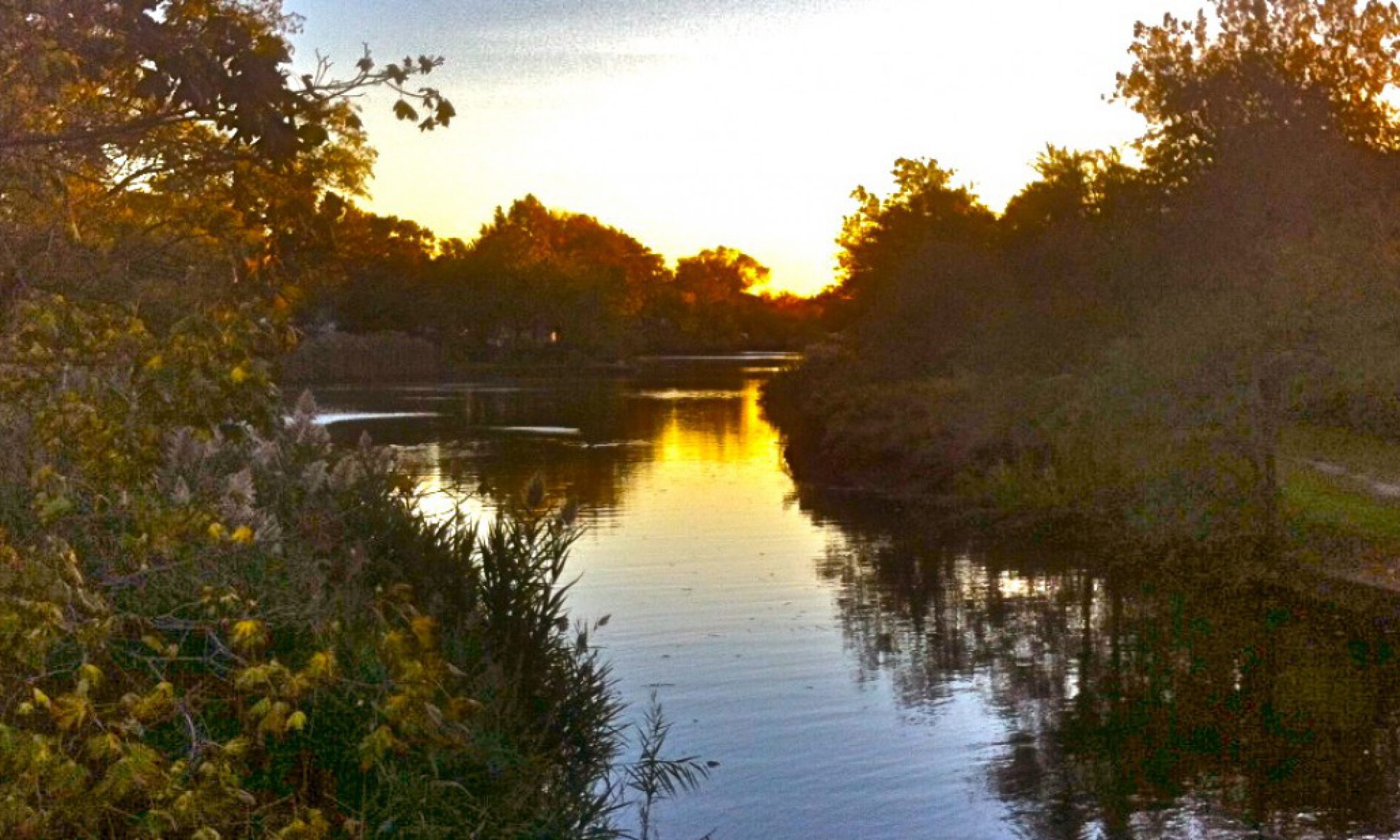


 It’s been another long, inexcusable break from blogging, but for better or worse, A Creek Runs Through It rises from the ashes today. Today, it’s time to go for a good, long walk. If you’re up for it, Mookie and I would be pleased to take you along on a tour of Valley Stream, Long Island, New York, or at least a nice, big chunk of it.







 We do have Ancona, which is famous for their true New York pizza, calzones and heroes, and where you are officially in with the Valley Stream in-crowd if George knows you by name. We have Itgen’s, famous for their homemade ice cream, and recently sold with the promise that it will continue. We have Mitchell’s, a nice little restaurant, though I prefer the Valbrook Diner up on Merrick Road, and an Italian Restaurant called Mia’s that’s been on my list of places to try a lot longer than Meli Melo. We used to have Morris’ Variety, which for years was the place to get everything from a screw to a fake Christmas tree. It was taken over a few years back by Raindew. Not quite as quirky as Morris’, but it serves the same purpose. They got me hooked on Yankee Candles. A lot of businesses have disappeared over the years, but there are a surprising number of survivors.


 We have a neat and clean and picturesque village park called Hendrickson Park a mile and half due north of Duffy’s Creek, which gets it fresh water and anti-freeze runoff from Mill Pond – which we’ll pass on the way back – and from Hendrickson Lake via pipes that go under Merrick Road and through the Village Green. Hendrickson Lake features a fine walking and biking path that leads up to Valley Stream State Park, and there’s an equally fine community pool complex in the park that we pay lots of money to swim in every summer. But no dogs are allowed on the path, and they can only swim in the kiddie pool on the day after Labor Day because everybody at Village Hall likes Mike Powers, who first had the idea. And how could you not?


 And don’t think that Mookie doesn’t get in on all this. For three of the last four years, he’s worked a three-hour shift at the “Doggie Kissing Booth”, raising money to support the Friends of Valley Stream Dogs. On Fest Day, he’s in Mookie Heaven, wagging people over to him as they walk by (“Ohhhhh!!! Look how cute!!!) and convincing them to hand Mike a dollar so they can lean down and get a big, sloppy wet dog smooch. Once Mookie is sufficiently overwhelmed, Bella the Chocolate Lab takes over, and that’s usually when we grab a compleato from San Antonio and head on home to the backyard. The creek is too icky for Mookie to swim in, so he has a kiddie pool to jump in to cool down after his walk. I can offer you a cold Dr. Pepper.


 The shopping mall is still called Green Acres, and it’s about thirty times the size it was when I was a kid. I may be exaggerating there a little bit. All I can tell you is that there aren’t any kids looking for rabbits or pretending to be Indians around here anymore. Lately they’ve been looking for Pokemon.
 Mr Gibson built our house. Thirty years before, he bought up a wooded area north of the farms and south of Sunrise Highway (which apparently was a hunting ground up until that time, though I don’t know who was hunting what) and built a planned neighborhood south of Sunrise Highway and north of the Lord’s Woods. Some of the houses were brick capes, but most of the houses were called “Gibson Colonials”. I’ve been in lots of Gibson Colonials
 , and they’re great houses. Before the 1920’s were over,
  Gibson started building bigger, pointy colonials on Munroe Boulevard and the surrounding streets. They’re great houses, too. In the middle of it all, he built his own Long Island Railroad Station in 1929.
 After World War II, Gibson bought up some more farmland and built hundreds of cookie-cutter capes and rickety ranches. Not as big as the colonials, but darn comfy, and with slightly less claustrophobic backyards. My parents bought a cape from an original owner who left after five years (for a bigger house). Gibson cranked out South Valley Stream in the course of thirty years. Our house was built in 1950 on what was the a small patch of woods at the edge of potato fields belonging to Reising Farm, which was divided between the Gibson development called “West Sunbury”, Harbor Road Elementary School (later renamed Robert W. Carbonaro School) and Valley Stream South High School.


 A Creek Runs Through It