Chapter 10 of Mountain High, Valley Low or My Life as a Wishbone: Tales of Valley Stream and Copake Falls, New York: “How I Spent My Winter Vacation, Part 2: ‘Real Feel’”

I was a student in the Valley Stream Public Schools for 13 years. The single best thing they ever did for me was when they took me off Long Island for a week and showed me an Upstate New York winter. 

It was the traditional trip to the Ashokan Center, the one my son didn’t get to take because the tradition ended sometime between my time in the Valley Stream schools and his time 41 years later. I’m gonna go out on a limb here and say the lawyers and insurance consultants got involved. But in February of 1975, way back before they ruined everything, two schools worth of sixth graders were loaded on tour buses and transported to a big camp near the Ashokan Reservoir in Olivebridge, NY, smack in the middle of the Catskill Mountains and smack in the middle of winter. 

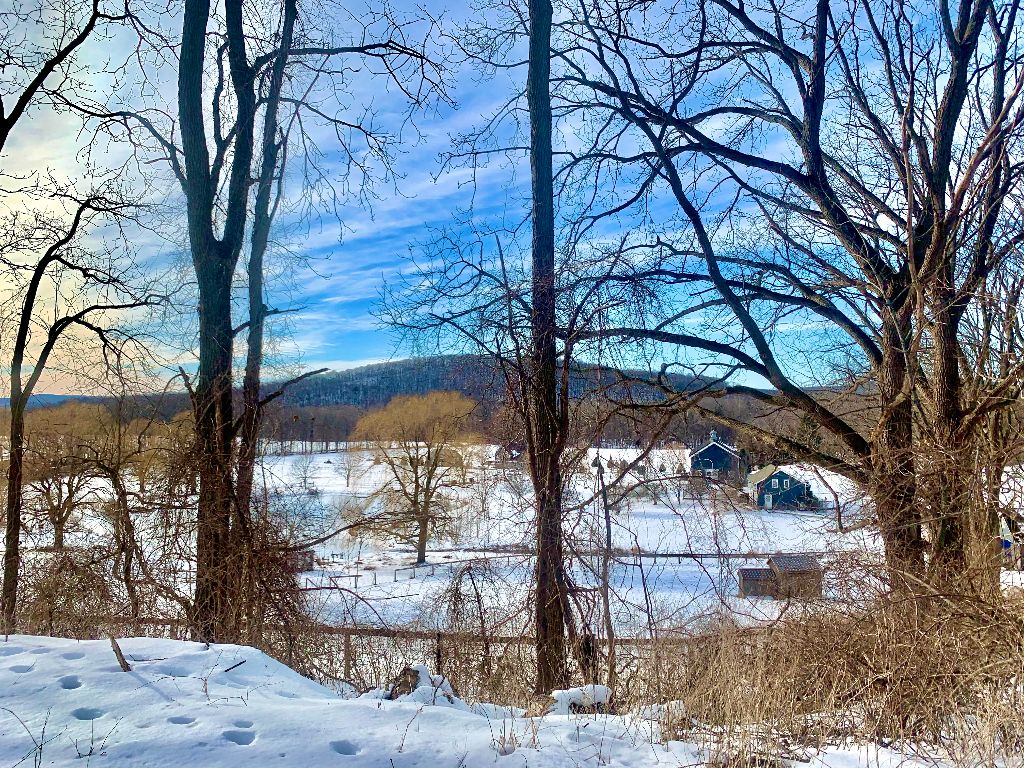
I was thinking about this trip when I was acclimating to the weather earlier this month up on Trisha’s Mountain. Embracing the cold, as my Buddhist friend likes to say. And Buddha, it was cold. The temperature only got above 30 degrees twice in 11 days, and then only briefly. It snowed on five of the days, and there was already two feet of snow on the ground when we got there. This of course didn’t stop Mookie from dragging me to the top of the backyard hill to sniff up every animal track immediately upon our arrival, which I expected. But he did keep looking back at me as if to ask why I, as God, had made this snow so deep and difficult for his little English Labrador Retriever legs to walk through. 

Meanwhile, there were two things I remember from that 6th grade Ashokan trip. 

One was the sheer exhilaration of flying through the air on a toboggan down a preposterously steep hill and whipping out across the frozen Esopus Creek, which is, coincidentally, the very same creek I was looking down on from a steep hill when I met Mookie in his breeder’s kitchen in nearby Saugerties 36 years later. 

That toboggan ride is one of the single favorite memories of my life, and I always thought it was interesting that Lois Lowery chose sledding down a hill as Jonas’ first transmitted memory of the real life he was missing out on in the novel The Giver, a book I read with a lot of kids that never got to ride a toboggan down a hill and across a frozen creek and likely never would. I fully endorsed the experience, though, if they ever did happen to get the chance. 

It was wild. When you hit the bottom of the hill, it was like being in a Hot Wheels car going through the speed booster, except you were propelled straight out across the ice instead of around the loop-de-loop. And don’t think that I don’t think of this image every Christmas Eve when George Bailey has to save his kid brother Harry. I’m gonna go out on a limb again here and say that the lawyers and the insurance consultants used that particular activity as Exhibit A when they finally put the kibosh on the sixth-grade trip. 

The other thing I remember was winter. 

I wanted to see if I could fill in some blanks about Ashokan, so I cast a net on Facebook and asked people who shared this experience what they remembered, and about 10 of them responded, God bless them. 

Apparently I made a broom and a candle holder when I was there, and possibly a fire poker. I would have made a little man out of pewter, but somebody’s husband had broken the machine years earlier. I thought I had put on snowshoes for the first time in my life up on Trisha’s Mountain, but I’m told that my first snowshoe hike was 46 years earlier than that. Who knew. 

One friend of mine, who went on to be a star pitcher on the Valley Stream South Falcons varsity baseball team, bravely recalled for us the memory of being such a homesick little wuss for the first two days of the trip that he required a full-scale intervention. As for myself, except for not wanting to poop in a public bathroom for the first two days, I don’t remember being homesick, but I probably missed TV, and Ace the beagle. 

Another friend checked in, a guy I’ve known since kindergarten. In the interest of sharing the little details of life’s rich pageant that never cease to amuse and astound, I must tell you that this particular friend of mine happens to be a world-famous strongman who’s in the Guinness Book of World Records for rolling 14 frying pans into burritos with his bare hands in under a minute. 

I pulled a couple of muscles in my ribcage opening the garage door last week. At the time, I thought my lung may have collapsed. 

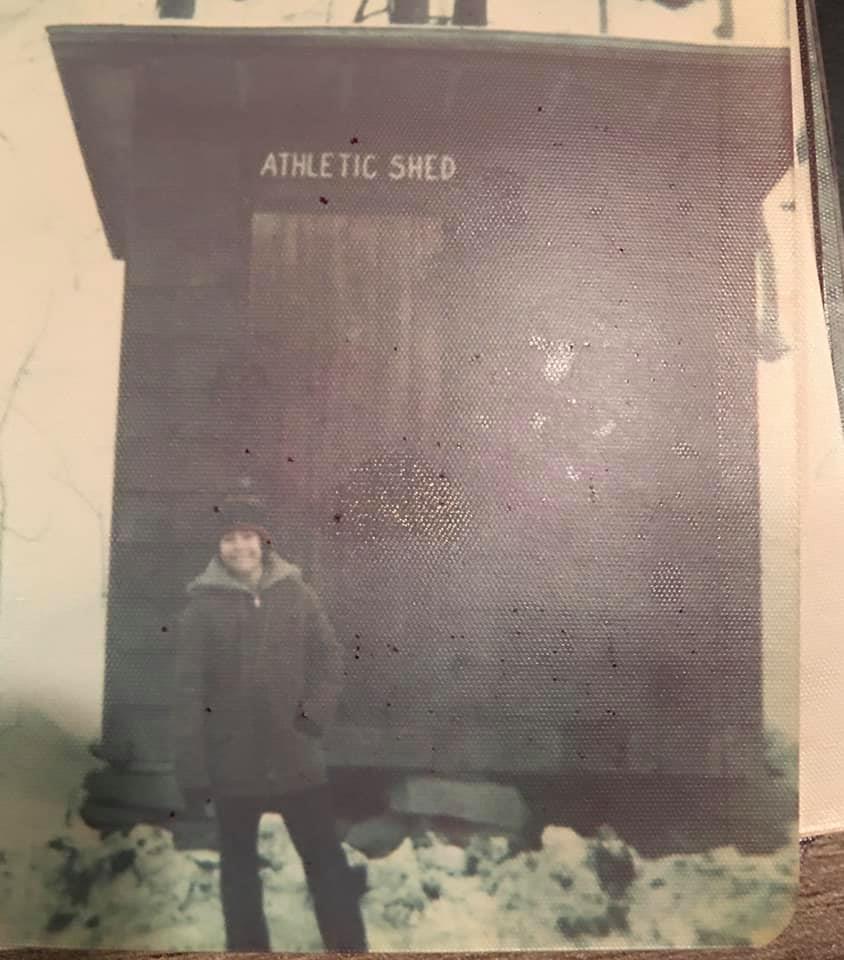
Not only did my old friend, a sweet, good-natured family man who is known in strongman competition circles as “The Crusher”, remember that the guys who set the toboggans up were named Kevin and Doug, and that another counselor named Andy challenged all comers to ice skating races, he was also able to pull up all the amazing pictures you see in this post in less time than I could have found last year’s tax returns. 

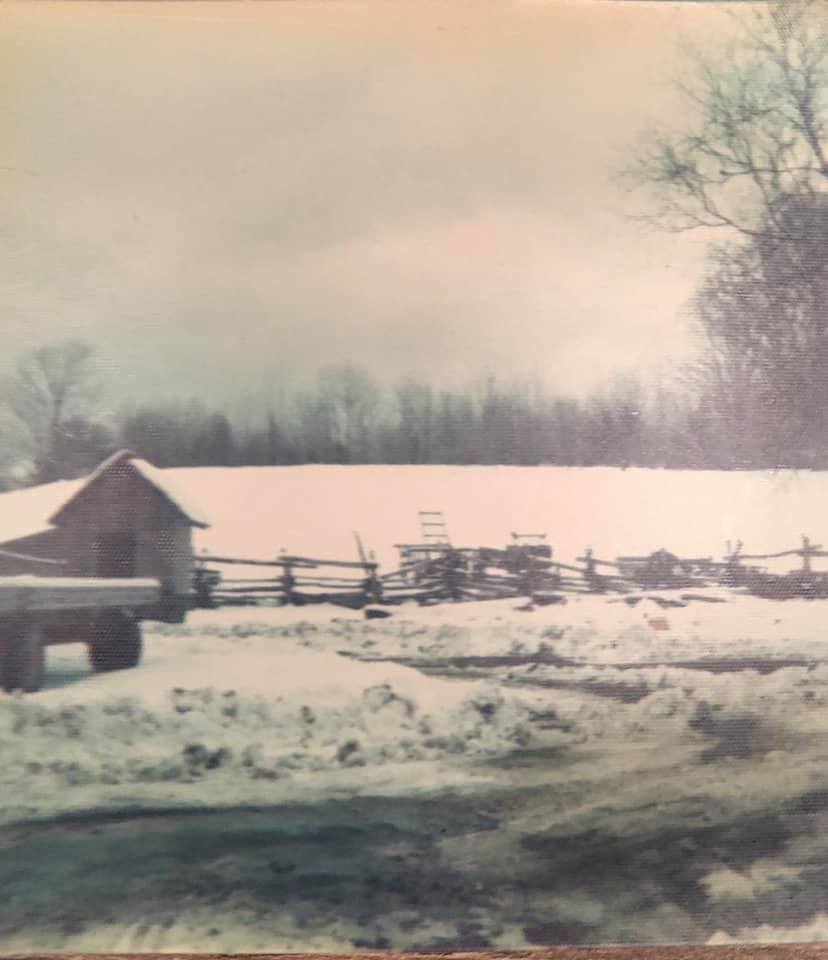
The first pictures he posted were of us and our classmates, which were fun to see. Then he told me he had some other pictures, but they were of scenery rather than people. I asked him to send those pictures, too, and he did. You’d think I would have remembered that there were farm animals at the Ashokan Center, or that one of the counselors looked suspiciously like Richard Manuel of The Band, who had a place near the Ashokan Reservoir at the time. 

What I did remember clearly as soon as I saw the pictures was the landscape, and the rickety old buildings dotting the snow and the bare trees stretched out across that landscape. Poking around the Ashokan Center website today, it looks like most of those buildings have been torn down and replaced. My broom and my fire poker are long gone, physically and in my memory, but the images of the countryside in winter that my friend probably took to finish up a roll of Kodak Instamatic film before we got on the bus back home are a direct match of the images in my mind’s eye. 
I was eleven years old, and I was instantly charmed by winter in Upstate New York. 

Now you can plainly see from the picture at the top of the post that my parents did not cheat when it came to keeping us dressed for the weather. That coat was as warm as a womb. There was an entire sheep sewed into that lining. And only fools go upstate in February without a good wooly hat and gloves. The picture doesn’t show them, but I’m sure I was wearing the sturdiest pair of boys’ brown leather waterproof hiking boots that JC Penney had on display that November. And I’m sure I had on a pair of long johns, which I still wear in the winter, as I’m still what my students in Rockaway amicably described as “one bony-assed motherf@#$er.” 

It snows on Long Island, of course. Sometimes a lot. And the wind howls and the temperatures drop. And when it’s just a little too warm for snow, cold rain will come along and prick you with a million little needles. But in winter, it’s always just a smidge or so warmer in Valley Stream than it is in Copake Falls. The cold rain on Long Island is often snow in the Taconic-Berkshires. But the difference in what winter actually feels like in one place as compared to the other seems like more than a smidge, which we can define here as bigger than a tinge but smaller than a whit.

It feels like a different climate entirely. 

To see if there were any scientific data to back this up, I learned all about the Koppen Climate Classification System, something I’m positive that I was not taught in school, but I don’t remember making the broom, either. 

According to several sources, none of them Wikipedia, Duffy’s Creek is in a Cfa, a warm oceanic climate, also called a humid subtropical climate. Trisha’s Mountain is in a Dfb, a warm summer humid continental climate. Some maps put all of Long Island and the Lower Hudson Valley in a Dfa, which is a hot summer continental climate. I can tell you that summers have been getting progressively hotter for twenty years in Copake Falls, which not only sucks, but would also suggest it’s probably well on its way to being classified as a Dfa climate. But the climate around New York City, which has always mostly sucked, is forever at the mercy of the Atlantic Ocean, so Cfa would be the more accurate classification. 

The difference between these climate classifications comes down to the number of days of sustained cold temperatures. It’s slightly colder upstate. There I proved it. Thank you Herr Koppen. 

But there’s way more to it than that. 

I have no scientific proof of this, and I’m too lazy to find any, but there are more days of stillness in upstate winter, more days when the wind isn’t blowing at all. While we get less snow and less deep cold on Long Island, it seems like the wind rarely takes a day off, and it accompanies every snow and rain event just to add to the misery. 

Up in the country, you can catch a stretch of days where even if it’s only 10 to 15 degrees in the afternoon, there’s no wind at all. When you put that together with a light falling snow or some blue sky, some clean, fresh mountain air and a foot or two of snowpack to muffle all the noise except for that satisfying crunch under your boots, you got yourself some magic weather.

On the first morning of our February vacation on the mountain, my rectangle informed me that Mookie and I would be greeted outside by six degrees Fahrenheit with a 10-15 mph wind, making the “real feel” (what your daddy called the wind chill) a robustly negative seven degrees. The sun thermometer on the back porch, which is more form than function, announced a Good Morning Copake Falls temperature of zero degrees. But while it stayed cold, the wind calmed down after the first couple of days, which was a beautiful thing, as Trisha’s Mountain has its own little microclimate, and in the warm months we suddenly get attacked by swirling 20 mph winds for no apparent reason. When it stops, its absence creates a loud silence. 

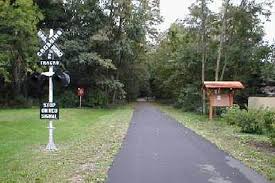
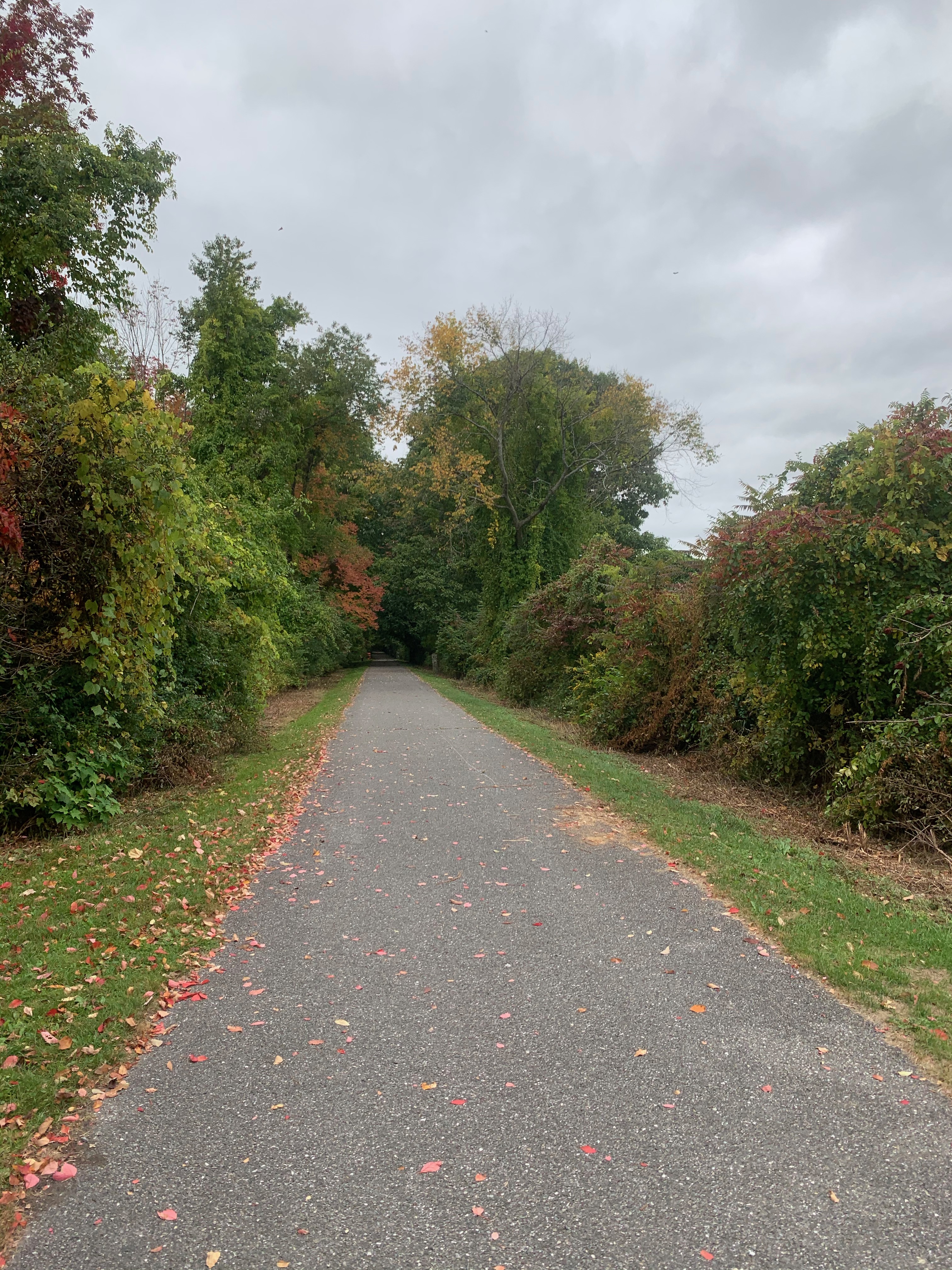
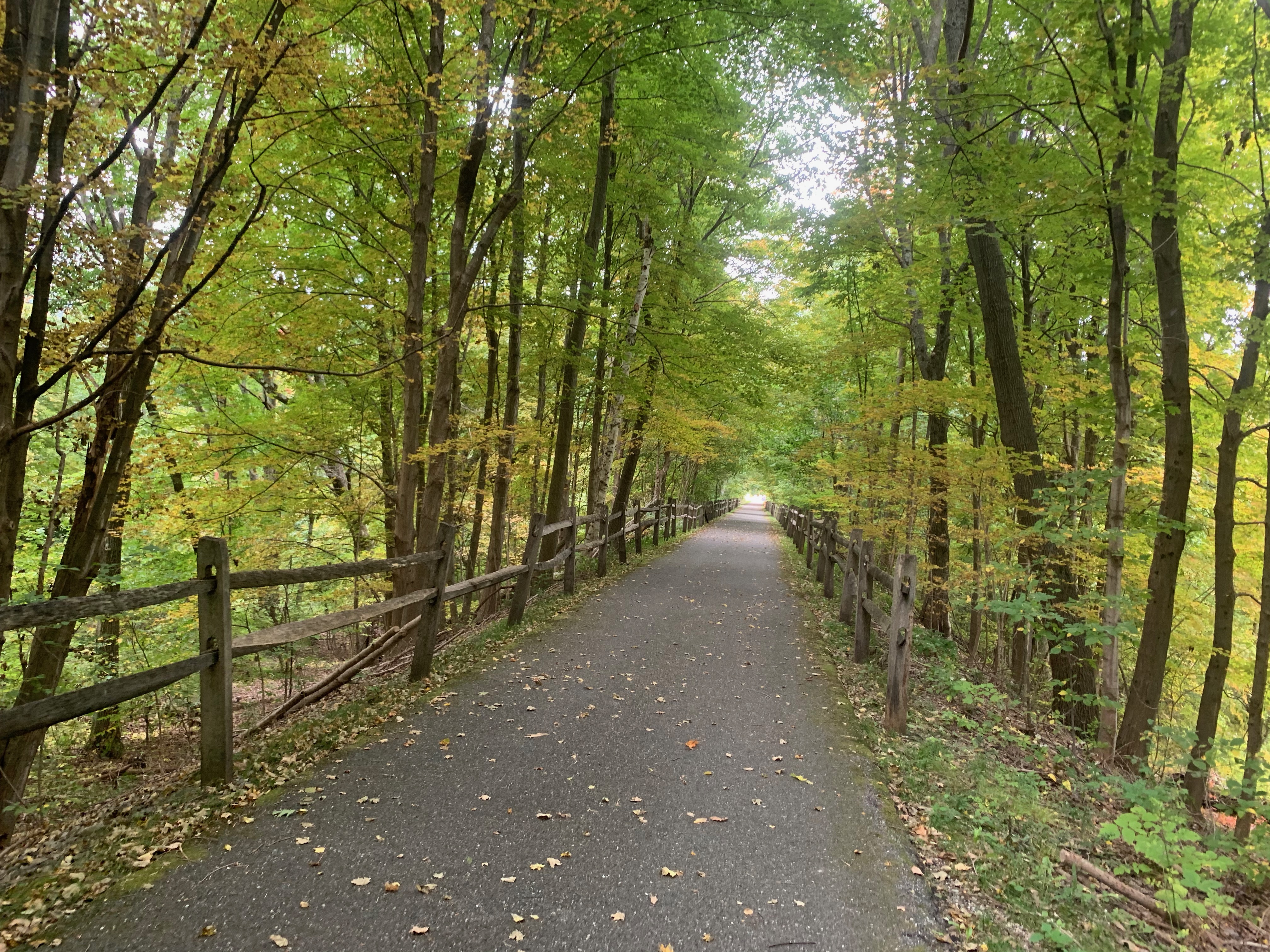
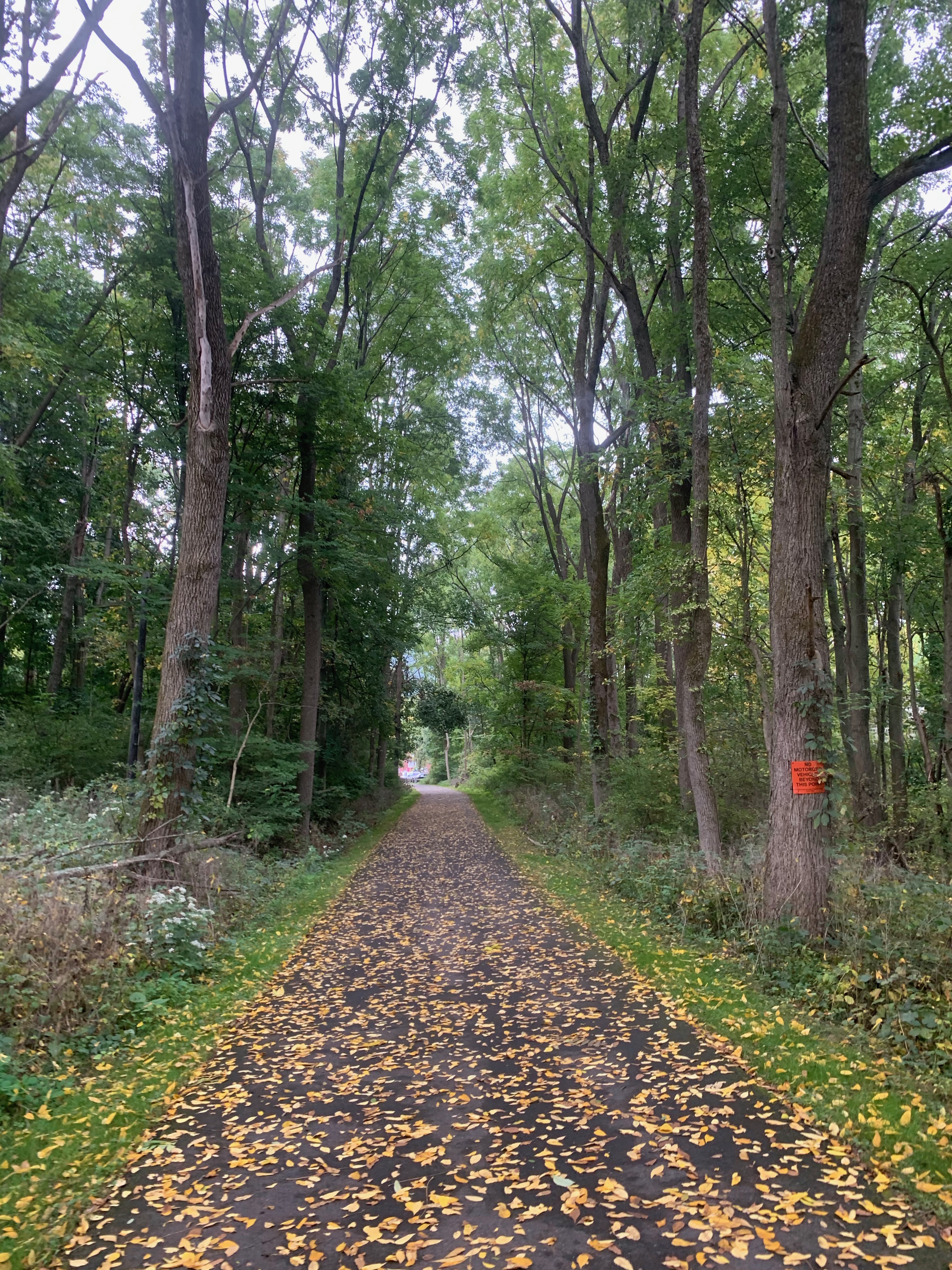
And since Mookie was working so hard to trudge up the hill through the snowpack in the yard and back down the hill through the adjacent cornfield, we did a lot of our walking along on the blessedly level Harlem Valley Rail Trail, where the snow had been already been snowshoed, cross-country skied and otherwise tamped down a bit. 

But even with all this evidence of human activity, a lot of time we had the whole thing to ourselves, which was both incredibly peaceful and a little bit frightening. First off, there was a lot of poop along the trail, and I know the good citizens of the Roe Jan Valley overwhelmingly clean up after their dogs, so it could have been anybody’s poop. It occurred to me that a couple of hungry bad ass coyotes or mountain lions could be somewhere up there in the woods, with one saying, “I’ll take the one with the fur, you take the tall duck.” 

And if we were a good ways up the trail and one of us suddenly pulled a hamstring or were otherwise unable to walk, the other would be pretty screwed. One scenario would involve a panicking, breathless 130 lb. man carrying a wriggling, confused 102 lb. dog and the other would be an equally confused dog searching frantically for someone with thumbs who can drive an Outback.

Plus of course, severe cold weather can kill you. There’s an extra risk in traveling in winter, as your troubles would be significantly more complex if you found yourself suddenly not traveling. And once you get where you’re going, there are also power outages to consider, which is why in a future chapter we’ll learn all about Generac. 

Add in the risk being further away from places you might need to get to in a hurry, hospitals in particular, through potentially pitch-dark, black-iced roads, and you could see why, just out of curiosity, I visited the website of an assisted living community across the border in Lenox, Mass. 

This was actually when I was in the kitchen on the mountain, warming up from the second time that day I had swept the snow off the entire driveway. In comparison to some of our fabulously wealthy neighbors with mile-long driveways further up the mountains on Breezy Hill Road, our driveway is nothing fancy. But it’s still over a hundred feet, mostly uphill. One of our neighbors owns a landscaping and plowing business and we’re all very happy that we met each other. But he only plows and sands the driveway if there’s more than three inches of accumulation. Not being a full-fledged country guy yet, I don’t have a snow blower, which meant that the “nuisance snow” (a term I learned from Albany TV News), which fell for four days in a row, had to be either shoveled or swept, then sanded by hand before it turned the driveway into an Olympic ski jump.

To paraphrase Steven Wright, it’s a small world, but I wouldn’t want to sweep it.

When you sign up for upstate, winter owns you for four or five months out of every twelve. My darling wife, raised in a culture where people roasted in the sun on Point Lookout Beach four or five months a year, jokes that she has no idea what she was thinking. 

But we both know. For every challenge that upstate winter presents in a place with fewer people and more hills, it more than rewards the survivors by enveloping them in its charms, its peace, its oxygen and its stunning natural beauty. Crunching through the snow along the Rail Trail, my mind was clear and easy enough to float me all the way back to that week in Ashokan, when I first experienced a wide open, heaven-sized country landscape under a quiet falling snow, and a clear and silent 15-degree blue sky morning amid rolling hills lit up with twinkling crystals. 

Yes it can be bleak. Lots of cloudy days to get through. One of the first things I noticed at the house on Trisha’s Mountain this month was that, since we haven’t gotten up to putting color on the walls yet, both the inside and outside color palette was an endless loop of brown and white, broken up only by rows of red-twig dogwood on the tree farm and a few big evergreen trees visible from the windows. But winter never lasts forever, and that bleakness is what makes the greens and the yellows truly beautiful when they show up in April. 

All the houses in Copake Falls, and all through the Dfb climate, look very serious about their jobs in the winter. And you can see houses that you can’t ordinarily see though the leaf cover. I can’t describe light through leafless trees in winter any better than Warren Zevon did when he said it looked like “crucified thieves”, so I won’t even attempt it. 

The houses are working very hard to keep their owners warm. No lace curtains billowing in the windows and no whirligigs spinning on the front lawn. This is crunch time. Sometimes when I see or smell the fires from the chimneys of these hundred-and-fifty-year-old houses, I think of the people who settled places like this, who couldn’t crank the thermostat up, and for whom a fireplace could be the difference between life and death. 

But despite the lurking dangers of winter, Mookie and I got to live our best life out there in the sharp and cold, here and now air, crunching through the snow along the Rail Trail. If it’s peace and quiet and a Zen feeling of no time and no self that you’re after, a trail through upstate winter woods is the place to be, particularly if you don’t have to get to a job. 

On one of those clear mornings, we literally walked into a flock of bluebirds. At least twenty of them, dancing and singing through the trees on either side of us. This moment now lives alongside others in my life where I witnessed something so beautiful that I said to God, out loud, smiling, “you gotta be kidding me, man!” 

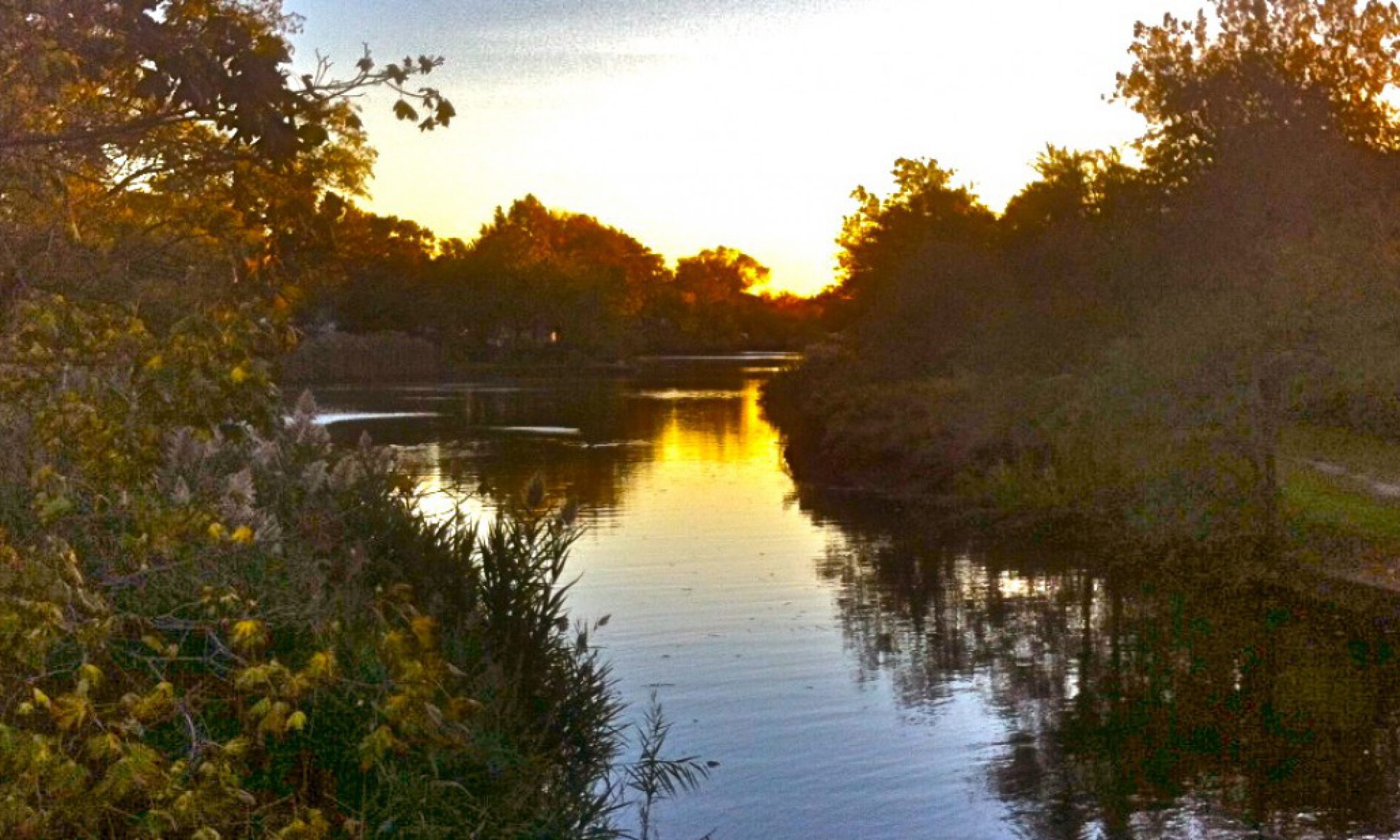
Though God has a sense of humor, when it comes to nature’s wonders, he’s dead ass. He arranged for a flock of bluebirds to come along and flitter through the trees that morning because he really thought that Mookie and I should see them, just like he arranged for a sunset to bathe the stalks of last years’ corn and the sweep of snow down the hill in an ethereal orange glow as my son and I snowshoed across the field late that afternoon. All we had to do was dress for it, and there it was. 

When people tell you not to waste your life away, they’ll sometimes tell you that we only get so many summers. Make hay while the sun shines and all that. Conversely, we only get so many winters. And because we needed all the oil and the plastic, winters are not what they were in 1975. I’d likely meet the bottom of the Esopus Creek if I took that toboggan ride today, and I’d need the Crusher to pull me out.  

So while it is a great time to enjoy the couch, catch up on books or naps or watch a little basketball, you’ve got to get out there and embrace the winter while it’s here, lean into its big shoulders, draw in its icy breath and let it embrace you back.

The day before we rolled down the sandy driveway on Trisha’s Mountain and back down to Duffy’s Creek, we got two inches of fresh snow upstate. But it was one of those occasional storms where Long Island gets a few more inches than Copake Falls. That snow stuck around for a few days, then started melting into patches. When the last patch started melting in the backyard on the creek, Mookie made sure to roll on his side and make a dog angel, and I made sure to crunch through it with my brown waterproof boots. 

It’s a long, hot summer, and we just needed a little more of that real feel before winter got away. 

Copyright 2021 by John Duffy

All Rights Reserved

Chapter 4 of Mountain High, Valley Low or My Life As a Wishbone: Tales of Valley Stream and Copake Falls, New York: “The Road to Nowhere”

Mookie Dog knows he’s got it good up in the country. In his Labrador heart, though, I think he’d always rather be in Valley Stream. For one thing, he has deep and soulful connections with all three of his cats, and it’s difficult for all of them to be separated. But that’s a story for Chapter 5. I feel bad for him because his puppy brain struggles to make sense of things these days. You can explain the what, the where, the who and sort of the when to dogs, but they’ll never fully understand the why. We do too many things that just make no canine sense. 

For the first eight and a half years of Mookie’s life, we took one or two long trips in the car in July and/or August. He stayed at his friend Gina’s K9 Bed and Breakfast a mile away because he wasn’t supposed to be in the cabin, and I’d come by to take him out to play for the day, then bring him back, and then after a couple of days we’d take another long car ride and everything went back to normal. For the rest of the year, including all the cold months, we were in the home he first arrived in as a nine-week old puppy. So you can certainly imagine his confusion as he finds himself, at the equivalent of 63 years old, suddenly going on two and a half-hour car trips every couple of weeks. 

But if I told him right now that we were going for a ride in the car, he would immediately begin wagging and hopping up and down and panting, because it would mean that we would possibly be going somewhere where things smell differently and there might be water for swimming or at the very least people who rub his face and say hi. We’d get there, wherever there might be, have our fun, and as soon as that fun was over and he came back to wherever we started, he’d have a short nap, then return to staring at me and moping, like he’s doing right now. He’s a fun junkie, my dog is. 

And even though he willingly and joyfully gets in the car every time I suggest the idea, he plainly dislikes the sensation of the wheels moving under him. Though a purebred labby, he’s just not a head sticking out the window dog, which is something I’ve accepted about him. I don’t shoot ducks out of the sky and he loves me just the same. As any long car ride evolves, If he’s not lying down across the back seat in defensive sleep, he sits up and stairs down at the seat with an expression I can only describe as existential dread, and I say, “everything’s OK! Everything’s fine! Lie down, Puppy!” until he lies down again and tries to sleep. He especially dislikes exit ramps. They mess with his large center of gravity. 

But while long car drives are stressful, staying home while I disappear for a couple of days is far more so. There were a few trips when I needed the whole car for transporting stuff and I left him home, safely with the others in the pack who have access to the dog food, but still this was not acceptable. So when he sees the duffle bag and the cooler come out, he never lets me out of his sight. And the cycle continues. 

This place where we go these days, which I realize will never truly be home to him until his cats are there, only recently got comfy couches, a dog crate and a big comfy queen bed. For the first eight months, he had a dog bed on the floor and an air mattress that made him nervous. But while he enjoys these amenities we’ve provided, and he loves his big upstate backyard that smells like bunnies, he misses his neighborhood around Duffy’s Creek. He’s spent most of his life marking every tree and pole within two square miles of his house, and that’s not an accomplishment that’s easy to just walk away from.

In Valley Stream, we’ve gotten to the point where he takes me for walks, and ideally, to him, those walks are circular in nature, or at least Q-shaped. He has pre-determined routes where he has to check and respond to his pee-mail at specific poles and trees. My job is to follow along with plastic bags and keep him out of trouble.  

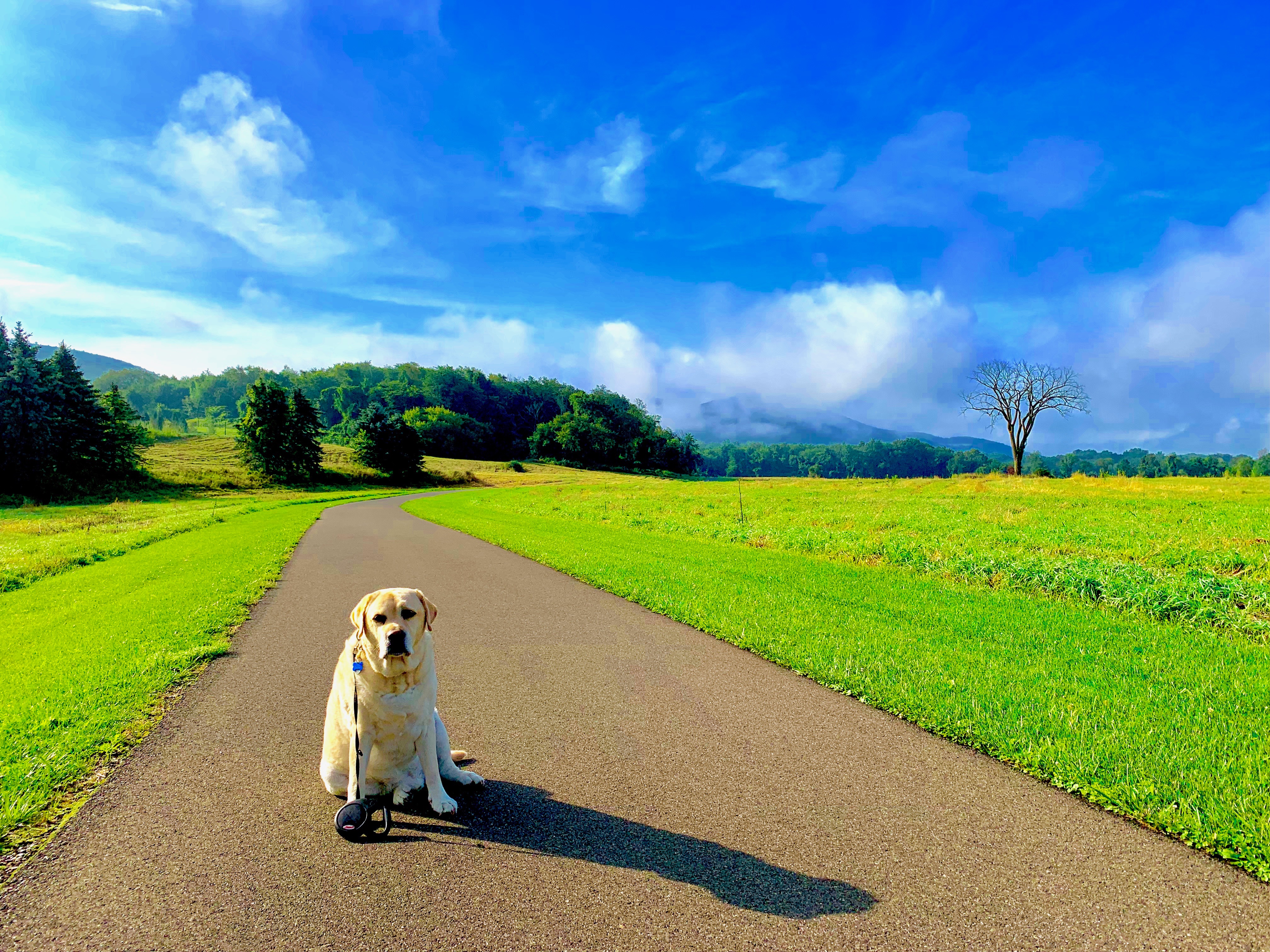
And while he certainly enjoys the variety of scents that one can encounter in and around Copake Falls, it’s taken him some adjustment to accept that the majority of our walks in the country are linear. We go somewhere and then we go back the way we came. It’s the Road to Nowhere. Picture a man and his dog on two ends of a taut leash, debating about which of two opposite directions is the way they have to go now. It looks as ridiculous as it seems. 

But he ultimately recognizes and accepts my position as the Alpha Dog. Actually, it’s bigger than that. He thinks I’m God. And of course, God doesn’t always give you what you want. Sometimes you can’t go lick the baby in the stroller and sometimes you can’t try to jump in the hammock that your favorite neighbor set up in his garage and that’s the way it is. God is all-knowing, and Mookie accepts this because he has faith. Every walk with God is essentially a good walk, circular or linear. Just like my own relationship to my own God, he’s a stubborn mule and his God loves him anyway. Besides, only a loving and benevolent God would know about a place like the Harlem Valley Rail Trial. 

My relationship with the Rail Trail predates my relationship with my dog, never mind my human child. It goes back to the year 2000, the first year that Trisha and I took a full week of vacation in Columbia County. It was three days of camping with the hippies on Long Hill at the Falcon Ridge Folk Festival in Hillsdale (what a scene, man) then four days in cabin GH1 at Taconic State Park. Back then, everything was new to us and everything was the greatest thing ever. (“Hey! The Methodist Church is having a chicken barbecue!” “There’s a school near here where kids learn about organic farming!” “Did you know Copake had a lake? It’s huge!” “Look at the price on this house! Two acres!”). And since (blessedly in retrospect) we didn’t have any magic rectangles with Internet connections while we were there, the first two days back home on Long Island would be filled with wasted hours looking up every single thing I’d come across in Columbia County the week before. (“Hey honey! Those cows we saw last week on North Mountain Road? Brown Swiss!”). 

I walked up to the Depot Deli the morning after we checked into cabin GH1, and there it was, something to do, forever: A paved path that hadn’t been there before with a sign explaining that I was entering the Harlem Valley Rail, which “derives its name from The New York and Harlem Railroad, chartered in 1831 and opened in lower Manhattan in 1832 with horse-drawn cars. In 1842, the line crossed the Harlem River, and in 1973 joined the New York Central Railroad, becoming known as the Harlem Division. By 1852, it extended north to the village of Chatham. In all, the line stretched 131 miles of track. What you see today while hiking and biking on this recreationway is a glimpse of Columbia and Dutchess Counties as thousands of paying customers saw the countryside until a little more than two decades ago, when passenger service was discontinued between Dover Plains and Chatham in 1972.”

Post-vacation research uncovered that this had all been developing under my radar for years. The first segment of the Harlem Valley Rail Trail opened in 1996, eventually connecting Wassaic, the last stop on Metro-North, and hence the southern end of the Rail Trail, to Amenia, which is a nice, little place. A connection from Amenia to Millerton, an equally nice, somewhat bigger little place than Armenia, came later, but I wasn’t hip to any of it at the time, as these were just the towns I passed through on the drive north and I wasn’t going to be in them again until my drive south. I also learned that there are a whole lot of people who have volunteered a whole lot of time and energy to building and maintaining this trail, and the guilt I feel at not being one of them is manifested annually to this day in the form of a charitable contribution to the Harlem Valley Rail Trail Association the week after Christmas.  

The Copake Falls to Valley View Road to Undermountain Road in Ancram section of the trail opened in 2000, just in time for me to stumble on to it that morning. The first thing I thought to myself as I began ambling along is I gotta bring my bike up here next year, though it was plain as the years passed and the Rail Trail Culture evolved that I’d be no match for serious fellows in black speedos and wicking shirts with bright yellow and orange patterns and calf muscles like beer kegs who’d often pass me by. No matter, I like my calf muscles as God made them, and for me the bike would be just a way to get to the places where the cool birds are. 

Birdwatching has always been one of my things, growing up on a creek and all. I had to know that those little ducks with the black and white heads who showed up in the winter were hooded mergansers, and not just  those little ducks with the black and white heads, and I had to know that they bred in wooded lakes, ponds in rivers in Canada and migrated to tidal creeks and estuaries all over the U.S., including mine. When I meet birds, I want to know their names and I want to know their stories.

That morning, I walked the first section of the trail, a little over a mile to Valley View Road and back again (while my fiancée, who was told only that I was walking to the Depot Deli for newspapers, waited back at the cabin, in days before I would’ve thought to take my cell phone just to walk to the Depot Deli). I walked over the bridge the spans the Bash Bish Brook, little knowing at the time that the swimming hole directly under that bridge would be my dog’s favorite spot someday, or that I’d be pushing a stroller across that bridge not four years later, or that I’d be following behind a red Radio Flyer tricycle on that bridge a couple of years after that, or that twenty years later I’d be riding across that bridge on one of the two bicycles that I bought on Craiglist from a guy who I’d exchange $350 with in the parking lot of the Pittsfield, Mass. Wal Mart so I wouldn’t have to keep lugging two bikes back and forth from Long Island, which I’m embarrassingly aware was a First World Problem. 

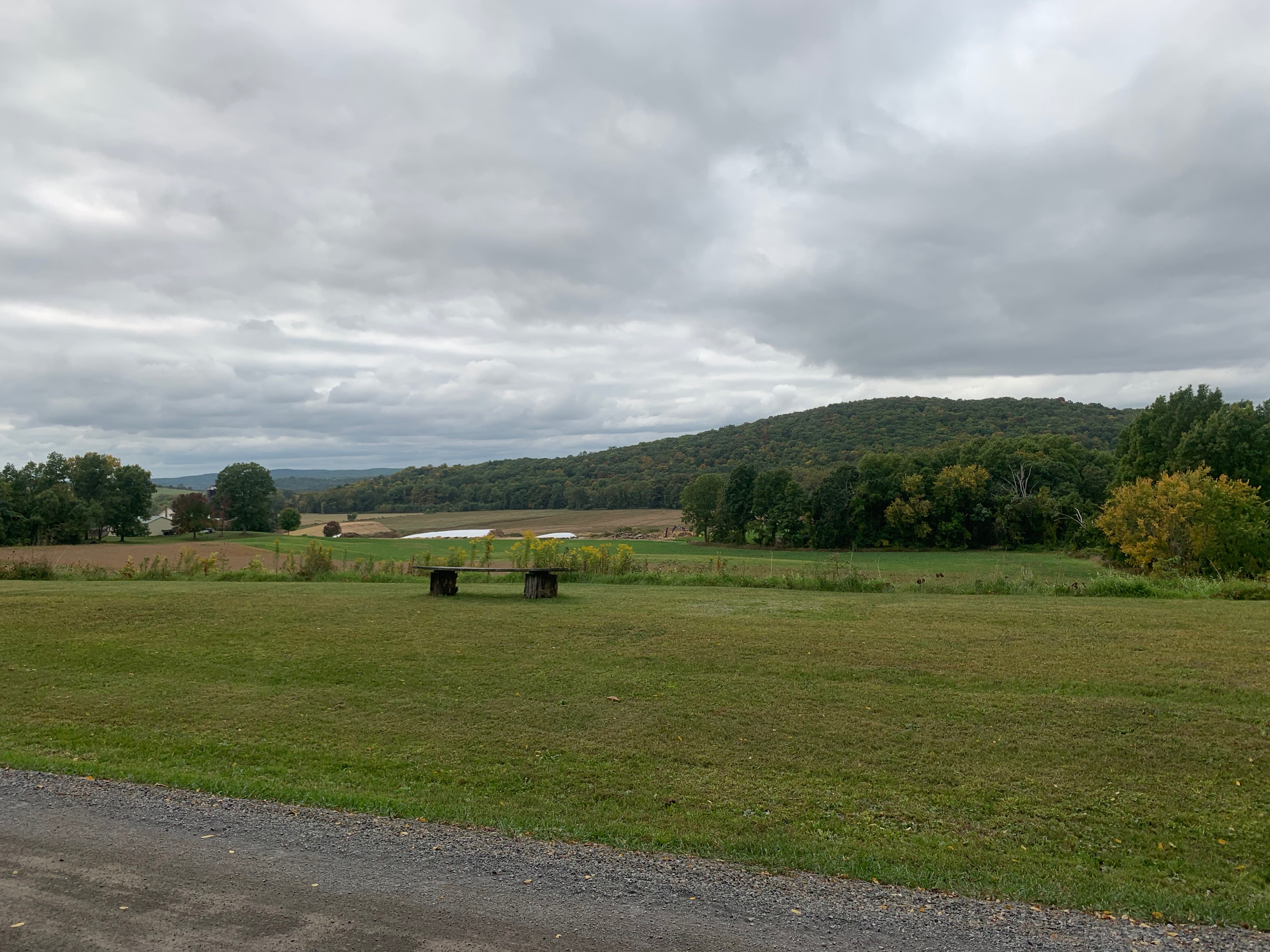
A little ways past the bridge, the west side of the trail opens up into a view of farmland sweeping up a gently rolling hill. Later, when I hit the trail at sunset, I found out why they had decided to put a bench there, as the sun sets directly behind that hill all summer. And I’ve got a thing for sunsets. On the east side is more farmland, but on a steeper climb, leading to the houses on the top of Valley View Road that are built into the side of Washburn Mountain, a point at which, if you can get a bike up the ridiculously steep hill that starts where the Rail Trail meets the road, whether by walking it up or with your overly-developed calf muscles, you can do a 30 mph coast about three quarters of a mile straight downhill and around a big turn right back to the Taconic State Park cabins. Just watch out you don’t get killed.  

In case you’re interested in trying the Valley View Downhill Challenge, this is where you’d disengage the brakes.

The morning I discovered the Rail Trail was a sweet, summer stunner and it was a Tuesday, so I pretty much had this whole thing to myself, and I knew Trisha wouldn’t be mad at me for wandering off once I told her what I’d found. While the spectacular views emerge in front of you, the trail is still lined with trees and bushes, and the birds were bursting at the seams. A line of thick brush along a farm or an open field or a meadow is what the good people at the Cornell Ornithological Society would tell you is “edge habitat.” 

I met some of my usual friends walking along the edge habitat that morning; cardinals, robins, sparrows, chickadees. My favorite bird, the grey catbird, was following me all down the trail, greeting me by name as he always does. “Johhhhnnnn!” I started to get the feeling that I’d be spending a lot of time here. 

At the point where the Rail Trail meets Valley View Road, the paved trail ends, and one has to follow a mostly uphill dirt road for about a half mile before reaching the next paved section that takes you south to Undermountain Road in Ancram. There are several properties along this dirt road. I may not have this story straight, but as I understand it, there’s a property owner who not only owns the road in front of his or her house but also the small meadow that looks out over the Peaceful Roe Jan Valley (hence “Valley View”) on the other side of the road. Apparently, this property owner refused to allow the road to be paved. There are also benches set up to take in the Valley View, adorned with angry “POSTED!” signs on poles surrounding them in case you even thought about sitting on one of them. 

When the Harlem Valley Rail Trail is complete, it will run 46 miles from Wassaic to Chatham, and that half mile might be the only part that isn’t paved. The HVRTA has purchased 14 of the privately held miles from Copake Falls to Chatham, and NYS State Parks, who run the Rail Trail, are “in negotiation” for the other 22 miles. Knowing the way people are, they’re bound to run into a few more selfish types before they can connect the whole thing. Some of our neighbors on the bottom of North Mountain Road have the trail right in their backyards, and down in Millerton, there are houses you could jump into from it, and I don’t think anyone is being terrorized by gangs of thuggish nature enthusiasts. 

I can tell you two things: One, I have passed the property in question on Valley View Road probably fifty times over twenty years. It’s built into a hill and has lots of windows.   Every shade in every window has been pulled down every time I’ve gone past. Two, while riding past that in that meadow, I saw the biggest male deer I’ve ever met in person, and he didn’t give a rat’s ass that he was on private property. 

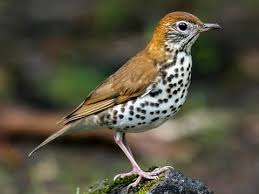
I didn’t continue on to the Undermountain Road section on my first visit to the trail that morning, again because I’d wondered off without telling Trisha, which I can attribute to less than a year of having to tell someone where I was going after going wherever I wanted whenever I felt like it for most of my adult life to that point. On the way back along the dirt road, in a heavily wooded area at the point where the rail trail to Downtown Copake Falls goes to the left and Valley View Road goes straight up in the air, I saw a wood thrush low in the bushes after following his call;  a deep, rich “bood-dood-a-weeeeee!” with bass in the “bood-dood” and treble in the “weeeeee!”. It’s a Morning in Copake Falls Sound, and like the nighttime sounds of bats chatting in the trees and coyotes howling at the full moon, I get homesick for it when I’m on Long Island. 

On the way back to Copake Falls, at the point where the sun goes down behind the hill, I saw a meadowlark singing his heart out from the top of an evergreen tree. I said screw the bike, I gotta come back here with a pair of binoculars. And Trisha.

I don’t know if it was that year, or two years later in ’02, when we walked the trail from Copake Falls to Undermountain Road to get in some intensive birding, early in the morning, heavily caffeinated and armed with binoculars and the Peterson Guide. I know it wasn’t ’01 because we were a little preoccupied with getting married that summer, and though we managed to squeeze in a couple of nights of camping out on the hill with the hippies at Falcon Ridge, we didn’t make it down to the park. We haven’t missed a year since then, and now we never miss a month, but I digress. 

The best birding turned out to be in a stretch with big trees adjacent to farmland most of the way, but with enough high trees along the trail itself for some kick-ass edge habitat. The catbird followed us along and called me by name. The wood thrush played their stereophonic flutes in the deep brush. All the cool songbirds were there: Little warblers and vireos that are only pass through Long Island in spring and fall all darting around here like they owned the place, swallows and flycatchers swooping over the fields while vultures and hawks hovered in circles above like guys cruising their hot rods around town. We found a whole family of cedar waxwings, Trisha’s favorite bird, with their new wave haircuts and their squeaky metallic “zeeet” call that sounds like feedback from tiny guitar amps. 

We took a lot of walks specifically to watch the birds back then. We followed people with very expensive spotting scopes around the pond at Jamaica Bay picking up pointers. I dragged the poor woman around the dunes on the West End of Jones Beach when she was six months pregnant, but we did see a saw-whet owl sleeping in a fir tree.  We spent my fortieth birthday circumnavigating Camusett Park and Target Rock Wildlife Refuge on the north shore of Long Island. We saw lots and lots of birds that day, but the highlight was spotting a bluebird flying across a field. 

When I think back on that first walk to Undermountain Road with my gal, that will always be the day of the indigo bunting.

Indigo Buntings are bluer than bluebirds. They’re as blue as blue gets before it starts turning black. They’re the blue of the denim jacket you got for your 13th birthday. And they chirp a little song like an overly friendly storekeeper who’s had too much coffee. “Helloo! It’s a beautiful day! Nice to see you! Thanks for coming! Isn’t this great! Please! Look around!”. He sat on top of a bush in plain sight, no binoculars needed, and sang to us and showed off his magnificent blueness for as long as we wanted to look at him, and we looked at him for a long, long time. 

Indigo Bunting: Photo credit Wendy Paulson – Birds of Barrington.

Once we got into the baby business, we had to curtail the birding adventures a bit, but by that time we’d built a wildlife refuge on the creek in the backyard, and there were still lots of high trees around that have since been cut down, so we put out lots of seed and let the birds come to us. One snowy January night in the Early Aughts we had twenty-one cardinals visit the feeders at dusk, something that will never happen again, as their homes were all cut up with chain saws over the ensuing ten years. But up in Copake Falls, where time stands more still and the trees are still tall, there was no better place to push a stroller than up and down the Rail Trail. And when it was time for the guy in the stroller to start powering his own wheels, that was the place to do it. 

And since you can’t rightly stare at trees with binoculars at the same time you’re making sure your five-year old doesn’t ride his bike into a ditch, we started to really appreciate the stunning variety of wildflowers just as much as the birds on the trail. Summer is a hippie festival of color and fragrance up and down the trail, and you can eat the wild blackberries and raspberries you come across and I promise that you won’t get sick and die. 

My son loves the Rail Trail. It’s never not been part of his life. He went from three wheels to four wheels to two wheels in the blink of five summers. Then of course Dad had to teach him about the Valley View Road Downhill Challenge, just to scare the crap out of Mom. I loved sitting on our front porch at GH7 waiting for him to come whipping around that corner as he coasted in. We regularly biked the Copake Falls to Undermountain Road and back again route together as part of our week in the park. 

They’re there.

Speaking of Undermountain Road, it’s under mountains, the biggest ones in the part of the Taconic Range that overlooks the Peaceful Roe Jan Valley. When you get to this section of the Rail Trail, you’re literally under Alander Mountain. The trailhead is just down the road. There’s another big boy called Brace Mountain that is easily accessed from Copake Falls. These mountains are not much taller than Baker Mountain in Saranac Lake, which I climbed twice in the last three years. When I was a whole lot younger, I climbed Mt. Marcy, the highest point in New York State and a mile up in the air, at least five times. I have a brother who is four and a half years older than me who still climbs mountains whenever he gets the chance and is working on being an Adirondack 46’er. I’ve also got a pack of Marlboro 27’s on the patio table. 

My excuse for not climbing any Taconic Mountains to this point is that I didn’t have a day when I happened to be up that way and the weather conditions would make it worth the effort. Now that I’m a part-time resident, that excuse is trickling away. I know I could always ask one of the people I know in Copake Falls who are in their 80’s, and don’t have a pack of Marlboro 27’s on their patio table, to serve as a guide. They climb the local mountains all the time. There’s something in the water up there and I sure as hell hope it works for me. 

Less intimidating is the challenge of a bike ride from Copake Falls to Millerton on the Rail Trail, which should be possible by 2021, when the newest eight-mile section is completed. That would be 12 miles of mostly level or slightly downhill rolling, with a sandwich and a ride back from Trisha waiting at the Millerton parking lot. Hell, we could even make it to Wassaic, 22 miles away, as long as I get that sandwich and that ride. Dream big, that’s what I say. 

I could point out to anyone who might actually be using this document as a guide to the Harlem Valley Rail Trail that you could stop wasting your time with me right now and got to hvrt.org, but I could also tell you that the two and a half miles of trail south of Millerton to Coleman Station (I haven’t made it to Armenia or Wassaic) is just about the nicest walk or ride you’d ever want to take. Right after you pass through the pretty little town, and right before the trail opens up to some beautiful scenery, you go through a section that was originally created by blasting through solid rock, and the solid rock they didn’t blast remains on both sides of you, so it’s always about fifteen degrees cooler on this part of the trail than it is everywhere else, which was a blessing on the hot day that Jack and I finally got around to riding this trail last summer, which was the same day I inadvertently cooked a mouse in the oven, which is a story for Chapter 6. 

In 2010, ten years after the Copake Falls to Undermountain Road section opened up, the trail was extended north to Orphan Farm Road, which now borders the Shagbark Tree Farm. This is the stretch where you’ll find Mookie and I most often these days. It’s a nice mile and a half jaunt with what is probably the most spectacular scenery that the paying customers on Harlem Valley Line saw from the trains, although I can’t state that for a fact. There is also a small section across Route 22 from Black Grocery Road (the etymology of which I want nothing to do with) to the Herrington’s Hardware store parking lot in Hillsdale. Eventually, the plan is to build a pedestrian bridge over 22, connecting Orphan Farm Road to Black Grocery Road, thereby connecting everything from Wassaic to Hillsdale, which would give the trail 26.6 of its eventual 46.1 miles to Chatham. The motto of the Harlem Valley Rail Trail Association is “Chatham or Bust!”, and I take them at their word. 

The Orphan Farm Trail.

Meanwhile, the end of the Orphan Farm trail is where Mookie questions the need for walks to be linear rather than circular in Nature. His nose tells him that his second home in the country is right up there at the top of a very steep and narrow path that runs between the hill full of Happy Little Trees and a heavily wooded patch of the Rail Trail right-of-way leading into my neighbor’s backyards. This shortcut back to Trisha’s Mountain is easily accessible from the Orphan Farm parking lot. He’s sniffed it and seen and it for himself while sitting on his front porch up on the hill. As a matter of fact, we could make this a completely circular walk by traveling down North Mountain Road to the rail trail, then climbing back up this path right back to our mailbox. What he doesn’t know is that 1) It’s private property, which he wouldn’t care about anyway, and 2) Trisha has already seen a coyote and I’ve already seen a black bear emerge from that path in broad daylight, not at the same time of course (that’d probably be newsworthy, even in Columbia County), and if my stubborn dog thinks he can talk shit to animals that live in mountains like he does to dogs and cats and squirrels that live in Valley Stream he would be tragically mistaken. God watches after fools, little children and their dogs. 

And since Mookie can’t think figuratively, which is really one of the best things about him, I wouldn’t be able to explain to him that these one-way walks are sort of metaphoric. While I hope we’re walking together for a couple of more years, mortality will eventually come between us. He’s a 9-and-a-half-year-old dog and I’m a 57-and-a-half-year-old human doing his best to stay alive in the midst of a pandemic. The road we’re on is not a circle, and one of these days, we’ll have gone as far as we can go. 

But the good news is that neither one of us I really have anything left to prove to anybody. We’ve both been good boys, and now we’re just trying to live in the moment, both happy to be walking relatively pain-free. Our journey is our destination. We’re on the road to nowhere, but baby, it’s all right. Despite all of our shared internal conflict about leaving behind everything we’ve loved and marked back in Valley Stream, when we’re out on the Harlem Valley Rail Trail, and the sun is shining and the birds are chirping and the breeze is blowing and the wildflowers are blooming, there’s just nowhere else we’d rather be. 

Copyright 2020 John Duffy

All Rights Reserved