Chapter 4 of Mountain High, Valley Low or My Life As a Wishbone: Tales of Valley Stream and Copake Falls, New York: “The Road to Nowhere”

Mookie Dog knows he’s got it good up in the country. In his Labrador heart, though, I think he’d always rather be in Valley Stream. For one thing, he has deep and soulful connections with all three of his cats, and it’s difficult for all of them to be separated. But that’s a story for Chapter 5. I feel bad for him because his puppy brain struggles to make sense of things these days. You can explain the what, the where, the who and sort of the when to dogs, but they’ll never fully understand the why. We do too many things that just make no canine sense. 

For the first eight and a half years of Mookie’s life, we took one or two long trips in the car in July and/or August. He stayed at his friend Gina’s K9 Bed and Breakfast a mile away because he wasn’t supposed to be in the cabin, and I’d come by to take him out to play for the day, then bring him back, and then after a couple of days we’d take another long car ride and everything went back to normal. For the rest of the year, including all the cold months, we were in the home he first arrived in as a nine-week old puppy. So you can certainly imagine his confusion as he finds himself, at the equivalent of 63 years old, suddenly going on two and a half-hour car trips every couple of weeks. 

But if I told him right now that we were going for a ride in the car, he would immediately begin wagging and hopping up and down and panting, because it would mean that we would possibly be going somewhere where things smell differently and there might be water for swimming or at the very least people who rub his face and say hi. We’d get there, wherever there might be, have our fun, and as soon as that fun was over and he came back to wherever we started, he’d have a short nap, then return to staring at me and moping, like he’s doing right now. He’s a fun junkie, my dog is. 

And even though he willingly and joyfully gets in the car every time I suggest the idea, he plainly dislikes the sensation of the wheels moving under him. Though a purebred labby, he’s just not a head sticking out the window dog, which is something I’ve accepted about him. I don’t shoot ducks out of the sky and he loves me just the same. As any long car ride evolves, If he’s not lying down across the back seat in defensive sleep, he sits up and stairs down at the seat with an expression I can only describe as existential dread, and I say, “everything’s OK! Everything’s fine! Lie down, Puppy!” until he lies down again and tries to sleep. He especially dislikes exit ramps. They mess with his large center of gravity. 

But while long car drives are stressful, staying home while I disappear for a couple of days is far more so. There were a few trips when I needed the whole car for transporting stuff and I left him home, safely with the others in the pack who have access to the dog food, but still this was not acceptable. So when he sees the duffle bag and the cooler come out, he never lets me out of his sight. And the cycle continues. 

This place where we go these days, which I realize will never truly be home to him until his cats are there, only recently got comfy couches, a dog crate and a big comfy queen bed. For the first eight months, he had a dog bed on the floor and an air mattress that made him nervous. But while he enjoys these amenities we’ve provided, and he loves his big upstate backyard that smells like bunnies, he misses his neighborhood around Duffy’s Creek. He’s spent most of his life marking every tree and pole within two square miles of his house, and that’s not an accomplishment that’s easy to just walk away from.

In Valley Stream, we’ve gotten to the point where he takes me for walks, and ideally, to him, those walks are circular in nature, or at least Q-shaped. He has pre-determined routes where he has to check and respond to his pee-mail at specific poles and trees. My job is to follow along with plastic bags and keep him out of trouble.  

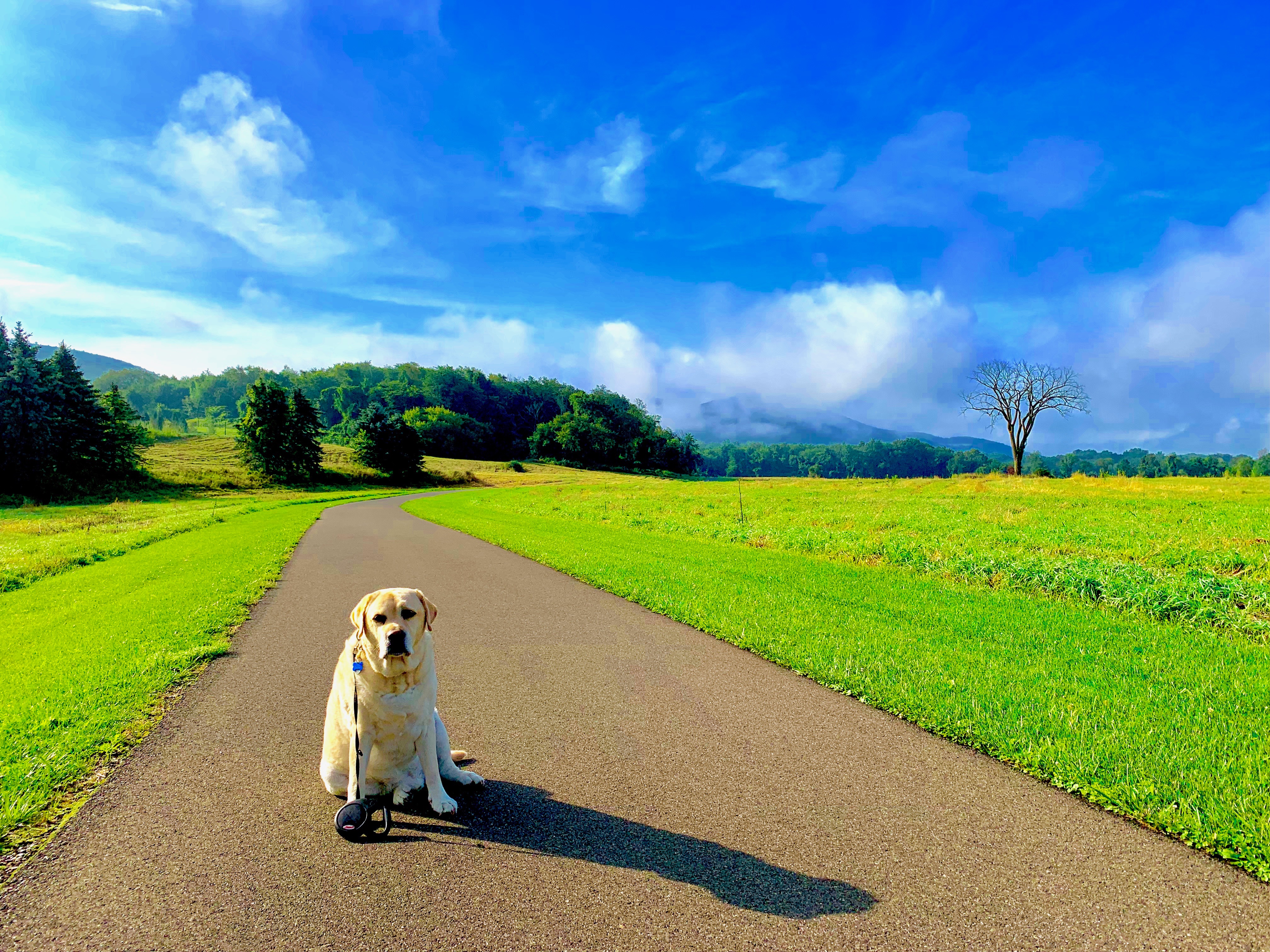
And while he certainly enjoys the variety of scents that one can encounter in and around Copake Falls, it’s taken him some adjustment to accept that the majority of our walks in the country are linear. We go somewhere and then we go back the way we came. It’s the Road to Nowhere. Picture a man and his dog on two ends of a taut leash, debating about which of two opposite directions is the way they have to go now. It looks as ridiculous as it seems. 

But he ultimately recognizes and accepts my position as the Alpha Dog. Actually, it’s bigger than that. He thinks I’m God. And of course, God doesn’t always give you what you want. Sometimes you can’t go lick the baby in the stroller and sometimes you can’t try to jump in the hammock that your favorite neighbor set up in his garage and that’s the way it is. God is all-knowing, and Mookie accepts this because he has faith. Every walk with God is essentially a good walk, circular or linear. Just like my own relationship to my own God, he’s a stubborn mule and his God loves him anyway. Besides, only a loving and benevolent God would know about a place like the Harlem Valley Rail Trial. 

My relationship with the Rail Trail predates my relationship with my dog, never mind my human child. It goes back to the year 2000, the first year that Trisha and I took a full week of vacation in Columbia County. It was three days of camping with the hippies on Long Hill at the Falcon Ridge Folk Festival in Hillsdale (what a scene, man) then four days in cabin GH1 at Taconic State Park. Back then, everything was new to us and everything was the greatest thing ever. (“Hey! The Methodist Church is having a chicken barbecue!” “There’s a school near here where kids learn about organic farming!” “Did you know Copake had a lake? It’s huge!” “Look at the price on this house! Two acres!”). And since (blessedly in retrospect) we didn’t have any magic rectangles with Internet connections while we were there, the first two days back home on Long Island would be filled with wasted hours looking up every single thing I’d come across in Columbia County the week before. (“Hey honey! Those cows we saw last week on North Mountain Road? Brown Swiss!”). 

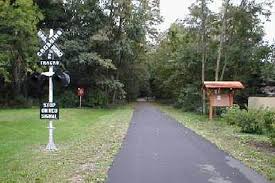
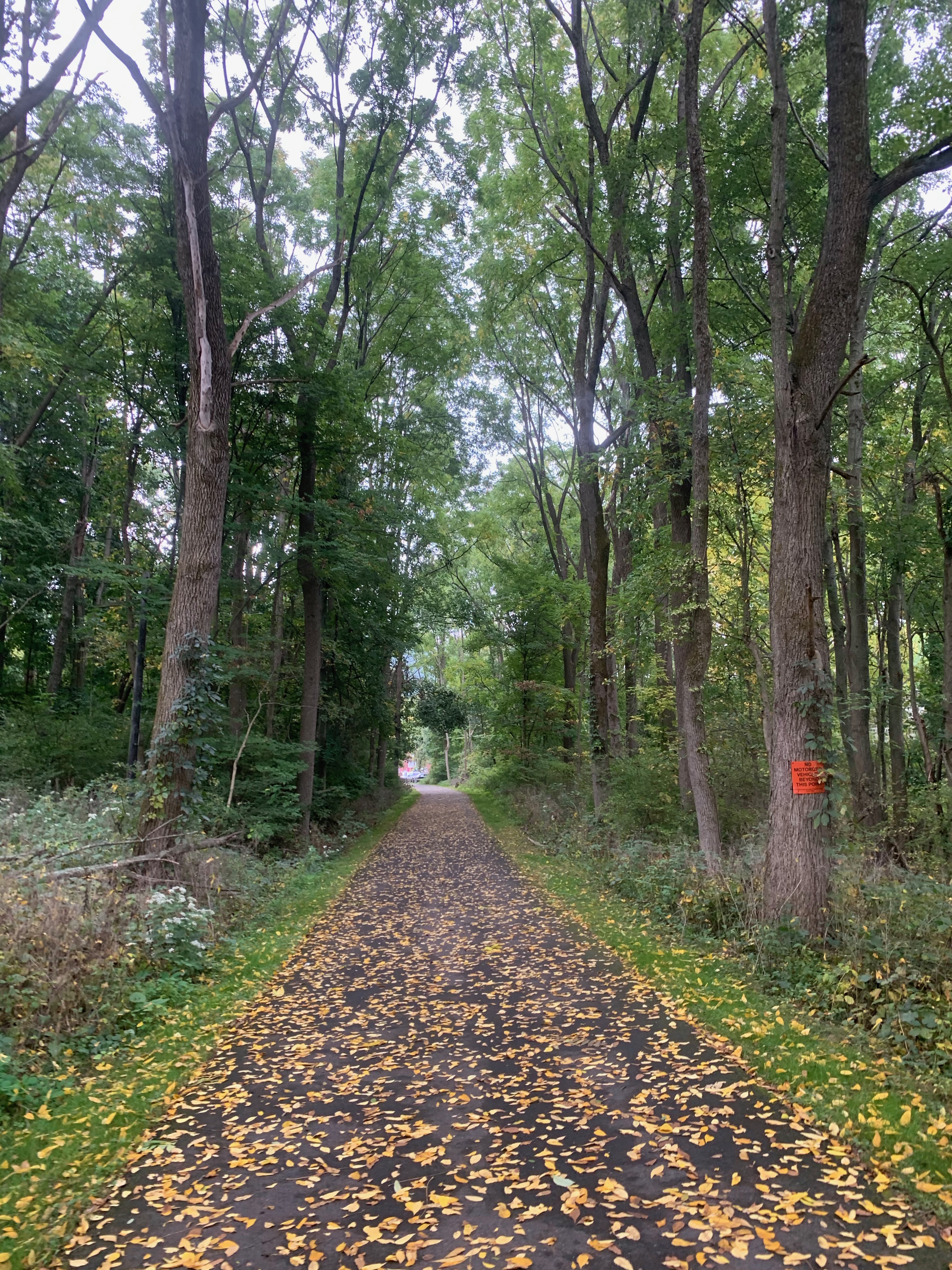
I walked up to the Depot Deli the morning after we checked into cabin GH1, and there it was, something to do, forever: A paved path that hadn’t been there before with a sign explaining that I was entering the Harlem Valley Rail, which “derives its name from The New York and Harlem Railroad, chartered in 1831 and opened in lower Manhattan in 1832 with horse-drawn cars. In 1842, the line crossed the Harlem River, and in 1973 joined the New York Central Railroad, becoming known as the Harlem Division. By 1852, it extended north to the village of Chatham. In all, the line stretched 131 miles of track. What you see today while hiking and biking on this recreationway is a glimpse of Columbia and Dutchess Counties as thousands of paying customers saw the countryside until a little more than two decades ago, when passenger service was discontinued between Dover Plains and Chatham in 1972.”

Post-vacation research uncovered that this had all been developing under my radar for years. The first segment of the Harlem Valley Rail Trail opened in 1996, eventually connecting Wassaic, the last stop on Metro-North, and hence the southern end of the Rail Trail, to Amenia, which is a nice, little place. A connection from Amenia to Millerton, an equally nice, somewhat bigger little place than Armenia, came later, but I wasn’t hip to any of it at the time, as these were just the towns I passed through on the drive north and I wasn’t going to be in them again until my drive south. I also learned that there are a whole lot of people who have volunteered a whole lot of time and energy to building and maintaining this trail, and the guilt I feel at not being one of them is manifested annually to this day in the form of a charitable contribution to the Harlem Valley Rail Trail Association the week after Christmas.  

The Copake Falls to Valley View Road to Undermountain Road in Ancram section of the trail opened in 2000, just in time for me to stumble on to it that morning. The first thing I thought to myself as I began ambling along is I gotta bring my bike up here next year, though it was plain as the years passed and the Rail Trail Culture evolved that I’d be no match for serious fellows in black speedos and wicking shirts with bright yellow and orange patterns and calf muscles like beer kegs who’d often pass me by. No matter, I like my calf muscles as God made them, and for me the bike would be just a way to get to the places where the cool birds are. 

Birdwatching has always been one of my things, growing up on a creek and all. I had to know that those little ducks with the black and white heads who showed up in the winter were hooded mergansers, and not just  those little ducks with the black and white heads, and I had to know that they bred in wooded lakes, ponds in rivers in Canada and migrated to tidal creeks and estuaries all over the U.S., including mine. When I meet birds, I want to know their names and I want to know their stories.
That morning, I walked the first section of the trail, a little over a mile to Valley View Road and back again (while my fiancée, who was told only that I was walking to the Depot Deli for newspapers, waited back at the cabin, in days before I would’ve thought to take my cell phone just to walk to the Depot Deli). I walked over the bridge the spans the Bash Bish Brook, little knowing at the time that the swimming hole directly under that bridge would be my dog’s favorite spot someday, or that I’d be pushing a stroller across that bridge not four years later, or that I’d be following behind a red Radio Flyer tricycle on that bridge a couple of years after that, or that twenty years later I’d be riding across that bridge on one of the two bicycles that I bought on Craiglist from a guy who I’d exchange $350 with in the parking lot of the Pittsfield, Mass. Wal Mart so I wouldn’t have to keep lugging two bikes back and forth from Long Island, which I’m embarrassingly aware was a First World Problem. 

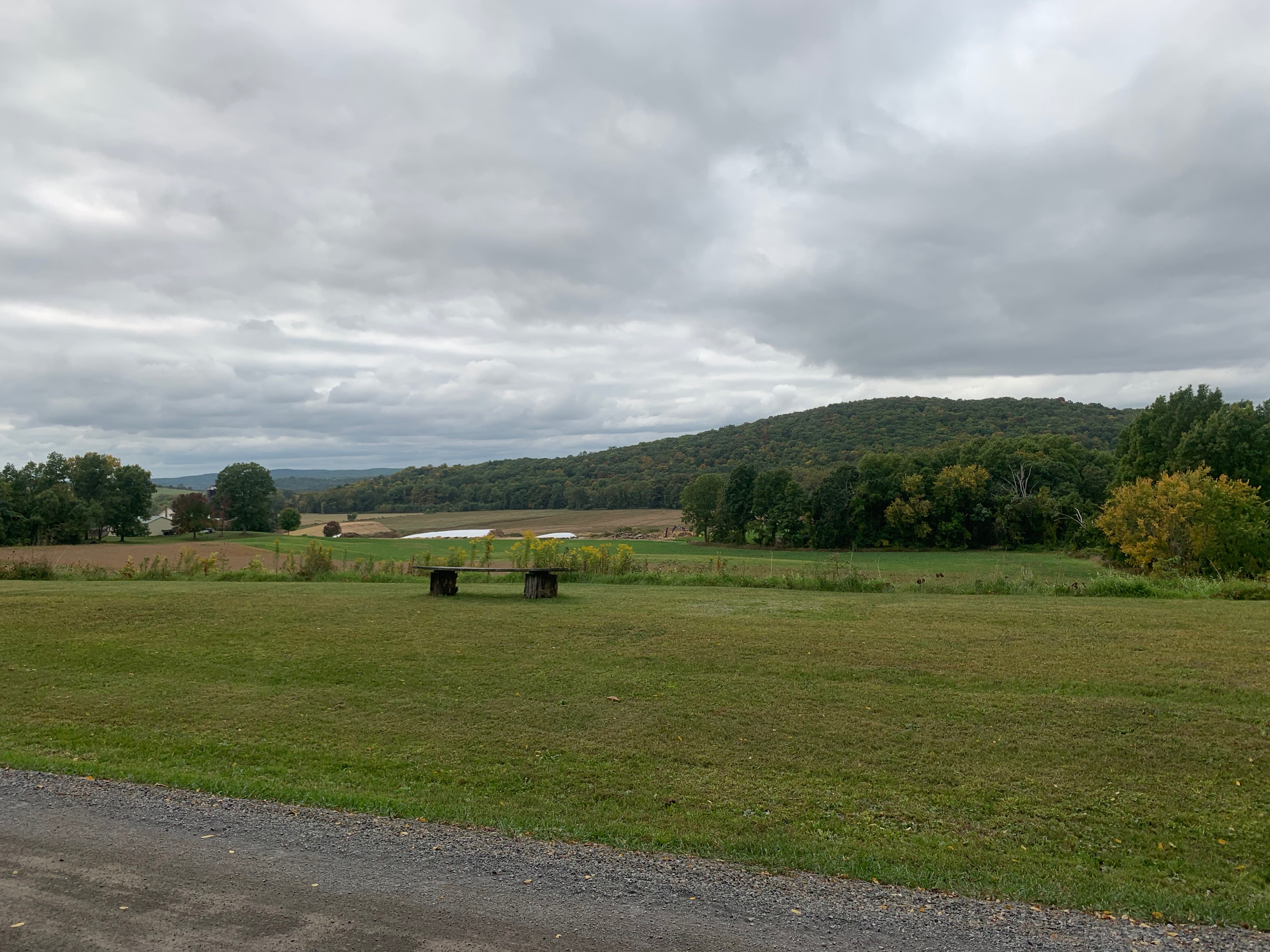
A little ways past the bridge, the west side of the trail opens up into a view of farmland sweeping up a gently rolling hill. Later, when I hit the trail at sunset, I found out why they had decided to put a bench there, as the sun sets directly behind that hill all summer. And I’ve got a thing for sunsets. On the east side is more farmland, but on a steeper climb, leading to the houses on the top of Valley View Road that are built into the side of Washburn Mountain, a point at which, if you can get a bike up the ridiculously steep hill that starts where the Rail Trail meets the road, whether by walking it up or with your overly-developed calf muscles, you can do a 30 mph coast about three quarters of a mile straight downhill and around a big turn right back to the Taconic State Park cabins. Just watch out you don’t get killed.  

In case you’re interested in trying the Valley View Downhill Challenge, this is where you’d disengage the brakes.

The morning I discovered the Rail Trail was a sweet, summer stunner and it was a Tuesday, so I pretty much had this whole thing to myself, and I knew Trisha wouldn’t be mad at me for wandering off once I told her what I’d found. While the spectacular views emerge in front of you, the trail is still lined with trees and bushes, and the birds were bursting at the seams. A line of thick brush along a farm or an open field or a meadow is what the good people at the Cornell Ornithological Society would tell you is “edge habitat.” 

I met some of my usual friends walking along the edge habitat that morning; cardinals, robins, sparrows, chickadees. My favorite bird, the grey catbird, was following me all down the trail, greeting me by name as he always does. “Johhhhnnnn!” I started to get the feeling that I’d be spending a lot of time here. 

At the point where the Rail Trail meets Valley View Road, the paved trail ends, and one has to follow a mostly uphill dirt road for about a half mile before reaching the next paved section that takes you south to Undermountain Road in Ancram. There are several properties along this dirt road. I may not have this story straight, but as I understand it, there’s a property owner who not only owns the road in front of his or her house but also the small meadow that looks out over the Peaceful Roe Jan Valley (hence “Valley View”) on the other side of the road. Apparently, this property owner refused to allow the road to be paved. There are also benches set up to take in the Valley View, adorned with angry “POSTED!” signs on poles surrounding them in case you even thought about sitting on one of them. 

When the Harlem Valley Rail Trail is complete, it will run 46 miles from Wassaic to Chatham, and that half mile might be the only part that isn’t paved. The HVRTA has purchased 14 of the privately held miles from Copake Falls to Chatham, and NYS State Parks, who run the Rail Trail, are “in negotiation” for the other 22 miles. Knowing the way people are, they’re bound to run into a few more selfish types before they can connect the whole thing. Some of our neighbors on the bottom of North Mountain Road have the trail right in their backyards, and down in Millerton, there are houses you could jump into from it, and I don’t think anyone is being terrorized by gangs of thuggish nature enthusiasts. 

I can tell you two things: One, I have passed the property in question on Valley View Road probably fifty times over twenty years. It’s built into a hill and has lots of windows.   Every shade in every window has been pulled down every time I’ve gone past. Two, while riding past that in that meadow, I saw the biggest male deer I’ve ever met in person, and he didn’t give a rat’s ass that he was on private property. 

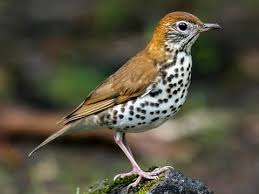
I didn’t continue on to the Undermountain Road section on my first visit to the trail that morning, again because I’d wondered off without telling Trisha, which I can attribute to less than a year of having to tell someone where I was going after going wherever I wanted whenever I felt like it for most of my adult life to that point. On the way back along the dirt road, in a heavily wooded area at the point where the rail trail to Downtown Copake Falls goes to the left and Valley View Road goes straight up in the air, I saw a wood thrush low in the bushes after following his call;  a deep, rich “bood-dood-a-weeeeee!” with bass in the “bood-dood” and treble in the “weeeeee!”. It’s a Morning in Copake Falls Sound, and like the nighttime sounds of bats chatting in the trees and coyotes howling at the full moon, I get homesick for it when I’m on Long Island. 

On the way back to Copake Falls, at the point where the sun goes down behind the hill, I saw a meadowlark singing his heart out from the top of an evergreen tree. I said screw the bike, I gotta come back here with a pair of binoculars. And Trisha.
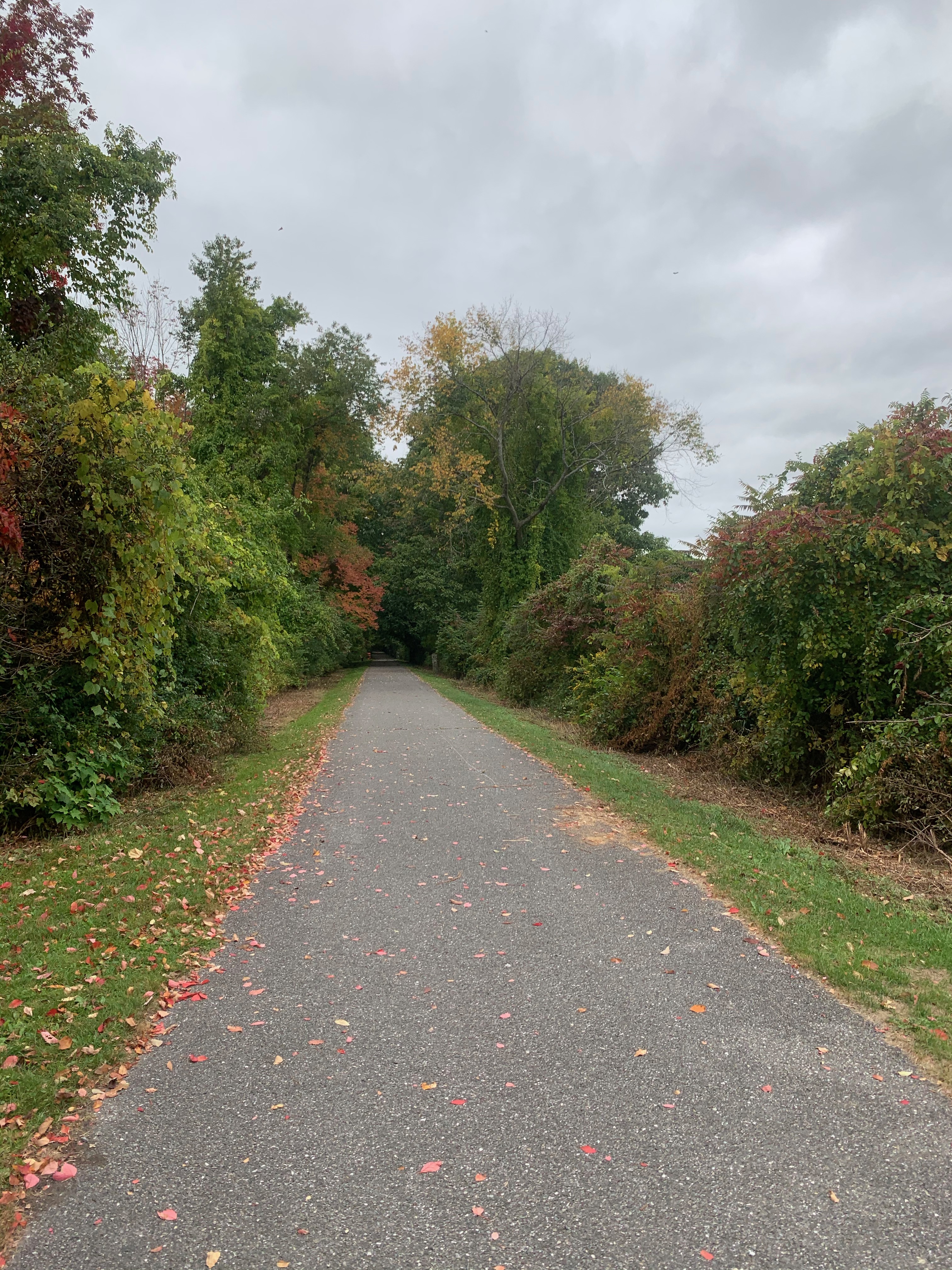
I don’t know if it was that year, or two years later in ’02, when we walked the trail from Copake Falls to Undermountain Road to get in some intensive birding, early in the morning, heavily caffeinated and armed with binoculars and the Peterson Guide. I know it wasn’t ’01 because we were a little preoccupied with getting married that summer, and though we managed to squeeze in a couple of nights of camping out on the hill with the hippies at Falcon Ridge, we didn’t make it down to the park. We haven’t missed a year since then, and now we never miss a month, but I digress. 

The best birding turned out to be in a stretch with big trees adjacent to farmland most of the way, but with enough high trees along the trail itself for some kick-ass edge habitat. The catbird followed us along and called me by name. The wood thrush played their stereophonic flutes in the deep brush. All the cool songbirds were there: Little warblers and vireos that are only pass through Long Island in spring and fall all darting around here like they owned the place, swallows and flycatchers swooping over the fields while vultures and hawks hovered in circles above like guys cruising their hot rods around town. We found a whole family of cedar waxwings, Trisha’s favorite bird, with their new wave haircuts and their squeaky metallic “zeeet” call that sounds like feedback from tiny guitar amps. 

We took a lot of walks specifically to watch the birds back then. We followed people with very expensive spotting scopes around the pond at Jamaica Bay picking up pointers. I dragged the poor woman around the dunes on the West End of Jones Beach when she was six months pregnant, but we did see a saw-whet owl sleeping in a fir tree.  We spent my fortieth birthday circumnavigating Camusett Park and Target Rock Wildlife Refuge on the north shore of Long Island. We saw lots and lots of birds that day, but the highlight was spotting a bluebird flying across a field. 

When I think back on that first walk to Undermountain Road with my gal, that will always be the day of the indigo bunting.

Indigo Buntings are bluer than bluebirds. They’re as blue as blue gets before it starts turning black. They’re the blue of the denim jacket you got for your 13th birthday. And they chirp a little song like an overly friendly storekeeper who’s had too much coffee. “Helloo! It’s a beautiful day! Nice to see you! Thanks for coming! Isn’t this great! Please! Look around!”. He sat on top of a bush in plain sight, no binoculars needed, and sang to us and showed off his magnificent blueness for as long as we wanted to look at him, and we looked at him for a long, long time. 

Indigo Bunting: Photo credit Wendy Paulson – Birds of Barrington.

Once we got into the baby business, we had to curtail the birding adventures a bit, but by that time we’d built a wildlife refuge on the creek in the backyard, and there were still lots of high trees around that have since been cut down, so we put out lots of seed and let the birds come to us. One snowy January night in the Early Aughts we had twenty-one cardinals visit the feeders at dusk, something that will never happen again, as their homes were all cut up with chain saws over the ensuing ten years. But up in Copake Falls, where time stands more still and the trees are still tall, there was no better place to push a stroller than up and down the Rail Trail. And when it was time for the guy in the stroller to start powering his own wheels, that was the place to do it. 

And since you can’t rightly stare at trees with binoculars at the same time you’re making sure your five-year old doesn’t ride his bike into a ditch, we started to really appreciate the stunning variety of wildflowers just as much as the birds on the trail. Summer is a hippie festival of color and fragrance up and down the trail, and you can eat the wild blackberries and raspberries you come across and I promise that you won’t get sick and die. 

My son loves the Rail Trail. It’s never not been part of his life. He went from three wheels to four wheels to two wheels in the blink of five summers. Then of course Dad had to teach him about the Valley View Road Downhill Challenge, just to scare the crap out of Mom. I loved sitting on our front porch at GH7 waiting for him to come whipping around that corner as he coasted in. We regularly biked the Copake Falls to Undermountain Road and back again route together as part of our week in the park. 

They’re there.

Speaking of Undermountain Road, it’s under mountains, the biggest ones in the part of the Taconic Range that overlooks the Peaceful Roe Jan Valley. When you get to this section of the Rail Trail, you’re literally under Alander Mountain. The trailhead is just down the road. There’s another big boy called Brace Mountain that is easily accessed from Copake Falls. These mountains are not much taller than Baker Mountain in Saranac Lake, which I climbed twice in the last three years. When I was a whole lot younger, I climbed Mt. Marcy, the highest point in New York State and a mile up in the air, at least five times. I have a brother who is four and a half years older than me who still climbs mountains whenever he gets the chance and is working on being an Adirondack 46’er. I’ve also got a pack of Marlboro 27’s on the patio table. 

My excuse for not climbing any Taconic Mountains to this point is that I didn’t have a day when I happened to be up that way and the weather conditions would make it worth the effort. Now that I’m a part-time resident, that excuse is trickling away. I know I could always ask one of the people I know in Copake Falls who are in their 80’s, and don’t have a pack of Marlboro 27’s on their patio table, to serve as a guide. They climb the local mountains all the time. There’s something in the water up there and I sure as hell hope it works for me. 

Less intimidating is the challenge of a bike ride from Copake Falls to Millerton on the Rail Trail, which should be possible by 2021, when the newest eight-mile section is completed. That would be 12 miles of mostly level or slightly downhill rolling, with a sandwich and a ride back from Trisha waiting at the Millerton parking lot. Hell, we could even make it to Wassaic, 22 miles away, as long as I get that sandwich and that ride. Dream big, that’s what I say. 

I could point out to anyone who might actually be using this document as a guide to the Harlem Valley Rail Trail that you could stop wasting your time with me right now and got to hvrt.org, but I could also tell you that the two and a half miles of trail south of Millerton to Coleman Station (I haven’t made it to Armenia or Wassaic) is just about the nicest walk or ride you’d ever want to take. Right after you pass through the pretty little town, and right before the trail opens up to some beautiful scenery, you go through a section that was originally created by blasting through solid rock, and the solid rock they didn’t blast remains on both sides of you, so it’s always about fifteen degrees cooler on this part of the trail than it is everywhere else, which was a blessing on the hot day that Jack and I finally got around to riding this trail last summer, which was the same day I inadvertently cooked a mouse in the oven, which is a story for Chapter 6. 

In 2010, ten years after the Copake Falls to Undermountain Road section opened up, the trail was extended north to Orphan Farm Road, which now borders the Shagbark Tree Farm. This is the stretch where you’ll find Mookie and I most often these days. It’s a nice mile and a half jaunt with what is probably the most spectacular scenery that the paying customers on Harlem Valley Line saw from the trains, although I can’t state that for a fact. There is also a small section across Route 22 from Black Grocery Road (the etymology of which I want nothing to do with) to the Herrington’s Hardware store parking lot in Hillsdale. Eventually, the plan is to build a pedestrian bridge over 22, connecting Orphan Farm Road to Black Grocery Road, thereby connecting everything from Wassaic to Hillsdale, which would give the trail 26.6 of its eventual 46.1 miles to Chatham. The motto of the Harlem Valley Rail Trail Association is “Chatham or Bust!”, and I take them at their word. 

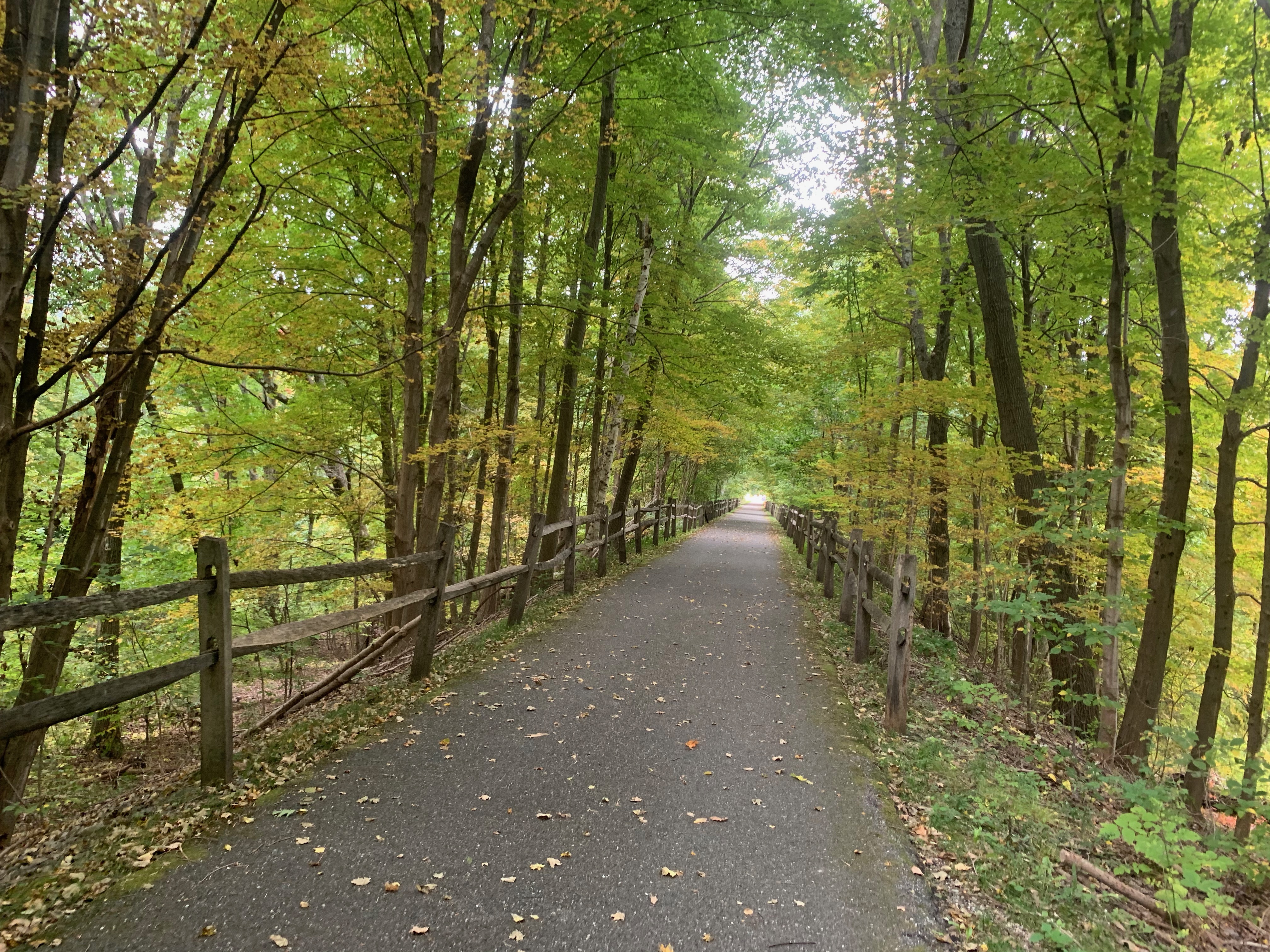
The Orphan Farm Trail.

Meanwhile, the end of the Orphan Farm trail is where Mookie questions the need for walks to be linear rather than circular in Nature. His nose tells him that his second home in the country is right up there at the top of a very steep and narrow path that runs between the hill full of Happy Little Trees and a heavily wooded patch of the Rail Trail right-of-way leading into my neighbor’s backyards. This shortcut back to Trisha’s Mountain is easily accessible from the Orphan Farm parking lot. He’s sniffed it and seen and it for himself while sitting on his front porch up on the hill. As a matter of fact, we could make this a completely circular walk by traveling down North Mountain Road to the rail trail, then climbing back up this path right back to our mailbox. What he doesn’t know is that 1) It’s private property, which he wouldn’t care about anyway, and 2) Trisha has already seen a coyote and I’ve already seen a black bear emerge from that path in broad daylight, not at the same time of course (that’d probably be newsworthy, even in Columbia County), and if my stubborn dog thinks he can talk shit to animals that live in mountains like he does to dogs and cats and squirrels that live in Valley Stream he would be tragically mistaken. God watches after fools, little children and their dogs. 

And since Mookie can’t think figuratively, which is really one of the best things about him, I wouldn’t be able to explain to him that these one-way walks are sort of metaphoric. While I hope we’re walking together for a couple of more years, mortality will eventually come between us. He’s a 9-and-a-half-year-old dog and I’m a 57-and-a-half-year-old human doing his best to stay alive in the midst of a pandemic. The road we’re on is not a circle, and one of these days, we’ll have gone as far as we can go. 

But the good news is that neither one of us I really have anything left to prove to anybody. We’ve both been good boys, and now we’re just trying to live in the moment, both happy to be walking relatively pain-free. Our journey is our destination. We’re on the road to nowhere, but baby, it’s all right. Despite all of our shared internal conflict about leaving behind everything we’ve loved and marked back in Valley Stream, when we’re out on the Harlem Valley Rail Trail, and the sun is shining and the birds are chirping and the breeze is blowing and the wildflowers are blooming, there’s just nowhere else we’d rather be. 
Copyright 2020 John Duffy

All Rights Reserved

Chapter 3 of Mountain High, Valley Low or My Life As a Wishbone: Tales of Valley Stream and Copake Falls, New York: “Fezzik! You Did Something Right!

They really do want me to stay in Valley Stream. As a matter of fact, they’ve spent millions of dollars in infrastructure improvements trying to convince me to stay. And they know I have a soft spot for the old dump. 

I can only tell them three things right now: 

1) It all looks great.

2) I’m flattered. 

3) I can’t promise you anything. 

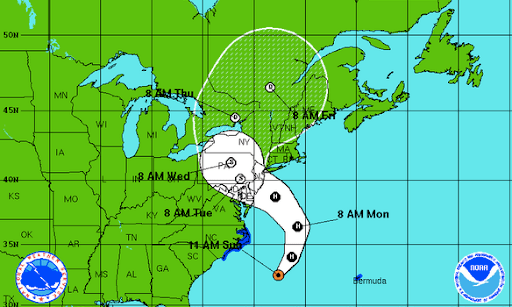
On a related note, hurricanes are way, way up on my list of scary things. Tornadoes, fire, cancer, car accidents, crazy people, snakes, Republicans, lightning. No particular order. There are scary things that enter your consciousness in an instant, and you have no time to think of how scary they could be because, well, there they are. You can only reflect back on how scary they were in retrospect. We’ll put snakes and crazy people in that category. But hurricanes, they creep up on you slowly. They mess with your head. They scare you silly, then when they leave, they say, “you know, I could have REALLY kicked your ass. Maybe next time, punk. Good luck.”  

Anyone who has lived through a hurricane and doesn’t have permanent psychic damage as a result is either very, very stoic or very, very stupid. “Superstorm Sandy” hit Long Island on October 29th, 2012.  Why “Superstorm”? Why? Well, I know why. It was October and the hurricane met a cold front. That’s why they called it that. It’s an actual meteorological term. Still. “Hurricane” would have been just fine. “Superstorm” sounds like what a three-year old or a TV news writer would’ve called it. But I digress. 
The most ferocious part of the storm hit at night. Trisha and Mookie went up to Jack’s room in the attic to and the cats took the other room in the attic, all to maybe sleep and/or to silently freak out. Jack was eight years old at the time, but he’d already experienced Hurricane Irene a year earlier, and he knew the best thing you could do was cuddle up with your mom and your dog and let Dad do what dads do, which in this case was to stay downstairs to monitor the situation.

Hurricanes mess with your head. When Craig Allen, the WCBS Newsradio 880 weatherman, told me around 9 p.m. that the storm surge at Battery Park at high tide was 14 feet, I knew that tide, and that storm surge, were coming, through Jamaica Bay and right up Duffy’s Creek. I was pretty confident that it wasn’t going to be 14 feet, but I also didn’t how high would be enough to submerge the first floor of the house, or how fast would be enough to knock it off its foundation. 10 o’clock, 11 o’clock, the water kept on rising higher and moving faster. I could hear it gushing into the cellar. At some point the broken garage door blew open, but at that point, I was too busy listening to the sinister glub glub glub sound emerging from the floorboards, so running around and picking everything I could off the floors became my first priority. At some point in the 11 to 12 hour, I looked out at the backyard to see that the water had completely submerged the three and a half foot high post and rail fence, and was just about up to the height of the windows, and the plastic playground set was careening wildly around the yard like a ship lost in a storm at sea. 

Lower Manhattan: 10/29/12

Lower Manhattan: 10/29/12
Floated from one end of the yard to the other through the entire storm surge.

T


The water got high enough to submerge these fence posts on Duffy’s Creek.

It was at this point that I asked my mom for help, as she had just died two months earlier and I was raised Catholic and I really didn’t know what the hell else to do, besides continuing to throw towels down on the kitchen floor. And whether coincidence or divine intervention, I looked out the back window again just a few minutes later and saw the tops of the fence posts. 

The aftermath was what Saint Joan herself would’ve called “a goddamn mess.” One smart thing I did was move Dan the Van and Buster the Fit up to higher ground on the hill at the end of the street in the parking lot of Valley Stream South High School (aka “Big Brick”), where I found them blessedly dry the next morning. Our neighbors’ cars were all wrecked. We didn’t have anything stored in the cellar, ‘cause anything down there had already been thrown away after the less-destructive Irene a year earlier (which got into the cellar but not the house). But after ripping up 20% of the wall-to-wall carpet and throwing out 75% of the contents of the garage, after seeing way too many of our shrubs, roses and perennials transformed into corpses, after having to rely on the kindness of relatives (who no longer live on Long Island or are no longer living at all) for heat and electricity for the better part of ten days, after reading about the destruction in every town between us and the ocean and realizing how stupidly lucky we actually were to have no more than three inches of water infiltrate the house, I now have a healthy dread of every little “X” off the coast of Africa that shows up on the NOAA Hurricane Central website, which I check each and every morning from June until November.

About a year and a half after Sandy, I heard about the New York Rising Reconstruction Plan, and about a meeting wherein members of the Mill Brook Civic Association and representatives from a consulting firm called Louis Berger Inc. would explain how they intended to spend South Valley Stream’s share of the State money. $3 million big ones. This is where my complete lack of faith in people comes in. I went to the meeting expecting them to tell me that they wanted to build a big concrete bulkhead all along the creek, piss off all the wildlife and further the degradation of my little paradise into an open sewer. I figured I was the only one who knew there were herons and kingfishers and sandpipers back there, and that nobody really gave a rat about the neglected old pedestrian path, hidden from our view by fifteen-foot tall phragmites, which are actually called woozy-woozys if you’re one of Francis Duffy’s children.

And then I met Niek. 

Successful people amaze me. From reading Niek’s Linkedin page, I know the friendly, well-dressed Dutch gentleman I met at that meeting in 2013 is a civil engineer and environmental impact planner, a landscape architect, a transportation and stormwater specialist who helped to rebuild lower Manhattan after Sandy, never mind Duffy’s Creek in South Valley Stream. By contrast, I drove back and forth on the Belt Parkway for 25 years and tried to get teenagers to read and write and think big thoughts, mostly by pretending to follow the orders of people who insisted that they knew how to do it better than I did. A noble profession, of course, but I sort of feel like my kind are a dime a dozen compared to people with Niek’s level of expertise. 

The meeting was at Forest Road Elementary school in Mill Brook, which used to be called Green Acres, which is technically not my neighborhood because I’m on the other side of the creek. Everyone who attended got a look, through pamphlets and power points and pictures blown up and hung on easels, of the plans for storm resiliency in South Valley Stream. Color me blown away. No concrete bulkheads. Lots of organic storm protection through a natural shoreline with native plants and green infrastructure. Exactly what I would have proposed if I were as smart as Niek. 

The Mill Brook Civic Association was chosen by New York State to represent the area, because there is no other active civic association in Valley Stream. The guy who was president of the association at the time took an instant dislike to me, among other reasons because I was from the wrong side of the creek and I had the temerity to ask pertinent questions and volunteer relevant information. The other people from the Civic Association who I met were wonderful, but this guy didn’t want me around. I later found out that he did that to a lot of people for no particular reason, so I kept showing up at the meetings, mostly because of my vested interest in the project but a little bit just to piss him off. 

I think he was particularly pissed off that Niek and I hit it off so well. When I told Niek that I had counted over 100 bird species on and around Duffy’s Creek in the ten years I had been back there (which is the truth), Niek lit up. He told me that he had grown up along a river in the Netherlands and had begun watching and counting bird species as a boy. This put a great image in my head that’s still there. Then he asked me if I had written down all those species, and I told him I sure had. Then he told me that New York State was allocating an extra $3 million big ones (a “race to the top” thing) to communities that could demonstrate that their projects would have a positive impact on the environment, including habitat for native flora and fauna, and could I email him that list, and I said I sure could. 

At a few subsequent meetings of the Green Acres Civic Association that I insinuated myself into, Niek’s people were there to represent Louis Berger. The next time I saw Niek himself was about a year later, after New York State announced that South Valley Stream was among the winners of the extra $3 millon big ones and the final plan was being introduced to the public at Forest Road School. Niek recognized me and came over and shook my hand and thanked me. He told me that my bird species list had been extremely helpful, if not critical, in winning that extra money. I was as pleased as punch, as happy as a lark, for the contribution that I had made to my community and my bird friends, and because Niek thought I was cool. 

The guy who didn’t like me, his name is at the top of the South Valley Stream New York Rising Community Reconstruction Plan, published in March 2014.

I wrote down the names of birds in a spiral notebook. 

This is why my Linkedin page sucks. 

But I’m pretty sure my friends over at the Town of Hempstead Department of Engineering were able to use some of that extra $3 million big ones to raise the street I live on six inches higher.  So you could say I ultimately took care of number one..

It certainly took a long time for it all to come together. The next time there was a meeting to tell everybody what was going to happen, Niek had moved on to his next adventure, the guy who didn’t like me had moved to Cedarhurst, and the meeting was being conducted by the chief engineer of the Town of Hempstead, who turned out to be the brother-in-law of one of my high school friends. I didn’t recognize him at first, as he was wearing a nice suit and I had only ever seen him wearing a Jets jersey. But that’s one of the perks of living your whole life in the same town. Ask George Bailey. You end up knowing a lot of people and a lot of people know you. And if you behave yourself, you end up with a lot of people on your side.

From my new-found friend of a friend, I found out all the particulars of the creek path reconstruction, how there was going to be lots of native plants and trees, just liked Niek had planned, plus all sorts of engineering tricks aimed at flood-prevention, like a footbridge over a large oval-shaped spillway covered in eelgrass that’s designed to take in tide water and soak it up like a sponge. Plus they worked in an osprey nest, which in my informed opinion is too close to people to ever attract ospreys, and a kayak ramp, though I’ve only seen two other people kayaking in the creek besides myself and Jack. Still, the whole project was like they had sat down and begun planning by saying, “what would Duffy do, if he were smart enough?” 

And if that weren’t enough, I found out that Jedwood Place, on my non-Mill Brook side of the creek, was going to be torn up and rebuilt six inches higher, with new gas lines and storm drainage underground topped off by shiny new sidewalks, curbs and asphalt on top.

The reconstruction of the path started with some little red flags in the ground in October of 2018. Six years after Sandy. There was a lot of “well, they’re never actually going to follow through on this stuff” talk at our house during those six years. Mostly from Trisha. But the big machines came in November and they cut down a few giant trees and ripped out all the woozy-woozys, which was tough to watch, but you’ve got to break a few eggs to make real mayonnaise, now don’t you?

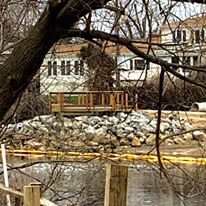
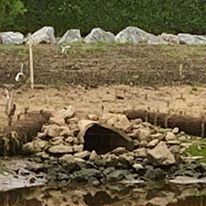
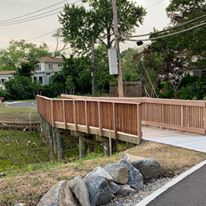
Over the winter and into the spring, we watched the plan come into action. They raised the whole path about four feet. They “terraced’ the bank of the creek with big logs of compressed dirt (which I’m sure Niek and the Town Engineer know the technical name for) and they planted all the pretty little shrubs that we planted years ago when we learned about going native: Rosa Rugosa, Red-Twig Dogwood, Inkberry Holly, Sweet Pepperbush aka Summersweet, plus new Maple, Dogwood and Oak trees to replace the ones they killed. They built the footbridge over the spillway, and a platform overlooking the creek where the path bends around towards Forest Road. They lined the whole thing with hunky rocks. They installed brightly illustrated educational signs to teach people about the birds and plants and flowers they’re looking at, and miraculously, no idiot Valley Stream kid has marred any of them with graffiti yet. Although the original plan called for a path surface that soaked up water, they ended up going with asphalt, probably to allow police cars to access it, which considering how many idiot Valley Stream kids there are, was probably a smart trade off. 

Before

After

In the summer of 2019, the construction in the backyard wrapped up as the construction in the front yard started. Without the woozy-woozys, we now had a front row seat in the backyard to people enjoying the brand-new path along Duffy’s Creek. Oddly, because they’re higher in elevation and because we have a lot of flowers in the way, we can see them, but they can’t really see us, which is kind of like watching your neighborhood park on a live webcam. Meanwhile, out front, National Grid came in and replaced all the gas lines under the street, then left it not unlike the surface of the moon. 

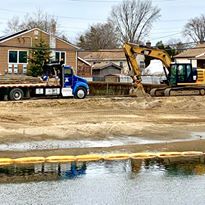
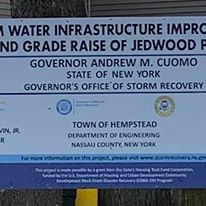
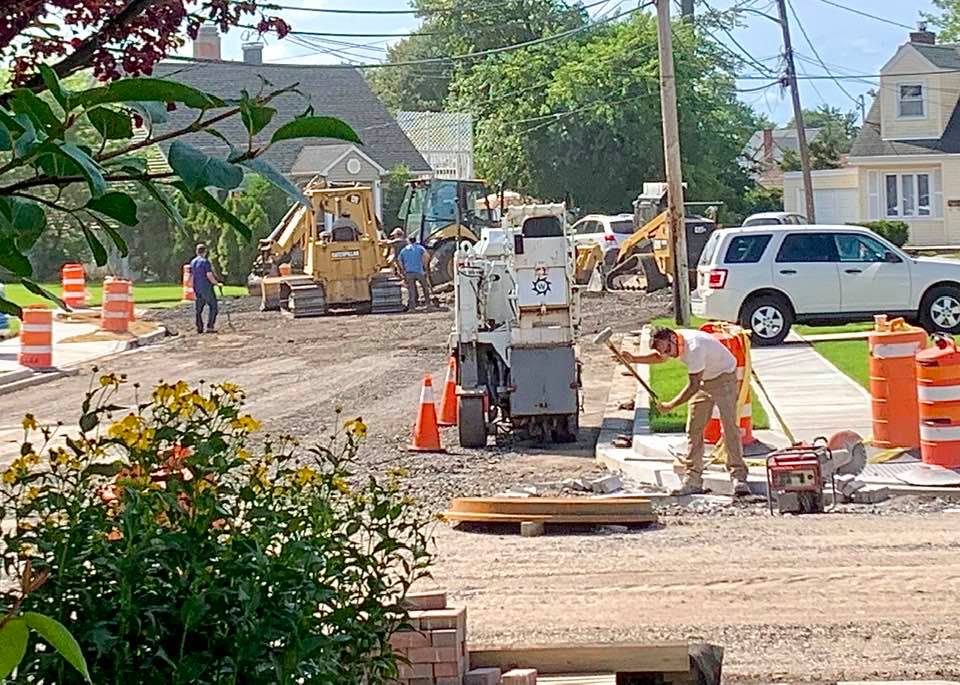
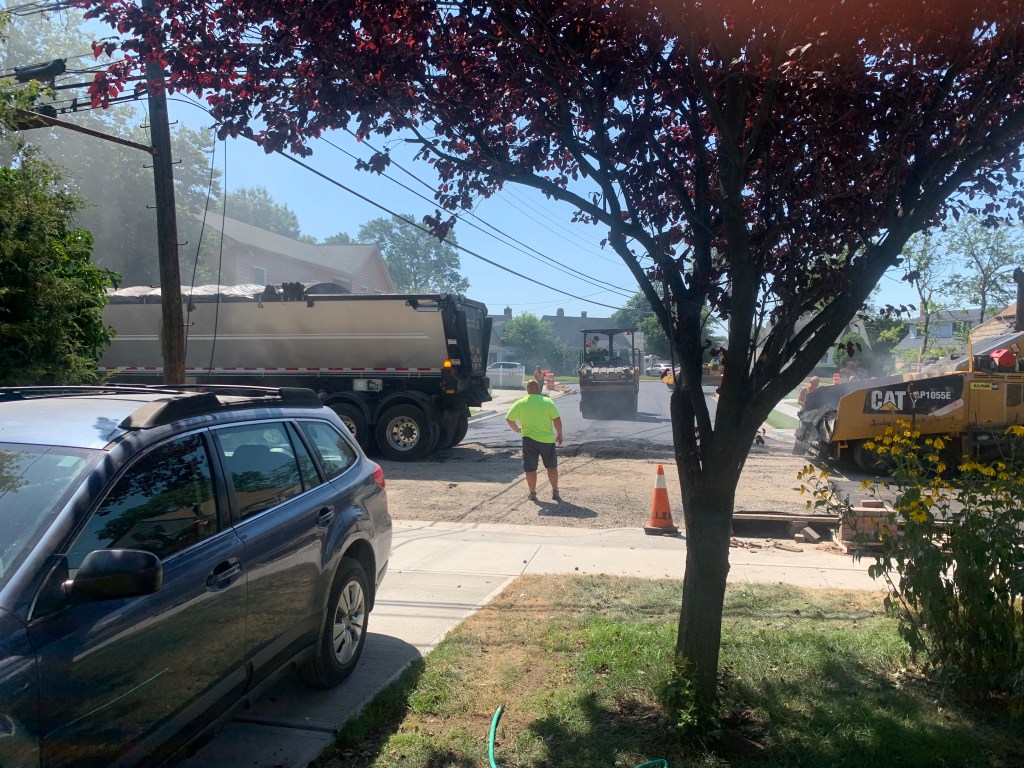
Then of course, in March of 2020, Trump broke the country, and everything closed down. The big construction work on the street was supposed to start as the school year was wrapping up, but as soon as Big Brick closed its doors for the Pandemic, the New York Rising sign with Andrew Cuomo’s name in 28-point type went up and the guys from Allen Industries of Amityville came in, with bulldozers, front loaders, excavators, backhoes, flatbeds full of concrete and the big pick-up trucks they commuted to work with. As we were all working from home, we got to watch the whole thing. I hardly minded the various inconveniences involved (noise, dust, no driveway, etc.) as I knew it was all for a greater good, and because I was in awe of how hard these guys were working every day, especially since I had it relatively easy. 

A side note: There’s a silly You Tube video in which a marmot chipmunk appears to be yelling “Allen!…Allen!…Allen!” over and over again. Maybe you’ve seen it. Trisha started walking around saying “Allen!” in the chipmunk’s English accent every morning when the guys showed up. By day three or four, we were both doing it. One of the secrets to happiness is to marry somebody who’s good at starting inside jokes. Here it is for your enjoyment, until they catch me and take it down:

The head guys, Mr. Allen himself and the rest, became like friendly neighbors with big machines and power tools for the four months they were here. They were guys we saw every day when we stopped seeing all the other people in our lives every day, so there was something weirdly comforting about their presence. And when it came time to tear up our driveway, they had to also tear up part of the curving inlaid slate walkway up to the door. We all had a meeting wearing masks on the on the front lawn where I watched them brainstorm how to take it out and put it back in without damaging it, which they ultimately did flawlessly. Plus we got brand-new sidewalks and most of a brand-new driveway, which was a couple of thousand big ones that we won’t have to spend on curb appeal. They even replaced the grass they ripped up with sod, but it got hot and dry out in June and the homeowner kept disappearing with his dog for a week at a time, so despite a valiant effort by Mr. Allen and the brand-new fire hydrant, the sod all died. Still, it’s the thought that counts, and we’ll always have fond memories of the guys from “Allen!” 

Mookie admiring the driveway work.

And then a day in July came when Mookie and I rolled back into town from Copake Falls, the construction vehicles and the pickup trucks were all gone, and everything was done. A brand-new, six-inch higher asphalt street, sewer grates twice the size of the old ones and beautiful new curbs and sidewalks (albeit lined with dead sod). And out back, people who couldn’t really see me were enjoying a stroll or a jog or bike ride along my creek, where thousands of yellow Black-Eyed Susans were in bloom at the same time all the yellow daisies in my insane patio garden were doing their thing.

Isn’t that nice?

At the end of “The Princess Bride” (if you don’t know, I can’t help you), Inigo Montoya compliments Fezzik the giant for finding four white horses with which the heroes can ride into the sunset together. Inigo says what I said when I looked around at my newly rebuilt neighborhood:

“Fezzick! You did something right!”

Fezzik answers, “I’ll try not to let it go to my head.”

I’d like to think I had a little something to do with helping this whole thing happen, but I’ll try not to let it go to my head, because it probably would have happened exactly as it did if I had just stayed home and kept my bird list to myself. Still I’ll always have that image of a little Dutch boy counting birds as he walks along a river, and I’m proud that I could help out the birds who’ve enhanced my life so much, ’cause God knows they can use every little bit of help they can get.

As far as storm resiliency, the last hurricane that scared the bejesus out of me blew through in just a few hours in August, just after the construction was completed. That was the unpronounceable Isaias, that actually hit Long Island as a tropical storm. We were on the right side of the eye this time, which meant less rain, but it also meant ferocious, relentless winds that messed with my head for six hours, and has left me with further psychic damage. It remains to be seen how the re-engineered Duffy’s Creek will respond to a major rain event, and if I’m lucky, and I am a lot but not always, I’ll never find out. 

Meanwhile, as we were all trapped in our neighborhoods by the Pandemic in 2020, nice weather came around just the same, and the seasons changed and the natural world went on as always, because nature doesn’t really care less what happens to us and would probably prefer that we all die at this point. And as the nice weather came around, so did people in masks desperate to get the hell out of their houses for a while. And the beautiful new “Mill Brook Park” gave them somewhere to take the dog for a walk, teach their kid to ride a bicycle, push a baby stroller, jog resolutely along with very serious faces or just sit on a bench and enjoy the pretty little winding creek along with all the plants and the ducks and the swans and the herons and the egrets and the osprey and the kingfishers. I’m sure more than one visitor to the park never knew how nice it was, and though our one-way mirror of flowers, I was proud to watch my creek get the recognition it deserves. 

So to Andrew Cuomo and the Mill Brook Civic Association and Niek Verhaart and his team and the Town of Hempstead Engineering Department and, of course, “Allen!” and every single construction worker who put his or her back into rebuilding my neighborhood: I don’t know how much longer I’ll be hanging around here, but thank you for making South Valley Stream somewhat more tolerable in the interim, and thank you for respecting my creek. 

You did something right, and you should all be very proud of that. 

Oh, and also, thanks most of all for ratcheting up the property values. 

Ca-ching!

Goldfinch and Associates: Landscape Architects – A Tour of The Gardens @ Duffy’s Creek

IMG_1430

We grow a lot of flowers here on Duffy’s Creek. And trees, and bushes, and vegetables. And we’ve spent way, way too much money doing it. And it takes a lot of time and grunting to maintain what we’ve done from year to year. But I tell you what: I’ve walked around a lot of neighborhoods with Mookie Dog these last four years, and I’ve gotten a good look at a lot of peoples’ properties while Mookie sniffed and peed on the nearest telephone poles (The Dude gets credit for coming up with: “he’s reading his pee mail.”). In the world of property ownership, and what a wonderful world it is, I have come to believe that people who have flowers growing around their house are the people who look like they’re enjoying their stay on Earth a bit more than the people who don’t. And they  probably are. I know I am. Of course if the homeowner is elderly or disabled it isn’t a fair statement, but still, if you can grow some flowers and you don’t, it looks to me like you just don’t care in general, and you probably don’t. Is that arrogant? It might be arrogant. Hell, I don’t know. I’d just like to take you on a tour of Gardens @ Duffy’s Creek. You like flowers? We got some flowers for ya today.

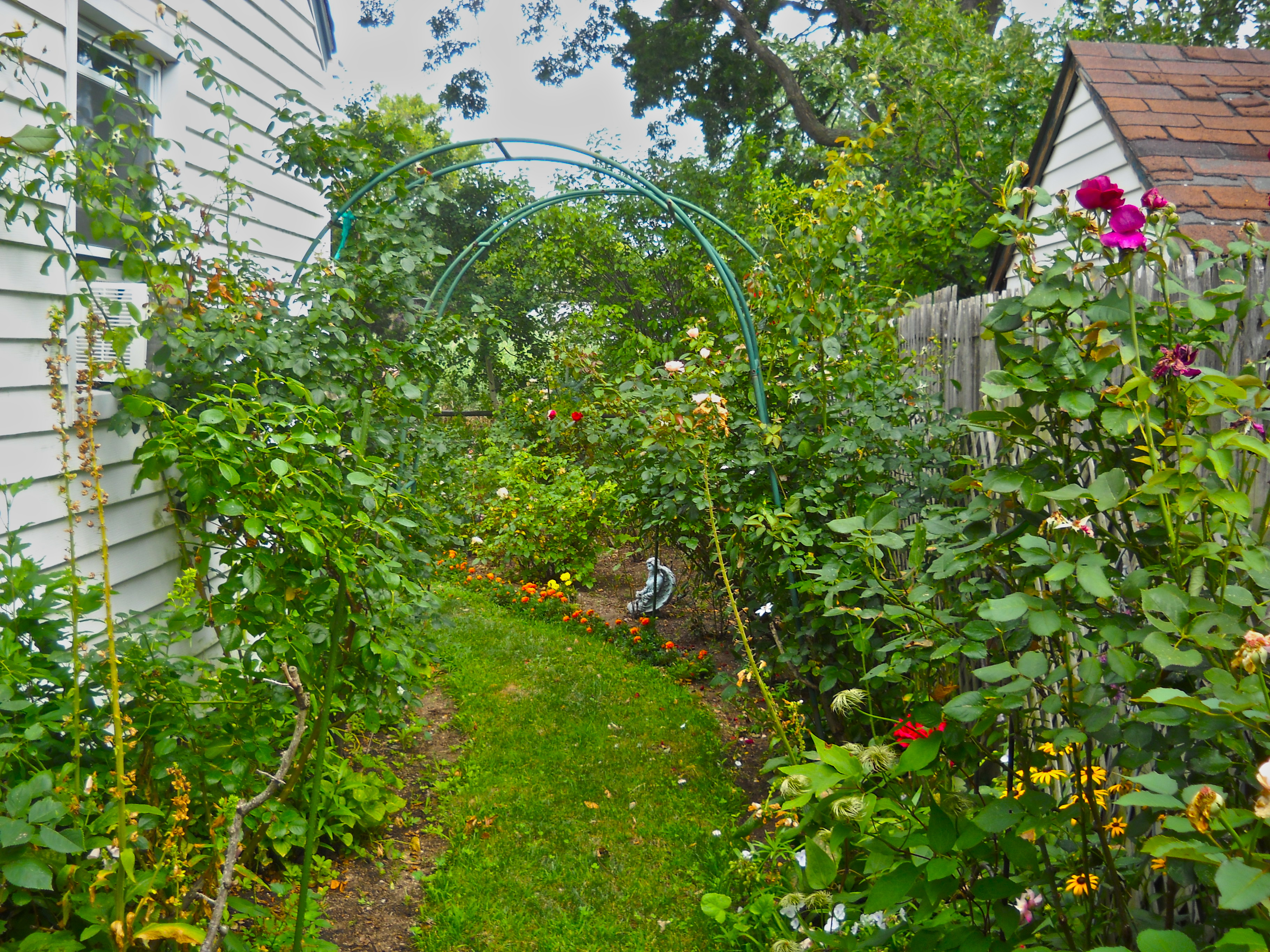
Trisha's Rose Garden. The big show is in the spring and fall. I'll post more pictures then
Trisha’s Rose Garden. The big show is in the spring and fall. I’ll post more pictures then

It doesn’t matter where we start, since you’re not actually here, so we can start where it all started. Trisha and I bought the old Duffy Family House on The Creek in 2001 from my parents, who moved to a Lifecare Community. My mom kind of went kicking and screaming, mostly because she loved the backyard on the Creek. Trisha’s family owned an operated a Florist and Nursery, McCloskey’s  on Woodhaven Boulevard in Rego Park, Queens for 86 years, Her grandfather started out by selling flowers for putting on graves in St. John’s Cemetery across the street. So as soon as she saw the backyard of this place, she knew what she wanted to do with it. The first thing she did was clear a whole lot of crap (her newlywed husband dug up a few tree roots for her) and plant this Hybrid Tea Rose Garden. I love that all the plants have names and little stories, but I can’t keep any of them straight. Still, I like hearing about them. And truly, there’s just nothing like roses. I don’t know what smells you associate with your spouse (Cheese? Cinnamon? Ben-Gay?) but to me the smell of hybrid tea roses, whatever the hell their names are, remind me how much I love my wife. Isn’t that nice?

The Secret Garden
The Secret Garden

We have a big six-foot wood stockade fence along the back of the Rose Garden, courtesy of some former psychotic neighbors who will get their own post one of these days. I’ll even name them for you. Anyway, the point at which the rose garden meets the house and the stockade fence is Trisha’s “Secret Garden”, which has more Hybrid Teas, plus some climbing roses and Clematis on arbors and some various perennials, the Lupines being my favorite, if only because of the silly Monty Python sketch. There’s some bitchin’ foxglove in there. And it’s a great place to hide from The Dude.

Around front, you get to Trisha’s Cottage Garden, modeled after a Thomas Kinkade painting if he dropped acid, which has a lot of beautiful perennials and some good smellin’ Mock Orange and Quince, plus this cool guy called a Purple Beautyberry Bush which is owned and defended by an insane Mockingbird.

Trisha's front yard Cottage Garden. It's a scene, Man.
Trisha’s front yard Cottage Garden. It’s a scene, Man.

Me, I always liked playing in the dirt. As a matter of fact, when I was very young in this very backyard I had a “diggy spot.” And when I was 30 and stuck living back with my parents after going through surgery and chemotherapy for testicular cancer, I decided to start a little garden out where my “diggy spot” used to be.  And my mom liked planting flowers, too. So one day in 1993 we went to Dee’s Nursery in Oceanside together – which in itself is a great memory – and she sprung for some perennials and bulbs to get that garden started. There’s still a couple of hyacinths that come up every year from that garden, but for the most part it got too shady under my neighbor’s giant oak tree to really get anything good growing there. So after my mom died in 2012, I planted a Colorado Blue Spruce as a memorial to her, thus taking the “diggy spot” out of the active flower gardening area. I’ve never visited her grave, and I don’t know if I ever will. If I need to talk to her, she’s right here.

The Colorado Blue Spruce I planted as a memorial to my mom in 2012 so she could keep an eye on things. This was my
The Colorado Blue Spruce I planted as a memorial to my mom in 2012 so she could keep an eye on things. This was my “diggy spot” as a little feller, and when I was 30.

When we moved back here in 2001, I started noticing the bird, including the ducks and the geese and the other assorted characters – osprey, egrets, kingfishers, terns, herons and cormorants to name a few- who made their living on the Creek. We had a lot of songbirds, too.  Unfortunately, one of the reasons was that the whole place was overgrown and they had lots of places to hide. Once we put up some bird feeders, it was madness. One January twilight we had over 20 cardinals dancing around in the snow. We don’t have as many birds now because we had to take down two massive maple trees and a pear tree before they killed us in a hurricane. (And there was one, and they didn’t. And we of course replaced those trees, but these things take time). Back when we started, I wrote down all the species of birds I saw and when I saw them in a spiral notebook (very neatly ’cause I’m OCD), then I looked them up and found out what they were doing here, and what they wanted for dinner. I have a list of about 115 bird species that have passed through or by this property. I will put that list up as a separate post sometime soon. It recently may or may not have helped earned South Valley Stream $3 million dollars in New York Rising Recovery grant money, but that’s a story for another day.

Anyway, around this same time, we started taking hikes through Jamaica Bay Wildlife Refuge, which is a long way from here but connected by water, and noticing not only the birds but the plants. This led to the Duffy’s Creek Bird Sanctuary. We started trying to use as much garden space as possible for bird-friendly habitat plants and stuff that grew here naturally. This led to the Wetland Gardens that run between the yard and the Creek, which is actually planted on land that belongs to Nassau County. But screw ’em, they don’t deserve it.

The Wetlands
The Wetlands
DSCN5960

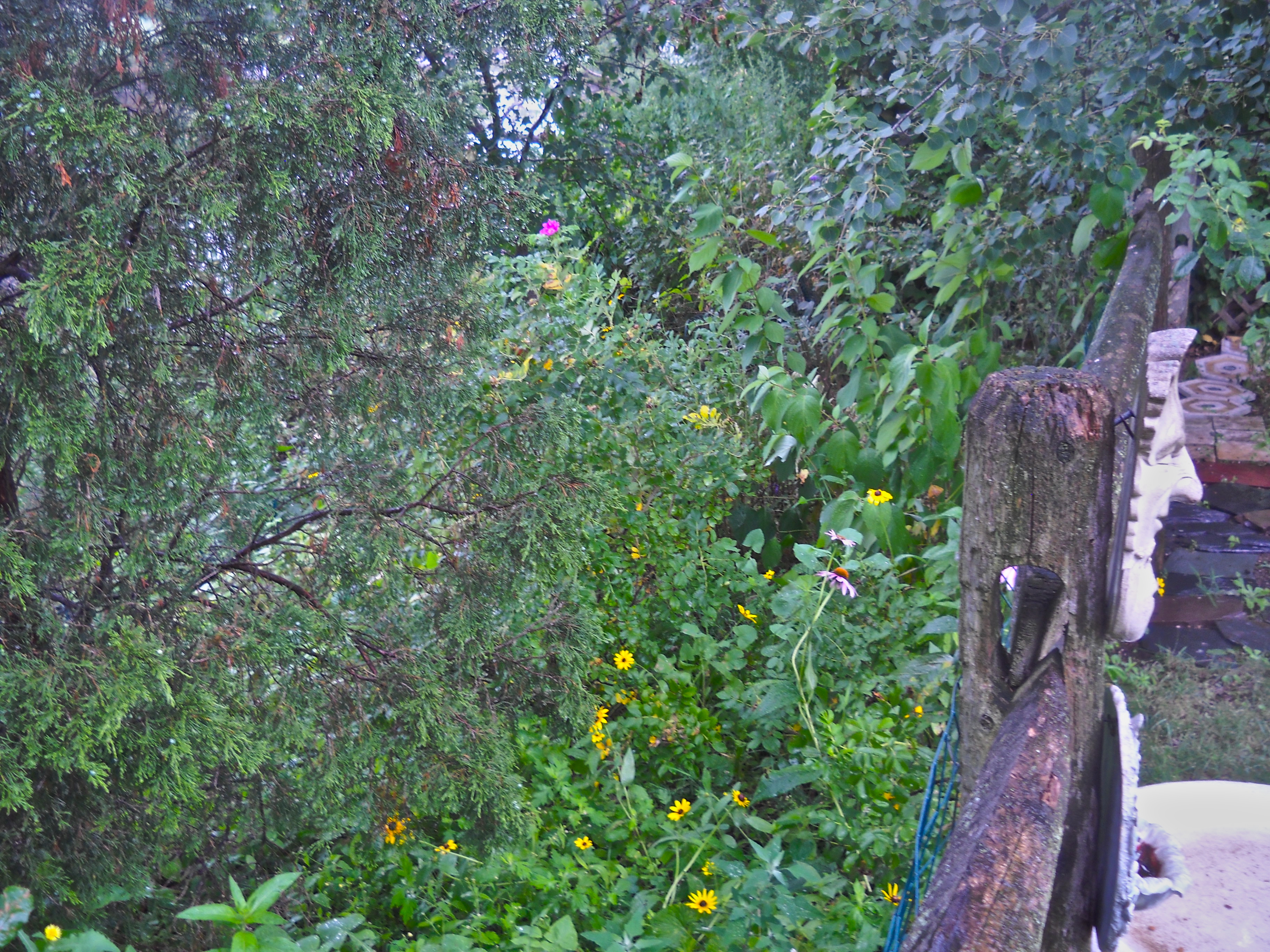
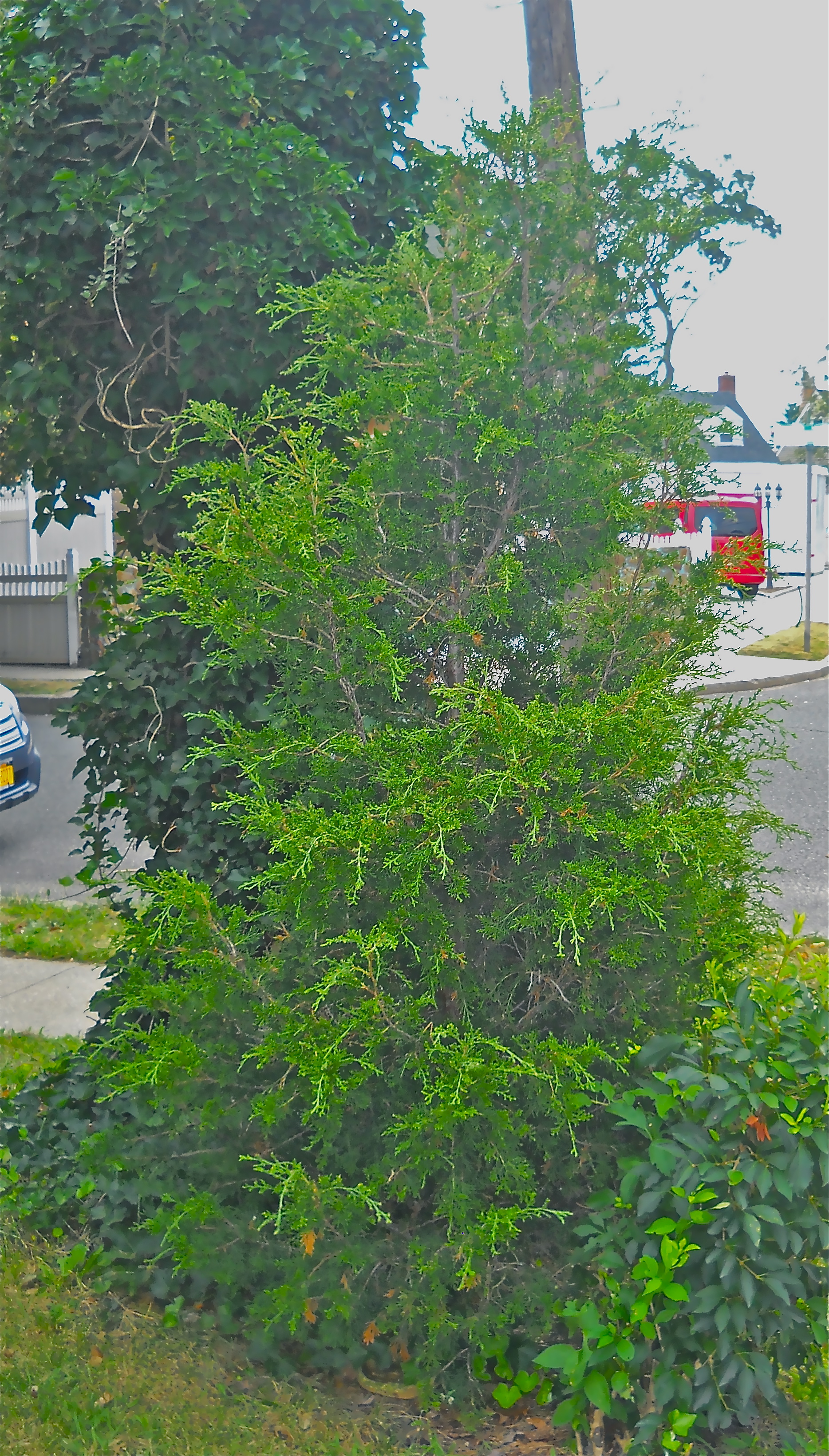
In the wetlands are Rosa Rugosa and Red Twig Dogwood and Winterberry Holly, a Weeping Willow Tree, a Butterfly Bush and one of our signature specimens, the Great Leaning Cedar of Duffy’s Creek. It was a four-foot tall Eastern Red Cedar bought from Dee’s Nursery. I really had to wonder about myself when I planted a $139 tree on property that I don’t actually own, but no matter. The Red Cedar got really tall, probably about 15 feet or more. Then Hurricane Sandy came along and knocked it to a 45 degree angle. My brother came down from Connecticut to help us out with the mess about a week after the storm. We raised the Cedar back up and he tied it to the fence using one of the knots that he learned in Boy Scouts and I didn’t. The Cedar survived, but it leans like the Tower of Pisa now. So we call our backyard The Leaning Cedar Cafe @ Duffy’s Creek, ’cause we like the way it sounds.

When we first moved in, we had a deck. It was a very 1970’s deck, probably because it was built in the 1970’s. And it was slowly rotting away. The final straw for the deck was when a cat caught a mallard and left his decapitated head under the step. It was a little too evocative of “The Godfather”, but I digress again. Around that same time, we took a day trip from Copake Falls to visit the Stockbridge Botanical Gardens in Stockbridge, Mass. Here we met some of the “Herb Associates”, whose name still inspires giggle fits around here. Basically a bunch of old ladies who planted and maintained an herb garden just off the kitchen of the house at the gate of the Gardens.

We were already planning to replace the deck with a loose-laid brick patio. The “Herb Associates” inspired us to include a little garden with some sage and lavender and thyme and oregano and mint. And then we just kept going, and started adding lots of cool perennials, dahlias and zinnias from seed.

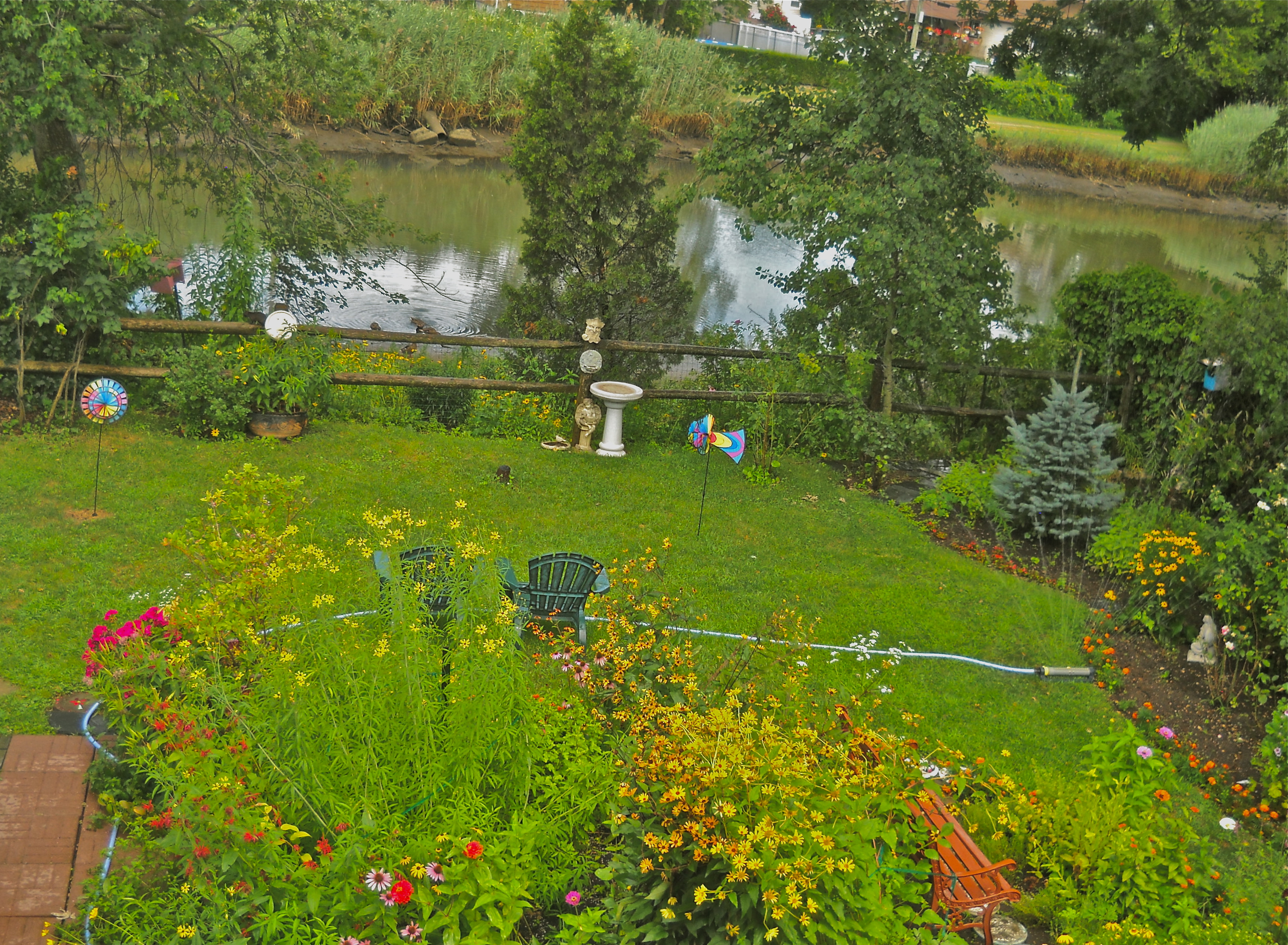
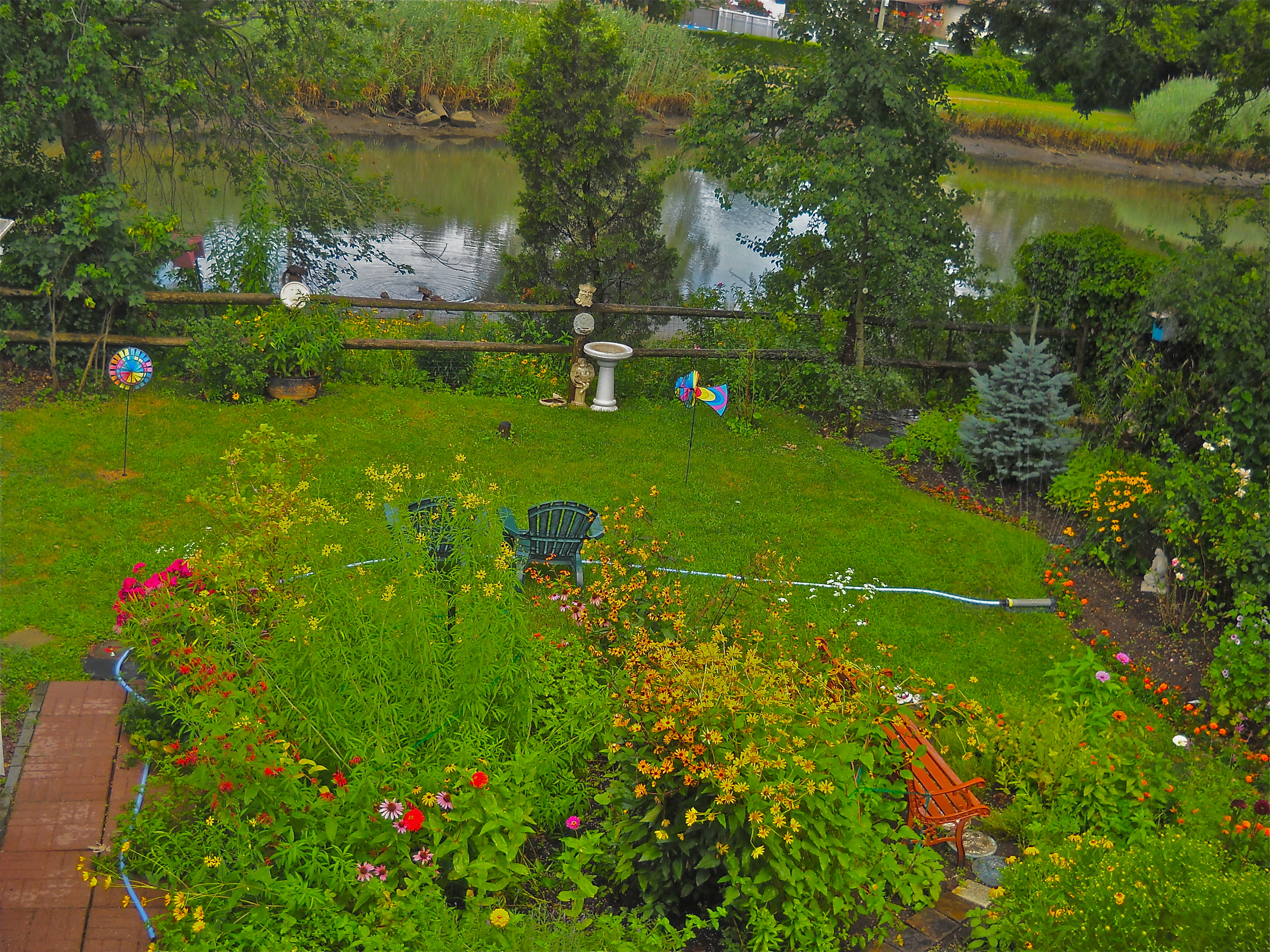
Patio Garden looking out towards Duffy's Creek, taken from the attic window
Patio Garden looking out towards Duffy’s Creek, taken from the attic window. You can also see my Quaking Aspen, which transports me to Lake Kushaqua in the Adirondack Mountains every time a breeze blows through.

Soon enough it was the insane garden you can see in the foreground of this picture. Some of the coreopsis and rubekia and hellenium and Mexican Sunflowers grow over six feet tall. We call them by their latin name: “Crazius Bastardus.” The patio garden is our landing place. It’s the nicest room in the house in the summer, and consequently, we watch a lot less TV. It’s where you sit and stare for five minutes  – or an hour- when you’re between things you have to do, or walk around and crush leaves between your fingers, take a big whiff and say, “damn that’s good!” At least we do.

Patio Garden
Patio Garden. Real gardeners rarely put away the hose.
Patio Garden
Patio Garden with Crazius Bastardus on display.

As you can see, the patio garden has some nice bee balm. And when you have perennials, you can make the same jokes at the same time every year. As soon as one of us mentions that the bee balm is coming into bloom, the other will either do a Monty Python falsetto and say, “Whatcha bringin’ a balm in here for!” or do the Jackie Childs voice from Seinfeld. “A balm? Nobody know what a balm will do! They’re unpredictable!” We try to have fun.

The patio garden. The bench is dedicated to our sister-in-law, who loved to exchange garden stories with us. Her spirit can visit and see what we're up to.
The patio garden in all it’s glory. The bench is dedicated to our sister-in-law, who loved to exchange garden stories with us. Her spirit can visit and see what we’re up to.
Patio Garden from another angle. The MAESTRO gave you a balm?

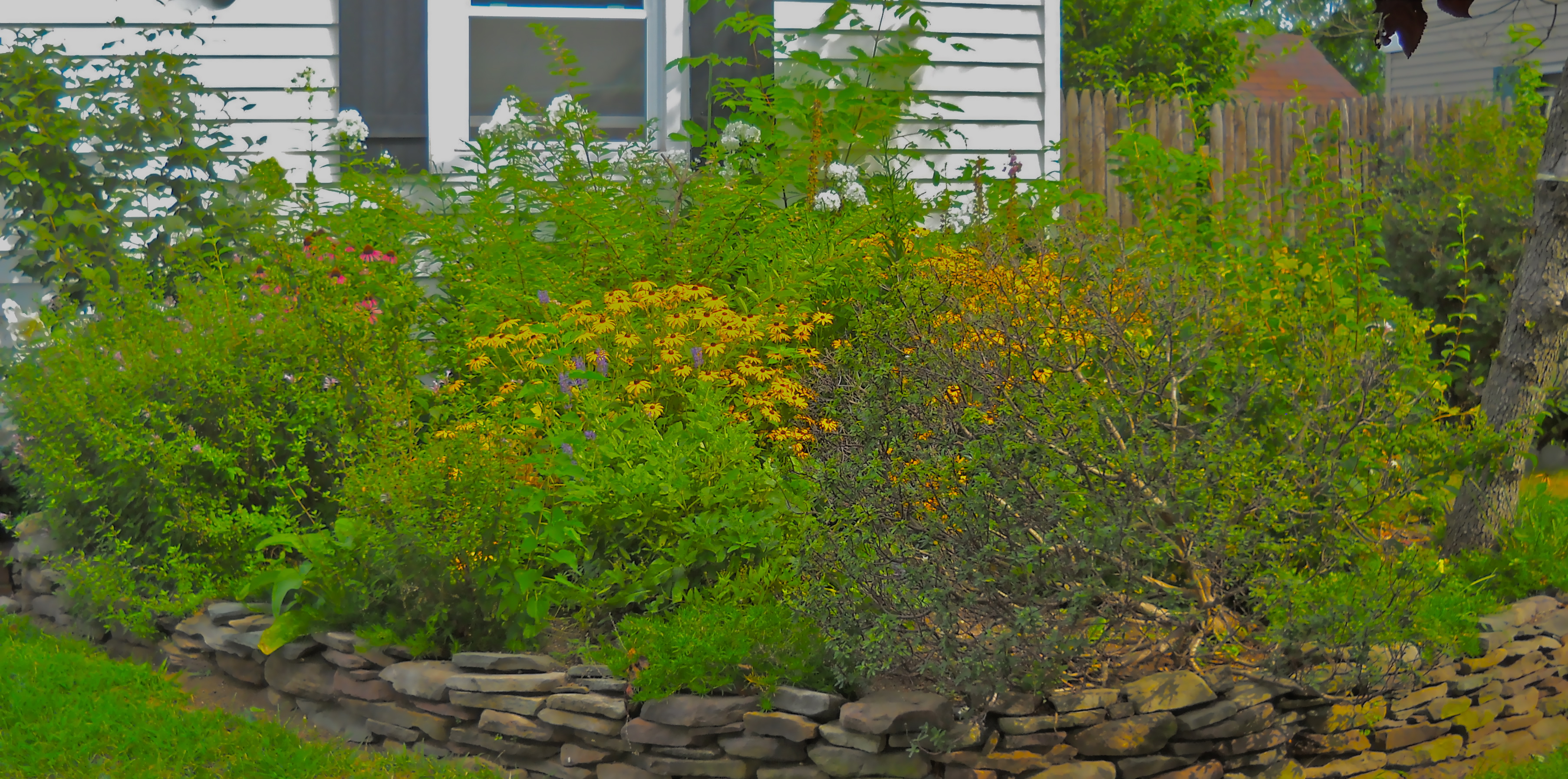
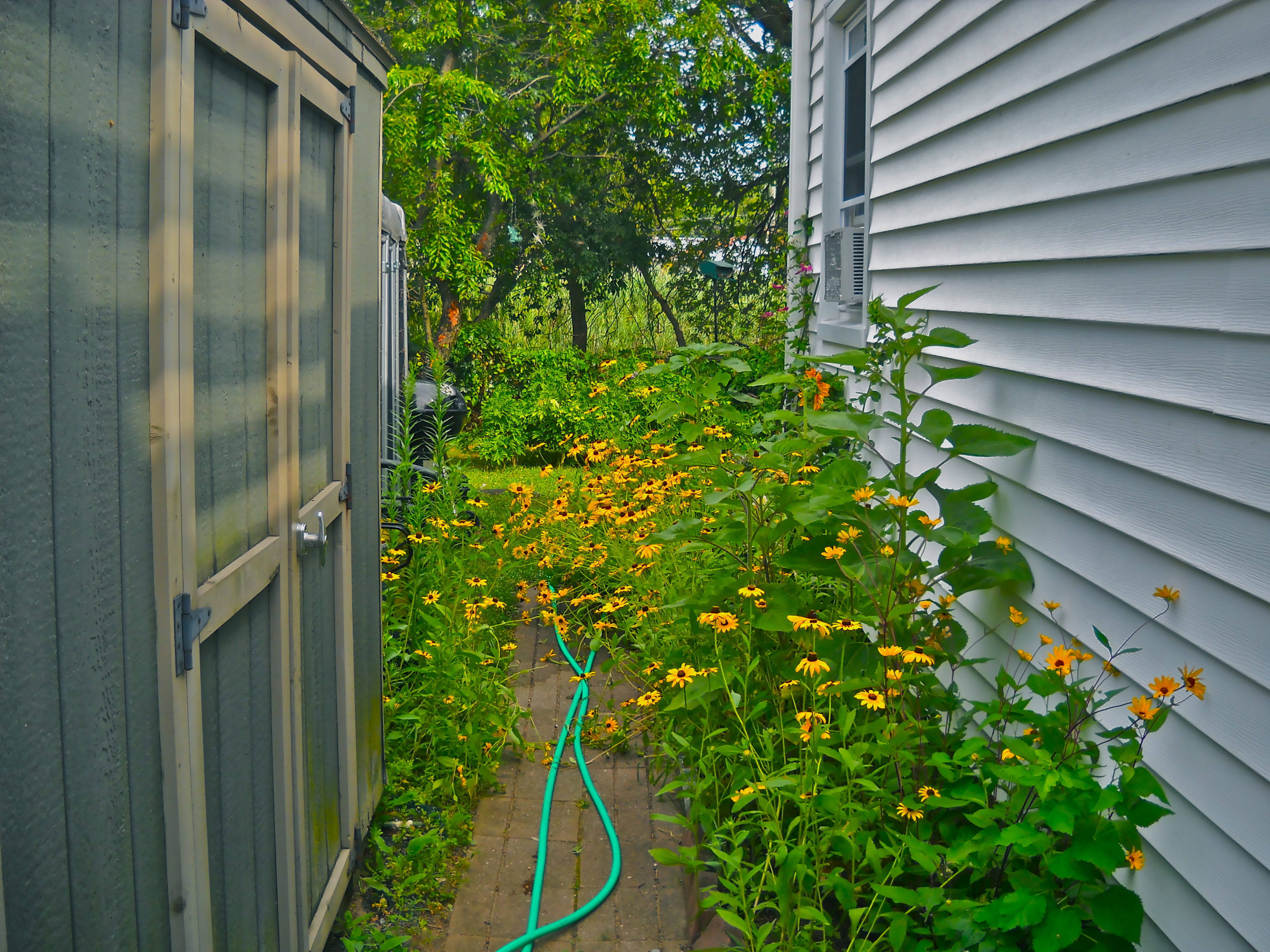
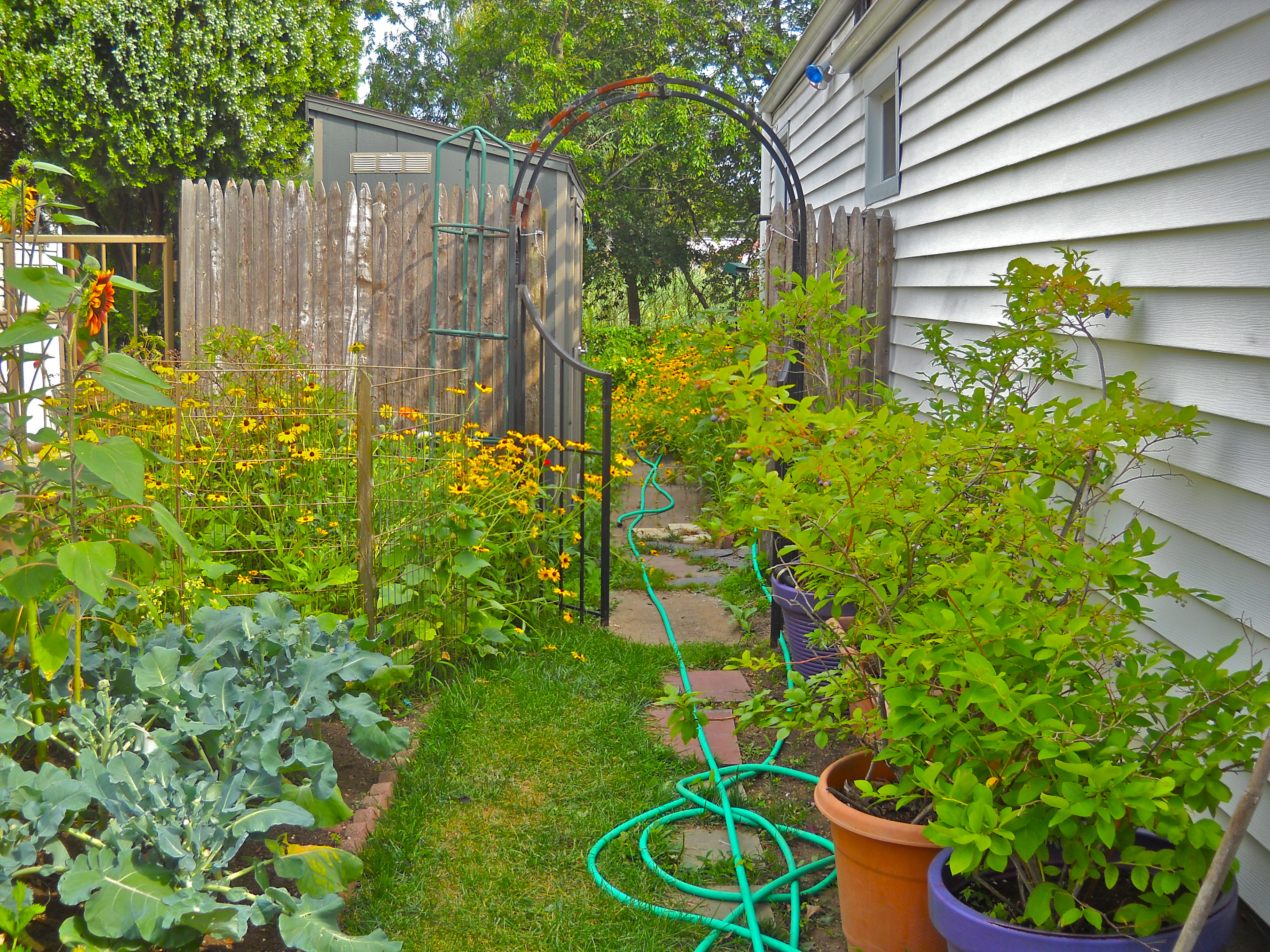
Along the side of the house this year I have some, OK a thousand, black eyed susans growing quite untidily. Usually I insist on tidy, but I’m letting them have their fun. Last year I planted a thousand black-eyed susan seeds in the Wetlands and in this spot, where I was out of ideas, and in one year they have naturalized and become our own resident wildflower. They are pretty weeds.  God bless ’em.

DSCN5953

We also have eight blueberry bushes in large planters which have been producing phenomenal fruit for us and the Robins, Catbirds, Song Sparrows and Mockingbirds for ten years now.

Blueberries and Vegetables, and more crazy Black-Eyed Susies.

During the Hurricane Sandy storm surge, the blueberry bushes floated on down the block. We found them the next day on various front lawns around the neighborhood. A neighbor with a van brought us two that he found at the high school at the end of the street, about a quarter of a mile away. We have a dog kennel that we bought when we first got Mookie, but that he decided he didn’t like one damn bit because we weren’t in there with him. We were going to sell it, then we realized it would come in handy in the next Hurricane as a place to put anything that might float away down the street.

Hurricane Sandy (I hate “Superstorm”) didn’t do the damage to us here in South Valley Stream as it did in points south, specifically East Rockaway, Oceanside, Island Park and Long Beach, which all got walloped. But it did take out some of our favorite specimens. We had two little Christmas trees growing on the side of the garage, a Frasier Fir and a Balsam Fir. We were going to make them our last two Chistmas Trees here someday if we had a choice in the matter. But the brackish water from the surge killed them, as well as a Mountain Laurel that had survived for 60 years and two outrageously beautiful Burkwood Viburnum bushes outside the front window. But when life hands you lemons and all that, we turned the space along the garage into a nice vegetable garden, where we’ve started feeding ourselves as well as the birds. We have carrots, celery, broccoli and cucumbers growing there now. I use the cucumbers to make homemade bread and butter Pickles, because I can. Actually because I jar, but no matter. The best part of making bread and butter pickles for me is being able adopt Robin Williams’ silly, exaggerated Scottish accent and scream at my wife, “Damn it, Woman! I’m makin’ The brine right now!” I never get tired of that one.

Carrots, Celery, Broccoli, Cucumbers.

Of course, every good gardener knows that you go through a lot of experimentation and a lot of failure on your way to creating a successful patch. That’s the thing that Thomas Jefferson and I have in common most of all. The spot outside the front window has seen and lost Two holly bushes, the aforementioned Viburnum, a peach tree that was really cool but was under constant siege from Ants, Squirrels and Fungus (which may have been the name of a Warren Zevon album).  I also planted and moved an Eastern Red Cedar and a Crabapple Tree from that spot after I decided they each looked better somewhere else.

Our resident Insane Mockingbird decided he like the Eastern Red Cedar so much he planted another one on the opposite side of the front lawn, and it has grown almost as big as the first.

Sargent Crabapple. Successfully transplanted twice, now happily right outside the front door, where you can watch the birds harvest the fruit in the fall.
We planted two Eastern Red Cedars, including the Famous Leaning Cedar of Duffy's Creek. A Mockingbird planted this one.
We planted two Eastern Red Cedars, including the Famous Leaning Cedar of Duffy’s Creek. A Mockingbird planted this one.

And this leads me to one of my favorite things about this whole 14 year experiment in floral hedonism that we’ve got going on here. Two years ago, I decided I would just fill up the spot in front of the window with flowers. I threw in some zinnias and gladiolas and dahlias and lilies and phlox that I grew from seed. As usual, I spent too much money that could have gone towards fixing the house itself, like say, a roof for instance. And after I do all that, and it all grows in, the most impressive flowers in the whole business are the a deep orange multiflower sunflowers that were planted by my friends the goldfinch.Who are busy eating the seeds of it and pooping them out to make sure they come back next year.

Front Yard Garden - My Patch
Front Yard Garden
Front yard - my patch
Sunflowers courtesy of resident goldfinch

So if you’re walking by our house (And your dog is reading his pee mail) you might notice a nice display of flowers growing outside. And if you knock on the door and ask, we’ll show you round the back. And you’ll say, these people, they seem to have a pretty good life here, and we do. And because we do, we praise God with a thousand flowers every year, because we care, and we’re trying to enjoy our time here on Earth. And we like birds. And it smells good.

And if you’ve got a couple of geraniums in pots on your front step, and you keep them watered, well you’re all right with me.

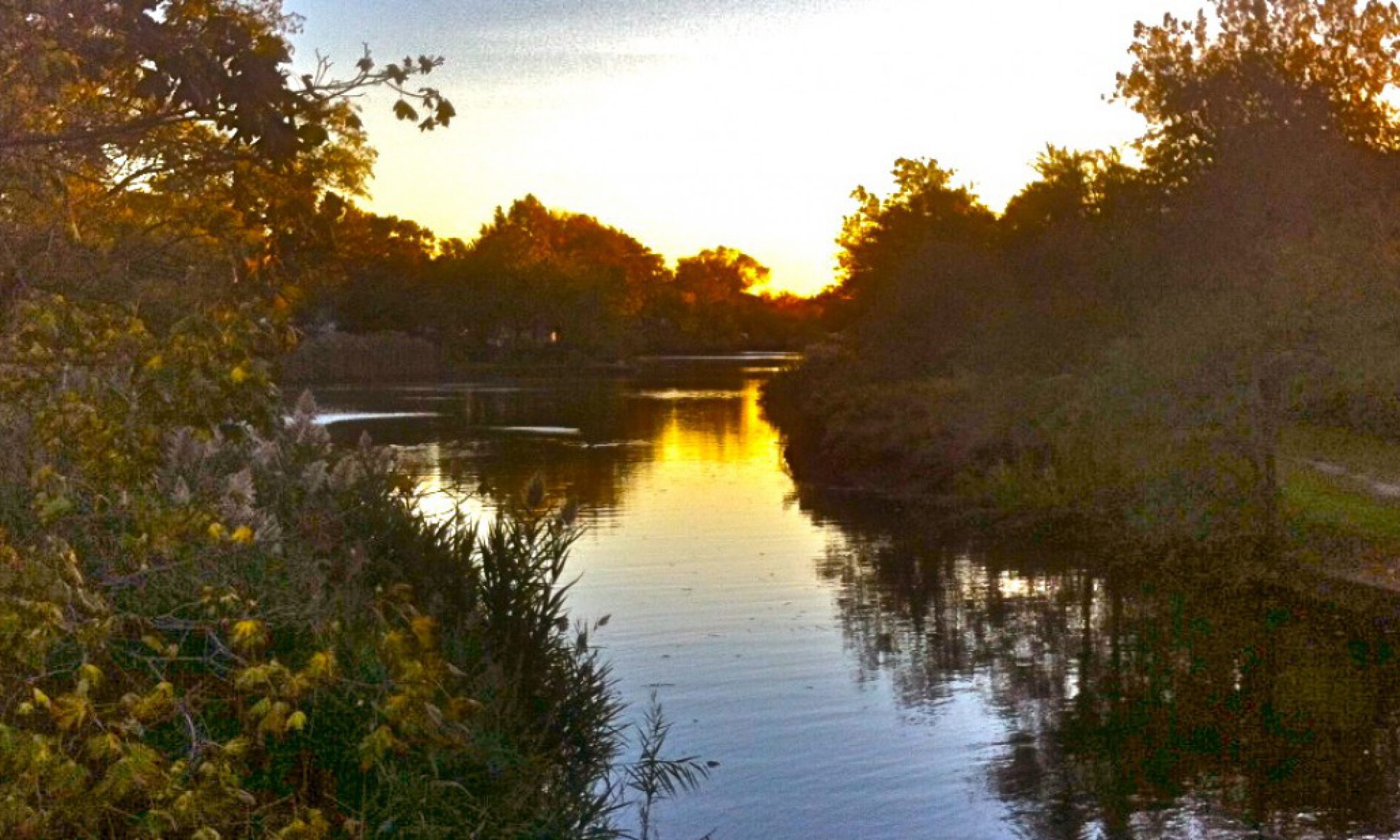
A creek runs through it, Duffy's Creek starts in Valley Stream State Park, goes through Hendrickson Park, goes under Merrick Road, reappears in the Village Green, ducks under Sunrise Highway, flows through Mill Pond Park where it becomes Mill Pond, goes through a spillway under Mill Road, flows past our about a mile until it goes under Rosedale Road, flows past North Woodmere Park into Jamaica Bay and out into The Atlantic Ocean. During the Hurricane Sandy Surge, the brackish water was up to the top of the post and rail fence.
A creek runs through it:  Duffy’s Creek starts in Valley Stream State Park, goes through Hendrickson Park, goes under Merrick Road, reappears in the Village Green, ducks under Sunrise Highway, flows through Mill Pond Park where it becomes Mill Pond, goes through a spillway under Mill Road, flows past our house and on about a mile until it goes under Rosedale Road, flows past North Woodmere Park into Jamaica Bay and out into The Atlantic Ocean. During the Hurricane Sandy Surge, the brackish water was up to the top of the post and rail fence. Other than that it’s nice in the summer.